FEED THE FUTURE
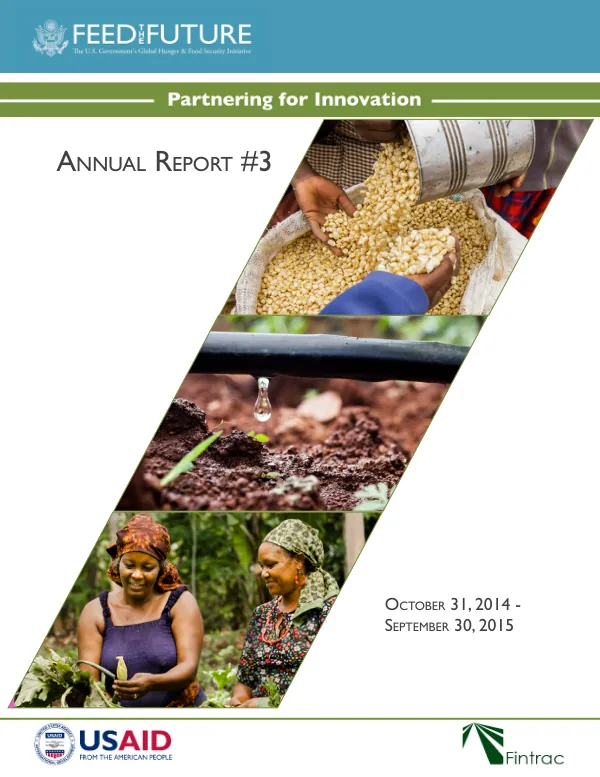
Feed the Future Partnering for Innovation Annual Report 2015
Feed the Future Partnering for Innovation (FTF-P4I) is a USAID-funded program that helps the private sector scale and market agricultural technologies for smallholder farmers through technology commercialization and knowledge exchange.
2015 · 33 pages
Sign in to readA free account is required to download.
Abstract
The program's goal is to improve the incomes of smallholder farmers, especially women, in developing markets. FTF-P4I has 15 technology commercialization partnerships in progress or completed, with another five in negotiation for the fourth round of commercialization grants. The program has commercialized technologies in 11 countries, with a total of $16.8 million in funding, including $7.9 million in total partner leverage. FTF-P4I has signed three new partnerships, managed eight ongoing partnerships, and graduated one partner during the reporting period. The program has also facilitated partnerships between USAID Missions and the private sector, providing business acceleration tools and services. One of the new partnerships is with Flow Equity (EthioChicken), which is selling improved breeds of poultry, quality blended feed, and vaccines and medicines necessary for healthy birds to smallholder farmers in Ethiopia. EthioChicken has already sold 31,134 day-old chicks as improved parent stock, which produce more than four times as many eggs per year and grow to be 250 percent larger than local breeds. Another new partnership is with Zamorano University, which is promoting the use of beneficial nematodes, with a product called NemaPower, instead of traditional pesticides to control insect infestations in select horticultural crops. Zamorano will produce and sell 20 times as many doses of beneficial nematodes than previous years, allowing farmers to purchase this biocontrol at a lower cost than synthetic chemical products and reduce pest infestations by as much as 98 percent in six months. The program has also partnered with MEA Ltd. to increase the amount of BIOFIX on the market by 50 percent through a scale-up of factory operations. The result will be a decrease in production time from 21 to seven days, allowing the company to fulfill and further generate demand for the legume inoculant. In addition, FTF-P4I has partnered with Tanseed International Ltd. to commercialize StrigAway, a technology that reduces striga infestations in maize crops. The program has also partnered with Syngenta Foundation for Sustainable Agriculture and Mercy Corps to encourage adoption of the Farmforce system in Guatemala, which helps exporters comply with forthcoming electronic traceability requirements of the US Food Safety Modernization Act. The program has also provided technical expertise and training to MKA Hatchery in algal culturing, biosecurity guidelines, larval rearing, maturation, and artificial insemination. The result was a system that achieved consistent production of three to four million larvae per day and enabled MKA to operate its commercial-size hatchery tanks at full capacity. Overall, FTF-P4I has made significant progress in commercializing technologies and improving the incomes of smallholder farmers, especially women, in developing markets. The program has also facilitated partnerships between USAID Missions and the private sector, providing business acceleration tools and services. The program's budget is $66.9 million, of which $52.5 million is allocated for program investment in technology commercialization and Mission partnerships. The program has committed to an investment of $71 million in partner funding and leverage to fund new technology and services to improve food security. Since 2013, partners have made $2.58 million in sales of new agricultural technologies to smallholder farmers. The program has also made significant progress in scaling up technologies, with 65 new technologies or management practices now in place for smallholder farmers. FTF-P4I now has 67 partners, with 26 primary and 41 sub-partners. The program's AgTechXChange was viewed 30,000 times this year, and 1,200 users are engaging in information-sharing around new technologies and scaling for smallholder access and affordability. The program's geographic focus is on 14 countries, with a total of 222,654 smallholder farmers currently using new technologies. The program aims to reach at least 350,000 farmers by 2017. The program's timeframes are from October 1, 2014, to September 30, 2015, with a total funding of $71 million, including leverage.