USAID DEC
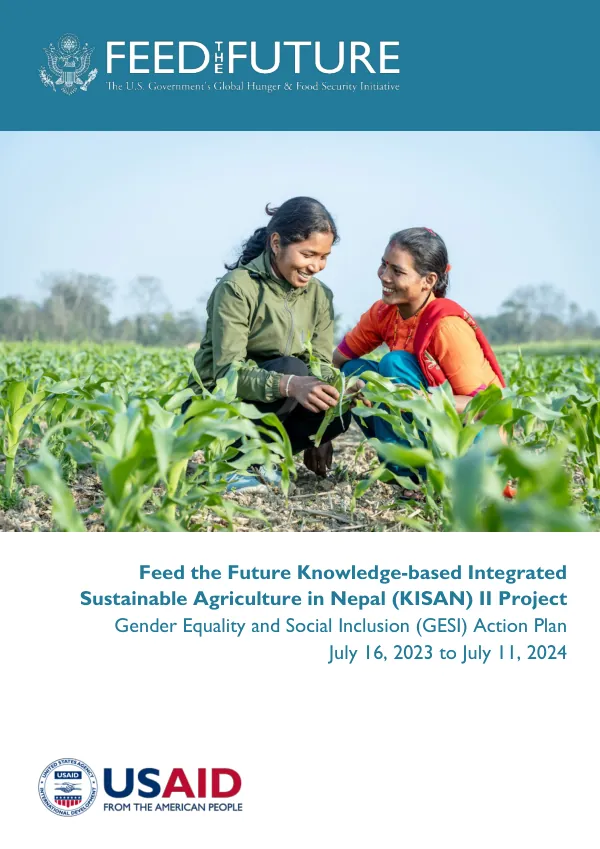
Feed the Future Knowledge-based Integrated Sustainable Agriculture in Nepal (KISAN) II Project
Sign inWINROCK INTERNATIONAL FOUNDATION
Feed the Future Knowledge-based Integrated Sustainable Agriculture in Nepal (KISAN) II Project
The KISAN II project in Nepal aims to increase the resilience, inclusiveness, and sustainability of income growth through agriculture development.
2023 · 17 pages
Sign in to readA free account is required to download.
Abstract
The project seeks to address gender and social inequalities through market systems development. As of May 2023, KISAN II has reached 240,096 farming households, with 73 percent being women and 62 percent from marginalized groups. The project has been extended through two supplemental scope of work (SSOW) awards: the COVID-19 SSOW and the Additional Ukraine Supplemental Appropriations Act (AUSAA) Fund. The COVID-19 SSOW focuses on three main outcomes: enabling market actors to upgrade their management and technical capacity and infrastructure to meet increased domestic market demand for improved fine rice and industrial maize products; facilitating the adoption of inclusive business practices that expand market actors' resource and customer base; and assessing the needs of migrant returnees and other populations heavily affected by the COVID-19 crisis and connecting them to agriculture-related employment opportunities. Under the AUSAA SSOW, KISAN II will generate quick wins in productivity and income generation for 35,000 households affected by the global food crisis. This will be achieved by expanding access to irrigation for the most vulnerable farmers and diversifying and intensifying the production of fine rice, industrial maize, and high-value vegetables to mitigate losses stemming from an anticipated shortage of chemical fertilizers. The KISAN II project mainstreams inclusiveness within its interventions by building Gender Equality and Social Inclusion (GESI) responsiveness among private sector partners and strengthening the ability of agriculture extension agents to better serve marginalized communities. The project enhances the capacity of partners to expand their networks and develop more inclusive customer profiles to include under-served groups and to help connect them with federal, provincial, and local government agricultural development programs. The GESI Action Plan indicates how KISAN II will ensure that GESI norms are addressed during project planning, management, implementation, and monitoring and evaluation of planned activities. The integrated and GESI-specific interventions equip private sector business partners, especially vulnerable business partners and farmers, to perform better toward improved livelihoods and sustainable resilience. KISAN II subscribes to USAID's Integrating Gender Equality and Female Empowerment guidelines (ADS 205) and utilizes references from USAID's Women's Economic Empowerment in inclusive market systems. The project has integrated GESI norms and women's economic empowerment elements into each of its original five components, including selecting women and marginalized group-led business partners, building the capacity of business owners and field staff on how integrating GESI in their everyday business activities can benefit them, and providing marketing and negotiation skills training for women and marginalized groups. The project will continue to identify farmers who need irrigation and/or other technical support to improve their production of high-value vegetables, fine rice, and industrial maize. KISAN II will also continue to coordinate with partners to provide direct services to farming households, some of which were supported by KISAN II's original scope or the COVID-19 SSOW. The KISAN II project aims to address inequality and market systems resilience by enabling market actors to upgrade their management and technical capacity and infrastructure, facilitating the adoption of inclusive business practices, and assessing the needs of migrant returnees and other populations heavily affected by the COVID-19 crisis. The project will also generate quick wins in productivity and income generation for 35,000 households affected by the global food crisis. KISAN II will continue to mainstream inclusiveness within its interventions by building GESI responsiveness among private sector partners and strengthening the ability of agriculture extension agents to better serve marginalized communities. The project will also enhance the capacity of partners to expand their networks and develop more inclusive customer profiles to include under-served groups and to help connect them with federal, provincial, and local government agricultural development programs.