USAID DEC
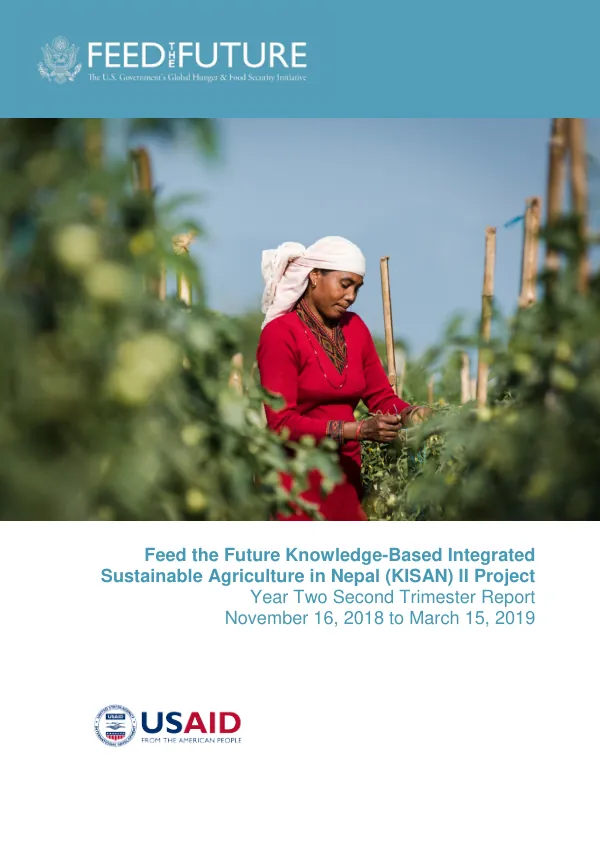
Feed the Future Knowledge-Based Integrated Sustainable Agriculture in Nepal (KISAN) II Project Year Two Second Trimester Report
Sign inGOVERNMENT OF SENEGAL
Feed the Future Knowledge-Based Integrated Sustainable Agriculture in Nepal (KISAN) II Project Year Two Second Trimester Report
The KISAN II Project is a Feed the Future initiative in Nepal that aims to improve the productivity and competitiveness of selected agriculture market systems.
2018 · 100 pages
Sign in to readA free account is required to download.
Abstract
The project's approach focuses on identifying and addressing constraints within key market systems through project initiatives. At the core of the KISAN II private sector-led facilitative approach is promoting the business case for buyers, intermediaries, and service providers to improve their business outcomes through more substantial engagement with producers and other value chain actors. During the second trimester of Year Two, KISAN II established 59 new partnerships with private sector actors that will directly impact 56,445 households. The project has committed $2.4 million in PIFAC funding for partnership activities, and private partners have committed $2.1 million. As of the end of the second trimester, KISAN II partners had formed 3,450 groups reaching 81,414 farmers in 138 municipalities. The project is on track for partners to be engaged with 130,000 households by the end of Year Two. KISAN II does not work directly with farmers; instead, it builds the capacity of private sector partners to address market constraints and reach farmers through partners. During the second trimester, a consultant working with consortium partner Overseas Strategic Consulting (OSC) provided training to KISAN II staff in Social and Behavior Change Communications (SBCC). SBCC best practices have been incorporated into training materials under development, including a pictorial booklet to promote Food Safety Practices and tool kits on 20 priority practices. As of the end of the second trimester, KISAN II partners had trained 49,029 smallholder farmers. The project's partnerships have led to significant outcomes, including the sale of produce from agrovet-supported farmers, improved farmer access to financial services and crop insurance, and the delivery of technical trainings on improved rice and vegetable production. The project has also worked with municipality officials to provide material support to farmers for high plastic tunnels for off-season tomato production. Additionally, KISAN II is providing business literacy training to approximately 100 farmers working with R.H. Agrovet to build their commercial capacity. KISAN II's integrated approach to partnerships is illustrated through its work with MOU partner, R.H. Agrovet, across all components. Under Component 2, KISAN linked R.H. Agrovet with traders to facilitate the sale of produce from agrovet-supported farmers and with Agriculture Development Bank and a private insurance company to improve farmer access to financial services and crop insurance. Under Component 1, KISAN trained R.H. Agrovet to deliver technical trainings on improved rice and vegetable production and conduct varietal demonstrations and field days to their 500 farmers. Under Component 3, KISAN worked with R.H. Agrovet to build a strong relationship with municipality officials, which has led to material support to farmers for high plastic tunnels for off-season tomato production from the municipality. Under Component 4, KISAN is providing business literacy training to approximately 100 farmers working with R.H. Agrovet to build their commercial capacity. The project's partnerships and activities have led to significant progress in improving the productivity and competitiveness of selected agriculture market systems in Nepal. The project's integrated approach to partnerships has enabled it to address multiple constraints within key market systems, leading to improved outcomes for farmers, buyers, and service providers.