USAID DEC
Feed the Future Knowledge-Based Integrated Sustainable Agriculture in Nepal (KISAN) II Project Year Two First Trimester Report
Sign inUSAID
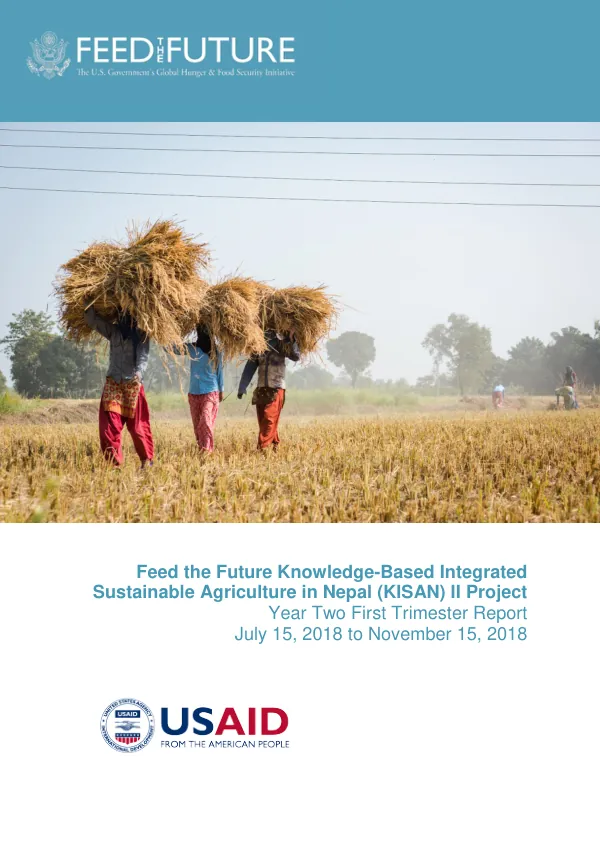
Feed the Future Knowledge-Based Integrated Sustainable Agriculture in Nepal (KISAN) II Project Year Two First Trimester Report
The Feed the Future Knowledge-Based Integrated Sustainable Agriculture in Nepal (KISAN) II Project is a key initiative aimed at improving the productivity and competitiveness of Nepal's agriculture market systems.
2018 · 89 pages
Sign in to readA free account is required to download.
Abstract
Engaging private sector partners is a critical component of the project, with a focus on identifying and mapping private sector sourcing zones to target marginalized populations. During the first trimester of year two, KISAN II established 34 new partnerships with private sector actors through its Partnership and Innovation Fund (PIF), resulting in the training of 24,284 smallholder producers, private sector proprietors, and government staff. These key partnerships and trainings were achieved despite uncertainty about the timing and amount of future obligations. KISAN II maintained close contact with the United States Agency for International Development (USAID) regarding future obligations. The project's focus on private sector partnerships has led to significant progress in several areas, including the identification of 32,661 farming households within private sector sourcing zones. These households were oriented on KISAN II's activities, approach, target commodities, and were arranged into farmer groups. KISAN II also conducted 97 coordination meetings with the Government of Nepal at the federal, provincial, and municipal levels, increasing awareness of the project's private-sector led approach and identifying opportunities for collaboration. As a result, Gangadev Rural Municipality officials have committed resources to support farmer trainings led by partner, Jaljala Seed Company Udhyog. Additionally, due to coordination efforts at the central level, KISAN II will expand its policy assessment to include analysis across all districts, not just its Zone of Influence. The project also built the capacity of 143 extension workers through six 3-day Training of Trainers (TOTs), enabling them to deliver quality inputs and services to their farmers. KISAN II's integrated approach to partnerships is evident in its work with partner, Bihani Madhyavarti Multipurpose Cooperative (BMMC), which spans all components of the project, including organizational management, technical trainings, and business literacy training. Furthermore, KISAN II identified 10 Banks and Financial Institutions (BFIs) and Cooperatives to expand credit to rural farmers through innovative products such as digital financing, warehouse receipt financing, cooperative wholesale lending, and remittance-based loan products. This effort aims to increase access to financial services for rural farmers, a critical component of the project's goal to improve the productivity and competitiveness of Nepal's agriculture market systems. The project's focus on private sector partnerships, capacity building, and financial inclusion has led to significant progress in the first trimester of year two. As the project continues, it is expected to build on these achievements and make further strides in improving the productivity and competitiveness of Nepal's agriculture market systems.