USAID DEC
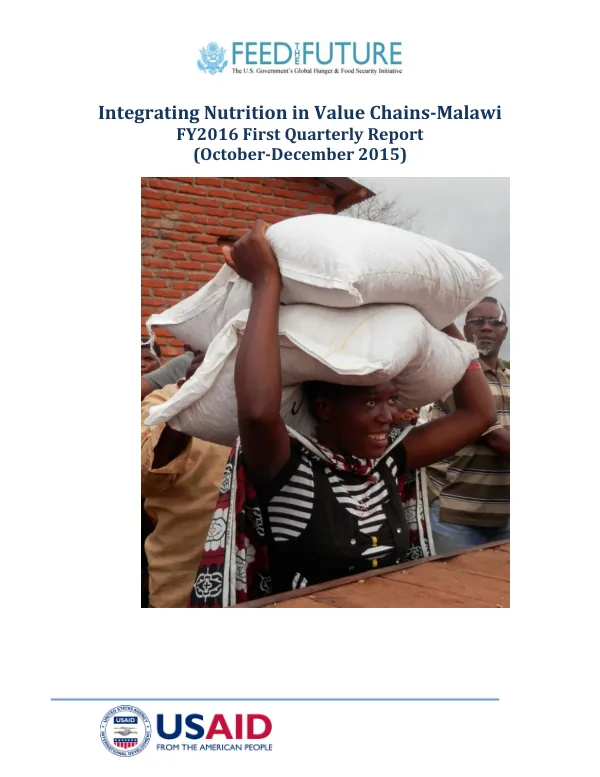
Feed the Future Malawi-Integrating Nutrition in Value Chains FY16 1st Quarter Report (Oct-Dec 2015)
Sign inDEVELOPMENT ALTERNATIVES, INC./FINNET
Feed the Future Malawi-Integrating Nutrition in Value Chains FY16 1st Quarter Report (Oct-Dec 2015)
The Integrating Nutrition in Value Chains project in Malawi began in 2012 with funding from USAID's Feed the Future initiative.
2016 · 112 pages
Sign in to readA free account is required to download.
Abstract
The project aims to improve the nutritional status of Malawians by integrating nutrition into agricultural value chains. The project focuses on four components: advancing value chain competitiveness, improving agricultural productivity, improving community capacity to prevent under-nutrition, and developing local capacity. Component 1, Advancing Value Chain Competitiveness, focuses on developing markets and improving sales and market options for farmers. The project has made significant progress in developing markets, including the establishment of a warehouse receipt system and the development of contracts for farmers. The project has also implemented a market information system and provided training on structured trade to farmers. Component 2, Improving Agricultural Productivity, focuses on adopting new technologies and improving extension training for farmers. The project has made significant progress in adopting new technologies, including the introduction of new crop varieties and improved irrigation systems. The project has also provided training to farmers on new technologies and has established a system for monitoring and evaluating the adoption of new technologies. Component 3, Improving Community Capacity to Prevent Under-Nutrition, focuses on improving behavior change and social behavior change communications. The project has made significant progress in improving behavior change, including the promotion of high-nutritive value crops and the facilitation of food processing. The project has also implemented a hygiene and sanitation program and has improved access to and utilization of key nutrition-related services. Component 4, Developing Local Capacity, focuses on developing the capacity of local organizations to implement nutrition and agricultural projects. The project has made significant progress in developing local capacity, including the establishment of a network of local organizations and the provision of training and technical assistance to local organizations. The project has also made significant progress in monitoring and evaluation, including the establishment of a monitoring and evaluation system and the collection of data on project outcomes. The project has also conducted a midterm evaluation, which found that the project has made significant progress in improving the nutritional status of Malawians. The project has also established partnerships with various organizations, including the Government of Malawi, the Catholic Development Commission of Malawi, and the Malawi Improved Seed Systems and Technologies Program. The project has also collaborated with other partners, including the International Potato Center and the International Institute of Tropical Agriculture. The project has also implemented a number of success stories, including the reduction of groundnut losses by Afrinut and the improvement of agricultural productivity by farmers in the project area. The project has also established a number of community-based child care centers and has improved access to and utilization of key nutrition-related services. Overall, the Integrating Nutrition in Value Chains project in Malawi has made significant progress in improving the nutritional status of Malawians and has established a number of partnerships and collaborations with various organizations. The project has also implemented a number of success stories and has established a number of community-based child care centers. The project has also faced a number of challenges, including the lack of infrastructure and the limited availability of resources. However, the project has implemented a number of solutions to address these challenges, including the establishment of a warehouse receipt system and the provision of training and technical assistance to farmers. The project has also made significant progress in developing local capacity, including the establishment of a network of local organizations and the provision of training and technical assistance to local organizations. The project has also established partnerships with various organizations, including the Government of Malawi, the Catholic Development Commission of Malawi, and the Malawi Improved Seed Systems and Technologies Program. The project has also faced a number of challenges, including the lack of infrastructure
![NAPAS:Malawi Annual Work Plan [FY2016]](https://covers.devme.ai/gen/145459.webp)