USAID DEC
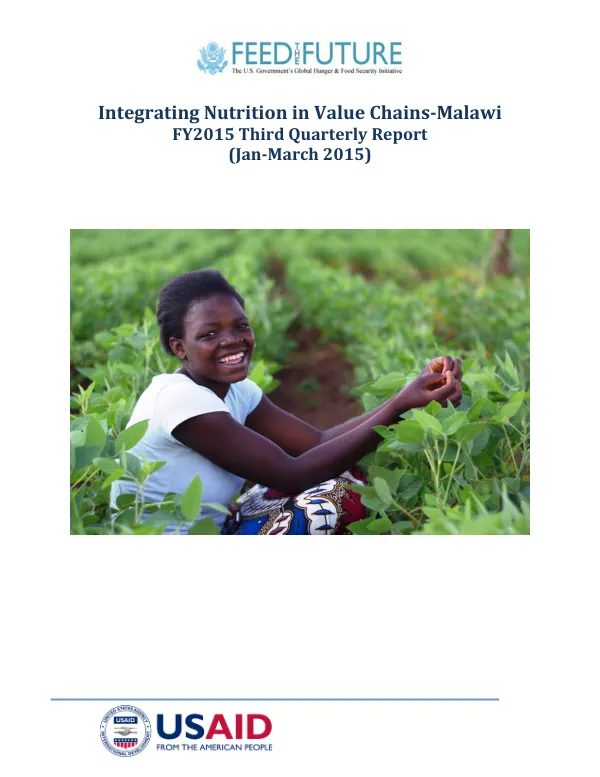
Feed the Future Malawi-Integrating Nutrition in Value Chains FY15 3rd Quarter Report
Sign inDEVELOPMENT ALTERNATIVES, INC./FINNET
Feed the Future Malawi-Integrating Nutrition in Value Chains FY15 3rd Quarter Report
The agricultural development initiative in Malawi, Integrating Nutrition in Value Chains, is a Feed the Future (FtF) initiative aimed at improving the nutritional status of Malawian communities.
2015 · 135 pages
Sign in to readA free account is required to download.
Abstract
The project focuses on four main components: Advancing Value Chain Competitiveness, Improving Agricultural Productivity, Improving Community Capacity to prevent under-nutrition, and Developing Local Capacity. Component 1, Advancing Value Chain Competitiveness, involves developing markets, collective marketing, food standards and safety, sales and market options, and financial services. The project has made significant progress in this area, including the development of a Warehouse Receipts System, contracts, and bid volume only auctions. Commercial bank linkages, collateral financing facilities, and innovative value chain financing are also being implemented. The project has achieved a 27% increase in household income among program participants compared to the control group. Component 2, Improving Agricultural Productivity, focuses on extension staff and farmer training, demonstration plots, soybean seed recovery rates, environmental compliance, and INVC gross margin analysis. The project has made significant progress in this area, including the establishment of demonstration plots and the recovery of soybean seeds. The project has also implemented new farming technologies, which have improved crop yields and reduced the use of chemical fertilizers. Component 3, Improving Community Capacity to prevent under-nutrition, involves behavior change communication, nutrition, integration, mentoring, coaching, and monitoring. The project has made significant progress in this area, including the dissemination of research results, theatre performances, radio programs, and public service announcements. The project has also promoted the cultivation of high-nutritive value crops, facilitated food processing, and promoted energy-efficient stoves. Component 4, Developing Local Capacity, focuses on improving partner organizational capacity to manage grants, building organizational capacity of partners, collaboration with the STEPS project, building governance and business management capacity of farmer associations and cooperatives, and building capacity of district councils. The project has made significant progress in this area, including the improvement of partner organizational capacity and the establishment of a grants management system. The project has also made significant progress in monitoring and evaluation, including data quality, data entry, and unique ID rollout, nutrition outcome survey, gross margin spot survey, GIS pilot and training, staffing, data quality assessments, and M&E partner training. The project has achieved a 27% increase in household income among program participants compared to the control group. The project has also implemented a Village Financial Platform (VFP), which provides financial services to farmers. The VFP has made significant progress, including data management and capacity building, VFP field officer-refresher training, and VFP as a point for integration and collaboration. The project has also implemented a partnership with the 3 C's, which involves ministries and government institutions, NGOs and projects, and has achieved significant progress in this area. The project has also implemented a number of success stories, including the story of Estery Justin, who is leading by example in improving agricultural productivity and nutrition in her community. The project has also implemented a number of success stories in the area of monitoring and evaluation, including the story of a farmer who has improved his crop yields and income through the use of new farming technologies. Overall, the Integrating Nutrition in Value Chains project in Malawi has made significant progress in improving the nutritional status of Malawian communities and has achieved a number of significant outcomes, including a 27% increase in household income among program participants compared to the control group.
![NAPAS:Malawi Annual Work Plan [FY2016]](https://covers.devme.ai/gen/145459.webp)