MANAGEMENT SYSTEMS INTERNATIONAL
Monthly Report – September 2018: Feed the Future Mali Cereal Value Chain Project
The Feed the Future Mali Cereal Value Chain Project, funded by the United States Agency for International Development (USAID), aimed to improve agricultural productivity and market access for smallholder farmers in Mali.
2018 · 8 pages
Sign in to readA free account is required to download.
Abstract
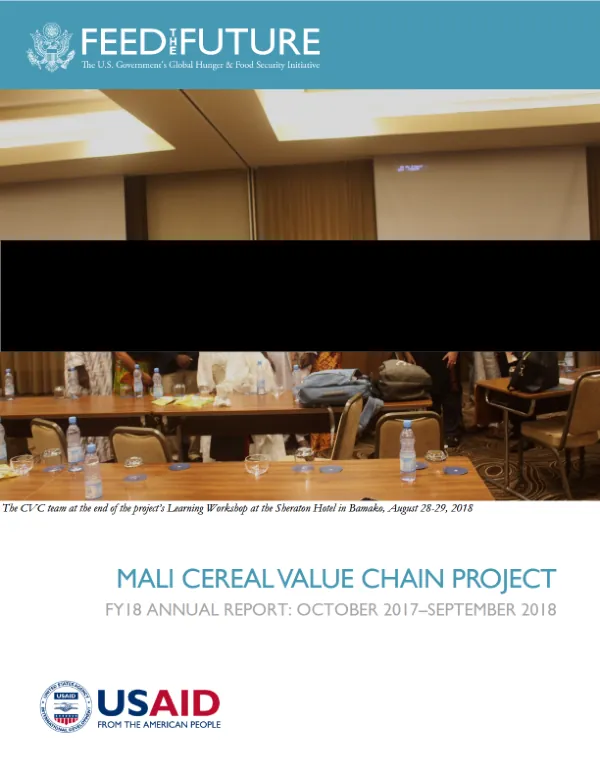
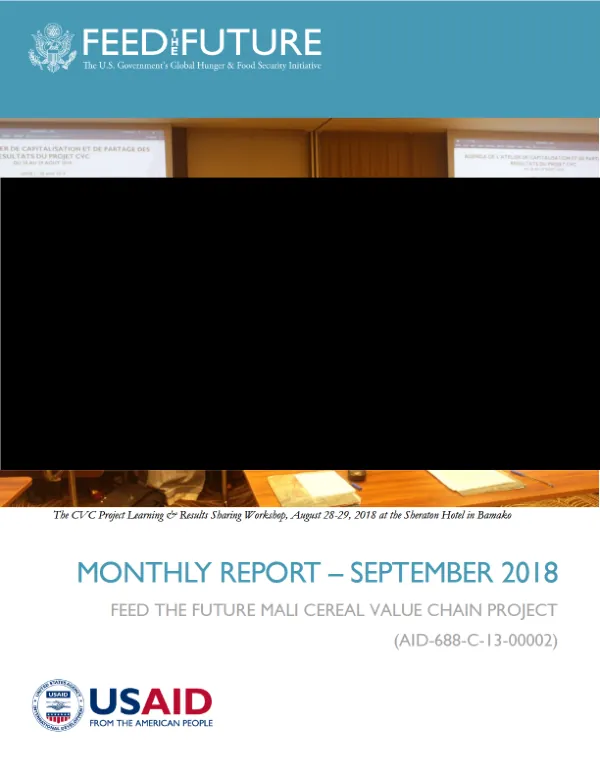
The project's main objective was to increase the competitiveness of the cereal value chain, with a focus on maize, millet, and sorghum. During the reporting period from August 21 to September 20, the project's activities focused on wrapping up and consolidating key program components. These included technology development, dissemination, management, and innovation; data collection on cultivated areas under improved technologies and best cultural practices; credit facilitation for cereal value chain actors; irrigation pump distribution in the Mopti and Timbuktu regions; assistance to the national Association of Millet and Sorghum Wholesalers; and the CVC's learning event, which took place at the Hotel Sheraton in Bamako. The project continued to supervise the adoption and application of improved technologies and best practices promoted by the project in partnership with public sector partners and subcontractors. The agricultural season had evolved well throughout the project's zones of influence, with rainfall occurring on a regular basis and well-distributed spatially. However, delays were reported in the timely deployment and availability of inputs, particularly in the Mopti region due to insecurity and delays related to the distribution of subsidized fertilizer. Data collection sheets capturing cultivated areas from technical services were completed and forwarded to project headquarters for verification, data cleaning, and entry. More than 1,000 data collection sheets from the field related to "number of hectares under improved technologies" and "number of farmers applying technologies" were sent to Bamako for processing. Credit facilitation for cereal value chain actors was also a key focus area during this reporting period. Planète Distribution company facilitated in-kind credit for inputs (fertilizer, oil, and diesel fuel) to a total of 26 village irrigated perimeters (VIPs) for an amount of $149,685 (84,667,000 FCFA). In addition, the CVC project facilitated a total of $255,760 (144,667,000 FCFA) in input loans this month for cereal value chain actors and agro-dealers. The project also conducted a final data quality assessment (DQA) to assess M&E data for the indicators reported in the third quarterly report submitted at the end of June. The DQA was carried out in two phases: a field assessment in Mopti, Bankass, and a desk assessment in the CVC-Bamako office. A workshop was held from August 28-29, 2018, to highlight successes for scaling-up and identify future initiatives for the cereals subsector. The workshop gathered more than 80 participants representing beneficiaries, partners, collaborators, and government and donor representatives to discuss and analyze the major results of the CVC project that have contributed to the development of cereal value chains. The project's closeout activities were also underway, with a focus on consolidating project achievements and ensuring the sustainability of project impacts. The project's final report will provide a comprehensive overview of the project's achievements and lessons learned.