USAID DEC
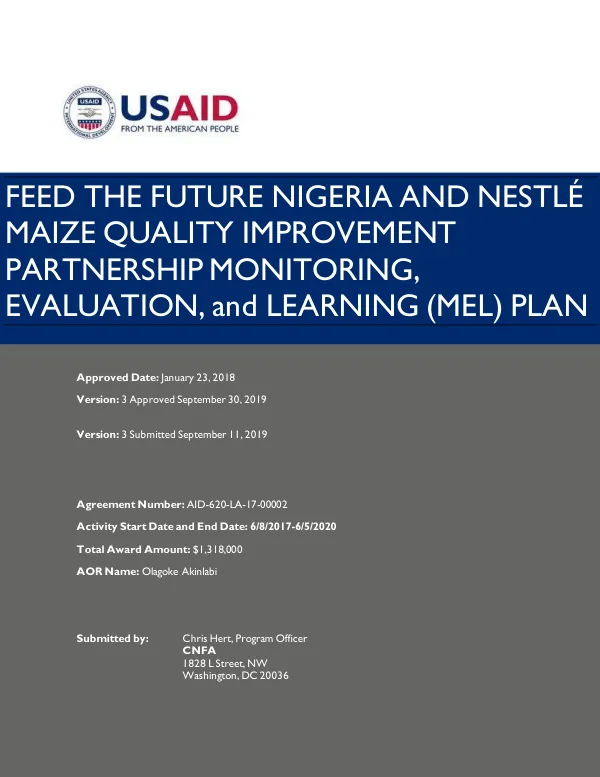
Feed the Future Nigeria and Nestlé Maize Quality Improvement Partnership Monitoring, Evaluation and Learning (MEL) Plan
Sign inCNFA, INC.
Feed the Future Nigeria and Nestlé Maize Quality Improvement Partnership Monitoring, Evaluation and Learning (MEL) Plan
The Feed the Future Nigeria and Nestlé Maize Quality Improvement Partnership aims to enhance quality, safety, and transparency in Nigeria's grain supply chain through a whole-of-supply-chain approach.
2018 · 53 pages
Sign in to readA free account is required to download.
Abstract
The project is implemented by CNFA in collaboration with multiple stakeholders, including smallholder farmers, input suppliers, grain aggregators, Nestlé, and local governments. The primary objective is to decrease levels of aflatoxins, fumonisins, and aluminum in maize and soybeans in the Kaduna State by training farmers and other stakeholders in effective mitigation measures. The project targets 20,000 beneficiaries, who will be trained by project staff and local volunteers in effective mitigation measures to reduce the levels of key contaminants in maize and soybeans. This will increase the available supply of safe, high-quality maize and soybeans. The project is implemented in two agro-ecological zones of the Kaduna State, with a focus on 11 Local Government Areas (LGAs) in the Maigana and Lere Zones. The project's logical framework outlines the interrelationship of intended results and the indicators to measure each result. The framework includes indicators such as the number of individuals participating in USG food security programs, the volume of high-quality maize and soybean produced in Kaduna state, and the levels of aflatoxins, fumonisins, and aluminum in maize and soybeans. The project will regularly collect accurate data from relevant sources, reports, and surveys to verify results. The project works closely with local agricultural ministries, who provide extension agents who provide training and oversight of project activities to each level of the value chain. These agents are managed by project staff. The project will scale up into all 11 LGAs in Year 2, expanding its reach and impact. The project's monitoring and evaluation plan includes a performance data table, which outlines the indicators and sets targets for each year of the activity. The plan also includes performance indicator reference sheets for each indicator, which contain the methods of data collection (verification) to be implemented throughout the program. CNFA will work with its partners, home office support, short-term consultants, and activity staff to regularly collect accurate data from relevant sources, reports, and surveys to verify results. The project's goal is to increase the volume of high-quality maize and soybean produced in Kaduna state, with a focus on reducing levels of aflatoxins, fumonisins, and aluminum. The project's indicators and targets are designed to measure progress towards achieving this goal, and the project's monitoring and evaluation plan will provide regular updates on the project's progress and impact. The project's implementation will be closely monitored and evaluated to ensure that it is meeting its objectives and making a positive impact on the lives of smallholder farmers and other stakeholders in the Kaduna State. The project's findings and lessons learned will be shared with stakeholders to contribute to wider learning and improvement in the grain supply chain.