CHEMONICS
Maximizing Agricultural Revenue and Key Enterprises in Targeted States (MARKETS) II
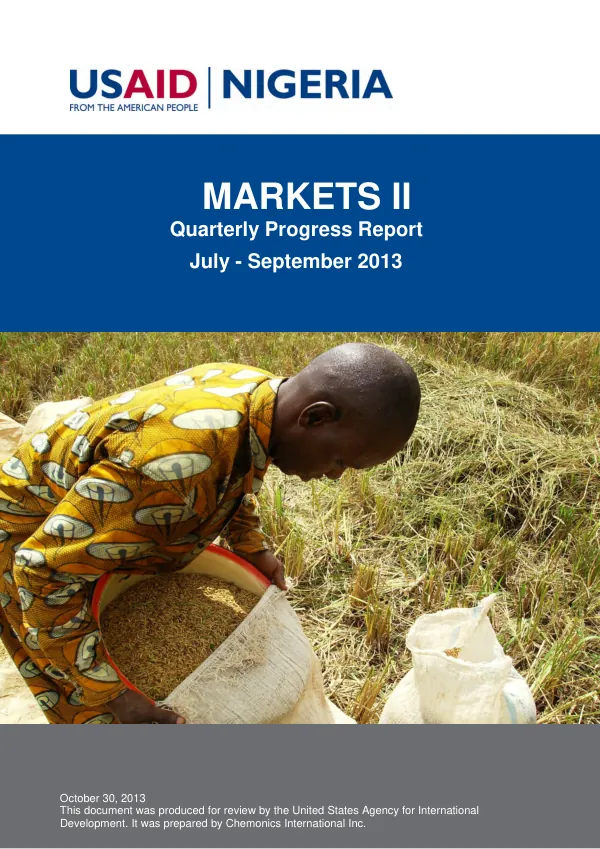
Maximizing Agricultural Revenue and Key Enterprises in Targeted Sites (MARKETS) II is a program aimed at improving agricultural productivity and revenue in Nigeria.
2013 · 67 pages
Sign in to readA free account is required to download.
Abstract
The program focuses on seven key areas: Producers' Capacity Development and Organizations Strengthened, Access to Agricultural Inputs Increased, Technology Generation and Deployment Expanded, Water and Soil Management Strengthened, Access to Finance Increased, Grants and Subcontracts Fund, and Program Modifier/Rapid Response Mechanism. During the July-September 2013 quarter, MARKETS II made significant progress in these areas. In Producers' Capacity Development and Organizations Strengthened, the program trained extension agents on Urea Deep Placement (UDP) technology, which involves the use of urea super granules to improve crop yields. The training was held in four states and focused on establishing UDP trial plots and technology transfer centers. In Access to Agricultural Inputs Increased, MARKETS II tested and introduced new technologies to networked farmers, including the USG wheel applicator, which was compared to the USG injector applicator and the USG manual application method. The program also established demonstration ponds in Warri, Delta state, to showcase best aquaculture practices to fish farmers. In Technology Generation and Deployment Expanded, MARKETS II worked with the Institute for Agricultural Research (IAR) to develop and disseminate improved crop varieties and technologies. The program also established a technology transfer center in Awka, which serves as a hub for the dissemination of UDP technology. In Water and Soil Management Strengthened, MARKETS II worked with the National Centre for Agricultural Mechanization (NCAM) to develop and disseminate improved irrigation technologies. The program also established a water management system in the Delta state, which helps to conserve water and reduce soil erosion. In Access to Finance Increased, MARKETS II worked with the Central Bank of Nigeria (CBN) to develop and disseminate financial products and services that cater to the needs of smallholder farmers. The program also established a microfinance scheme that provides loans to farmers at competitive interest rates. In Grants and Subcontracts Fund, MARKETS II provided grants to farmer organizations and small and medium-sized enterprises (SMEs) to support their business development activities. The program also established a subcontracts fund that provides financial support to SMEs to enable them to participate in government contracts. In Program Modifier/Rapid Response Mechanism, MARKETS II established a rapid response mechanism that enables the program to respond quickly to emerging issues and opportunities in the agricultural sector. The program also established a program modifier that enables the program to modify its activities in response to changing circumstances. Cross-cutting issues, such as gender and youth empowerment, were also addressed during the quarter. MARKETS II worked with women's groups to develop and disseminate improved agricultural technologies and practices that cater to their needs. The program also established a youth empowerment program that provides training and financial support to young farmers. Overall, MARKETS II made significant progress during the July-September 2013 quarter, and the program is well on track to achieve its objectives. The program's focus on improving agricultural productivity and revenue in Nigeria is expected to have a positive impact on the country's economy and food security. The program's performance data for the quarter is presented in Annex I, which shows the progress made in each of the program's seven areas. The annex also presents the program's environmental mitigation and monitoring plan, which outlines the measures taken to minimize the program's environmental impact. Two success stories are also presented in the report. The first success story highlights the impact of business training on youth empowerment, while the second success story showcases the benefits of fish farming in Delta state.