FINTRAC
Feed the Future Tanzania Mboga na Matunda Monthly Update: July 2021
Feed the Future Tanzania Mboga na Matunda is a five and a half-year activity funded by the United States Agency for International Development (USAID) that aims to increase the competitiveness and inclusiveness of the horticulture subsector in Tanzania.
2021 · 2 pages
Sign in to readA free account is required to download.
Abstract
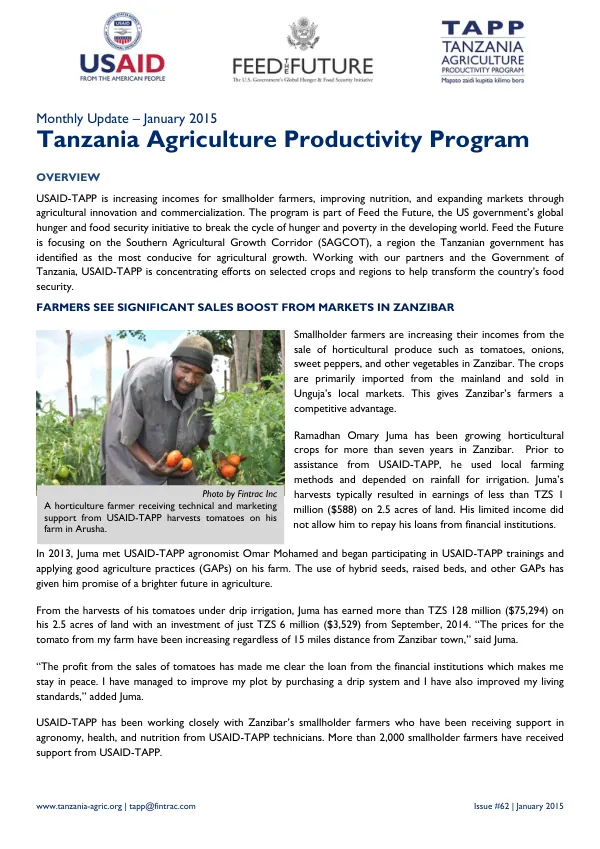
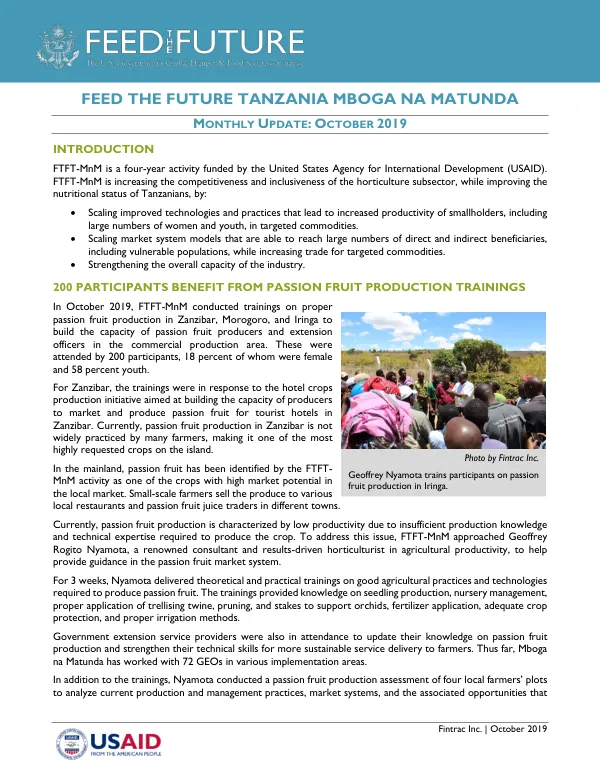
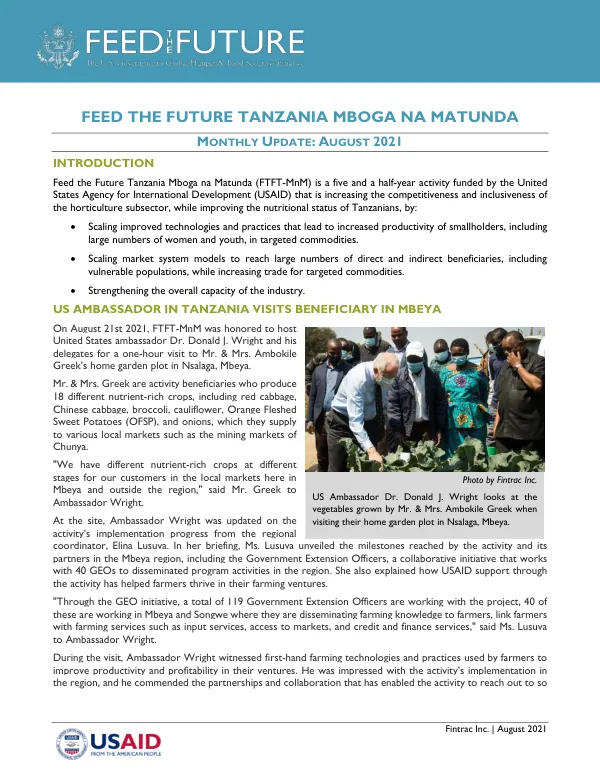
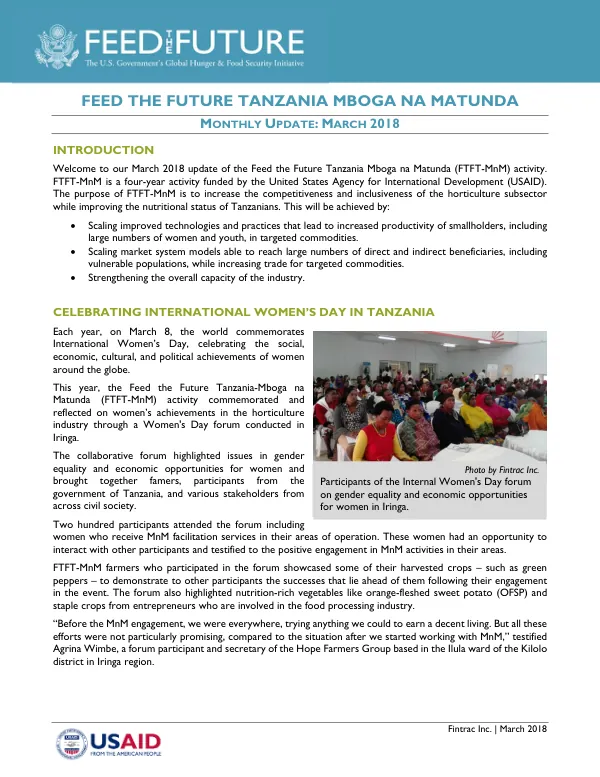
The project focuses on scaling improved technologies and practices that lead to increased productivity of smallholders, including large numbers of women and youth, in targeted commodities. Additionally, the project seeks to scale market system models to reach large numbers of direct and indirect beneficiaries, including vulnerable populations, while increasing trade for targeted commodities. Furthermore, the project aims to strengthen the overall capacity of the industry. Judith Kitivo, the Contracting Office Representative for Feed the Future Tanzania Mboga na Matunda, visited the islands of Zanzibar in June 2021 to review the implementation progress of the project. During her visit, Kitivo met with various stakeholders, including farmers, input suppliers, Government Extension Officers, buyers of produce from Mwanakwerekwe markets, and financial institutions such as Tanzania Growth Trust (TGT) and Zanzibar Economic Empowerment Fund (ZEEF). Kitivo also paid a courtesy visit to the Ministry of Agriculture, Natural Resources, Livestock and Fisheries located at Maruhubi, where she met with the acting Secretary General Hon. Haji Hamid Saleh and other top officials. The working relationship between the government and Feed the Future Tanzania Mboga na Matunda has been described as "superb" by Hon. Saleh, who noted that the project has helped in various areas, including trainings for Block Extension Officers in Pemba and Unguja. These trainings have increased horticultural crops production knowledge, resulting in increased crop production. Kitivo also learned about the challenges faced by traders and buyers associations, including ZESA, JUWASOMWA, and GREEN GROCERY, and the support they are receiving from the project. The project's marketing facilitation initiatives, including hotel crops and crates facilitation, have contributed significantly to strengthening their businesses with tourist hotels in Zanzibar. During her visit, Kitivo met with several beneficiaries, including Mr. Kassim Khamis, a passion fruit producer who has earned an average of 1.2 million shillings per month, and Nuru Mohammed Vuai, a young lead farmer who has been able to participate in capacity-building programs and benefit from exposure from the project. Vuai briefed Kitivo on how the project has strengthened his crop production capacity, data collection as an aggregator, and technical installation of drip irrigation infrastructures that earn him an average of TZS 300,000 per acre. The project has also empowered Vuai to use solar energy to irrigate his crops and mobilize fellow farmers to access financial loans from the project's financial partners. For more than four years, Feed the Future Tanzania Mboga na Matunda has helped various stakeholders in the horticulture value chain increase productivity and profitability. Through a number of initiatives, the project has successfully reached out to more than 748,438 farmers, of which 58% are youth and 44% are women. The project's efforts have contributed significantly to the growth and development of the horticulture industry in Tanzania, and its impact is expected to continue in the coming years.
Related documents