THE WORLD FOOD PROGRAMME
Feeding Central African Republic Refugees
The refugee crisis in the Central African Republic (CAR) has resulted in over 456,000 displaced individuals, with more than 456,000 refugees in neighboring countries.
2015 · 1 pages
Sign in to readA free account is required to download.
Abstract
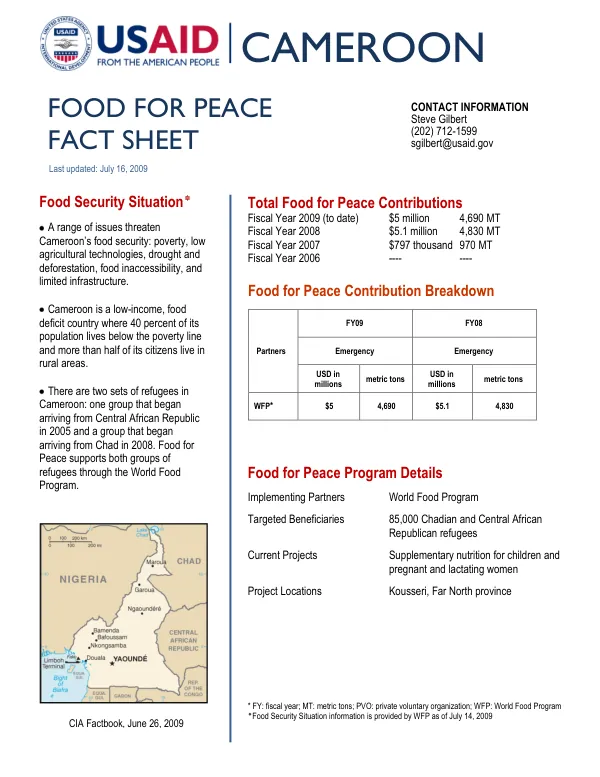
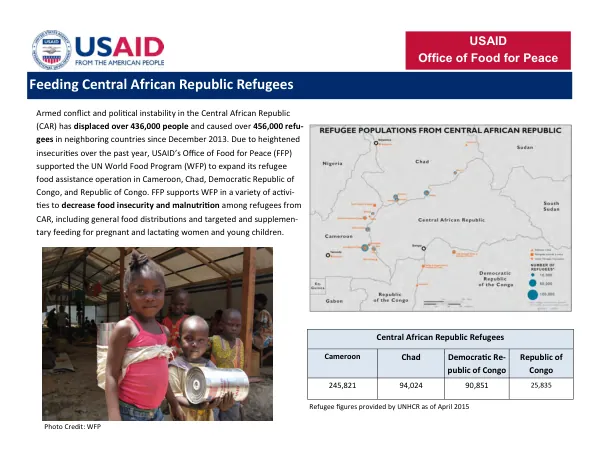
The conflict and political instability in CAR have led to a significant increase in insecurity, prompting the need for humanitarian assistance. USAID's Office of Food for Peace (FFP) has supported the UN World Food Program (WFP) in expanding its refugee food operation in Cameroon, Chad, Democratic Republic of Congo, and Republic of Congo. FFP's support for WFP includes various activities aimed at reducing food insecurity and malnutrition among refugees from CAR. These activities include general food distributions, targeted feeding for pregnant and lactating women, and supplementary feeding for children. The goal of these efforts is to alleviate the suffering of refugees and provide them with essential nutrition to maintain their health and well-being. The refugee population in the region is substantial, with significant numbers of displaced individuals in each of the four countries. According to the UNHCR, as of 2015, there were 456,000 refugees from CAR in the region. The breakdown of refugees by country is as follows: Cameroon (94,821), Chad (90,851), Democratic Republic of Congo (90,851), and Republic of Congo (90,851). These numbers highlight the scale of the crisis and the need for continued humanitarian support. The humanitarian response to the crisis is being led by the WFP, with support from FFP. The WFP is providing essential food assistance to refugees, including general food distributions and targeted feeding programs. The targeted feeding programs are designed to address the specific nutritional needs of vulnerable populations, including pregnant and lactating women and children. The WFP is working closely with local authorities and partners to ensure that the food assistance reaches those who need it most. The refugee crisis in CAR is a complex and ongoing issue, requiring sustained humanitarian support. The efforts of FFP and WFP are critical in providing essential food assistance to refugees and alleviating the suffering of those affected by the conflict. The scale of the crisis is significant, with substantial numbers of displaced individuals in each of the four countries. The humanitarian response is ongoing, with a focus on providing essential food assistance to refugees and addressing the specific nutritional needs of vulnerable populations.
Related documents