LINC LLC
Femicides - Prevention and Response Activities Assessment: Learning Brief
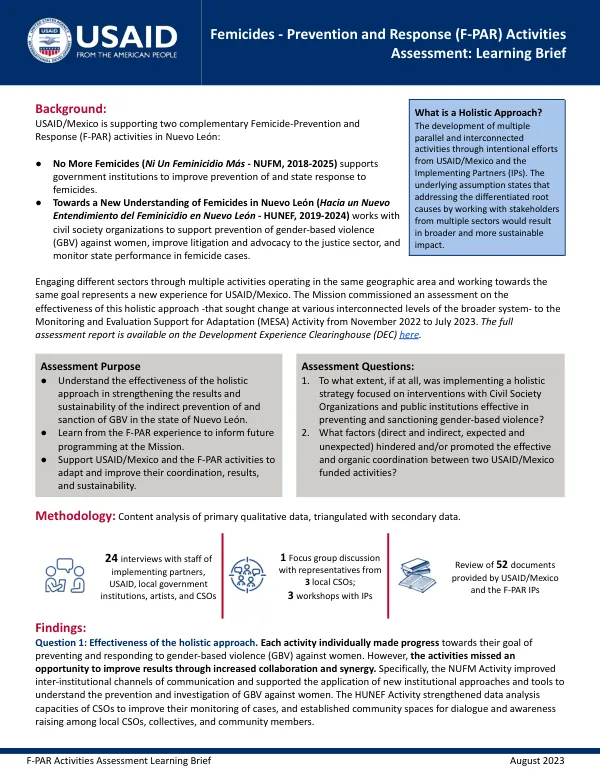
The holistic approach to preventing and responding to gender-based violence (GBV) against women in Nuevo León, Mexico, involves two complementary Femicide-Prevention and Response (F-PAR) activities: No More Femicides (NUFM) and Towards a New Understanding of Femicides in Nuevo León (HUNEF).
2023 · 2 pages
Sign in to readA free account is required to download.
Abstract
These activities, supported by USAID/Mexico, aim to strengthen the results and sustainability of indirect prevention of and sanction of GBV in the state. The NUFM Activity, which began in 2018, focuses on improving prevention of and state response to femicides through government institution support. Meanwhile, the HUNEF Activity, launched in 2019, works with civil society organizations to support prevention of GBV against women, improve litigation and advocacy to the justice sector, and monitor state performance in femicide cases. The two activities operate in the same geographic area and work towards the same goal, representing a new experience for USAID/Mexico. An assessment commissioned by USAID/Mexico from November 2022 to July 2023 aimed to understand the effectiveness of this holistic approach. The assessment, conducted by the Monitoring and Evaluation Support for Adaptation (MESA) Activity, sought to learn from the F-PAR experience to inform future programming at the Mission. The assessment also aimed to support USAID/Mexico and the F-PAR activities to adapt and improve their coordination, results, and sustainability. The assessment methodology involved content analysis of primary qualitative data, triangulated with secondary data. This included 24 interviews with staff of implementing partners, USAID, local government institutions, artists, and civil society organizations, as well as a focus group discussion and three workshops with implementing partners. The assessment also reviewed 52 documents provided by USAID/Mexico and the F-PAR implementing partners. The assessment found that each activity individually made progress towards their goal of preventing and responding to GBV against women. However, the activities missed an opportunity to improve results through increased collaboration and synergy. The NUFM Activity improved inter-institutional channels of communication and supported the application of new institutional approaches and tools to understand the prevention and investigation of GBV against women. The HUNEF Activity strengthened data analysis capacities of civil society organizations to improve their monitoring of cases and established community spaces for dialogue and awareness raising among local civil society organizations, collectives, and community members. The assessment identified factors that promoted collaboration, such as previous experience of collaboration among the implementing partners, which increased their willingness to explore synergies. The participation of the USAID/Mexico Human Rights team also directly facilitated communication and coordination between activities. However, unforeseen events such as the COVID-19 pandemic and the high turnover of implementing partner personnel and government officials hindered collaboration. Based on the key findings, the assessment concluded that, although each project made progress individually, if they had applied the holistic approach in a coordinated and collaborative manner, they would have achieved greater impact and better opportunities for sustainability. To maximize the effectiveness of a variety of interventions working toward a common goal, such as prevention and response to femicides, specific actions and practices are recommended. These include creating a space for ongoing collaboration between relevant activities and their stakeholders, developing and communicating a clear strategy for the holistic approach, and using a co-designed monitoring system to measure progress on the actions and objectives for the holistic approach.