LINC LLC
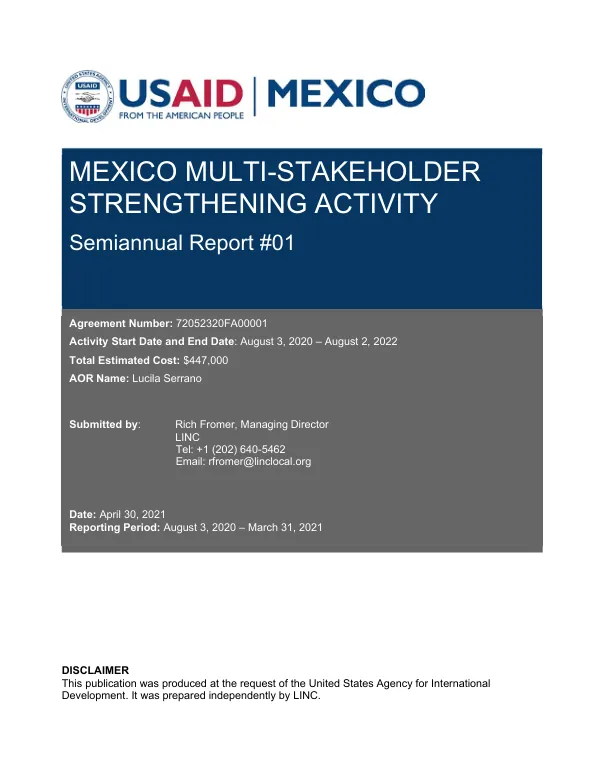
USAID/Mexico Multi-Stakeholder Strengthening Activity Semiannual Report #01
The USAID/Mexico Multi-Stakeholder Strengthening Activity (MSA) is a project aimed at strengthening the institutional capacities of local stakeholders, including civil society organizations (CSOs), local governments, and the private sector, to collaborate on drafting and implementing concrete actions that contribute to crime and violence prevention, criminal justice reform, and an improved enabling environment to protect human rights.
2021 · 21 pages
Sign in to readA free account is required to download.
Abstract
The project is being implemented in two main municipalities: the Zona Metropolitana de Guadalajara, in the state of Jalisco, and Ciudad Juárez, in the state of Chihuahua. The project has three components: CSO institutional strengthening, multi-stakeholder dialogues, and local resource mobilization. The CSO institutional strengthening component involves delivering a comprehensive capacity-building training course to 50 CSOs in Chihuahua and Jalisco. The multi-stakeholder dialogues component aims to build common strategies on violence prevention and security among CSOs, the private sector, academia, and government. The local resource mobilization component focuses on financing capacity-building and supporting the sustainability of the project. The project is led by LINC, together with Mexican CSOs Corporativa de Fundaciones (Jalisco) and FICOSEC (Chihuahua), who are providing cost-share equal to USAID's contribution. The project has made significant progress during the reporting period, including the successful launch event on February 24, 2021, and the selection of 51 CSOs to participate in the training program. The project has also delivered three modules to 72 participants and prepared to begin the mentorship program in April. The context in which MSA works is complex and dynamic, with several contextual factors influencing the evolution of the project. These factors include elections, crime and violence, the COVID-19 pandemic, and presidential discourse. Despite these challenges, CSOs have continued their work, building their networks and public service projects. In Jalisco, an intersectoral coalition has formed to promote a more equitable federalism, and in Chihuahua, the ImpulsOSC network has achieved the approval of the State Law for the Promotion of CSO activities. Monitoring and evaluation are critical components of the project, with two indicators having performance data for this reporting period: Indicator #5, Number of CSOs Trained, with a value of 48, and Indicator #7, Level of Satisfaction, with a value of 92.5%. The baseline values for most indicators is zero, and the MSA team will analyze the results of the Organizational Capacity Assessment (OCA) tool in April 2021 to measure the baseline capacity of the 51 organizations participating in the training process. The project has made significant progress in its first six months, despite the challenges posed by the complex and dynamic context. The project's focus on CSO institutional strengthening, multi-stakeholder dialogues, and local resource mobilization is critical to addressing the root causes of crime and violence in Mexico. The project's commitment to monitoring and evaluation will ensure that it is meeting its objectives and making a meaningful impact in the lives of Mexicans.