INSTITUTE OF TECHNOLOGY. DEVELOPMENT TECHNOLOGY CENTER
Ferrocement technology in Indonesia; interim report
Ferro- or fiber-cement (a cement reinforced with locally available materials such as wire mesh or bamboo) is especially suitable in developing countries as a substitute building material for scarce wood or imported steel.
Manga, J. B. · 1970
Sign in to readA free account is required to download.
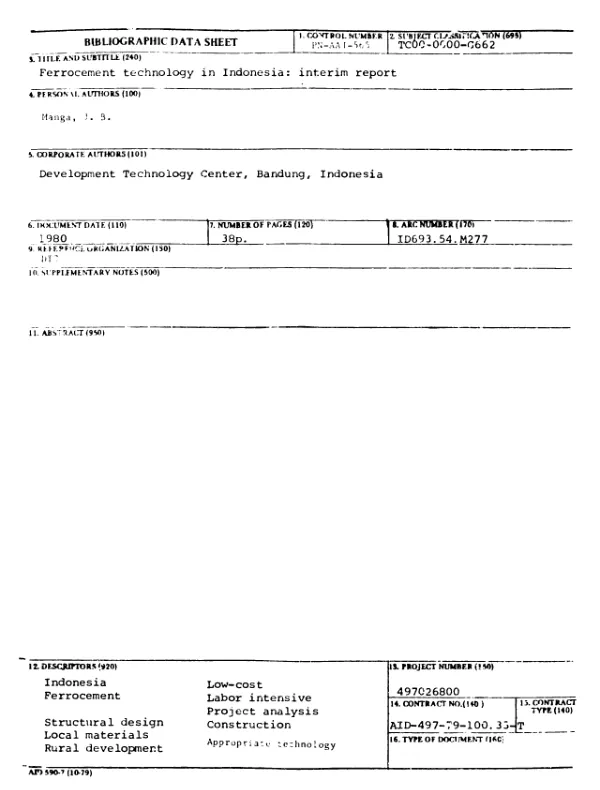
Abstract
This report details the results of a ferrocement technology development project sponsored in 1977 by USAID/Indonesia. Nine engineers from various Indonesian institutions were chosen to attend a 4-month training program at the Asian Institute of Technology in Bangkok, Thailand. Subsequently, three institutions (University of Hasanuddin, Syiah Kuala University, and the Development Technology Center, Bandung) were selected to research, design, and construct a variety of ferrocement products suitable to Indonesian conditions. Four types of ferrocement products were completed: (1) Marine structures such as fishing boats, pontoon ferries and docks, and mooring floats. Such structures did not rot or suffer teredo (shipworm), termite, or other infestations, making them attractive replacements for wood and thus slowing Indonesia"s rapid rate of deforestation. (2) Water structures, i.e., well casings, septic tanks, pipes, and chanels. Such structures proved watertight and helpful in overcoming the water storage problems that exist in most areas of Indonesia. (3) Building structures including mosque domes, curved foot bridges, and walls for houses. Ferrocement was found to be easily formed and curved, to reduce the total weight of the building, and to minimize building costs by as much as 70%. (4) Fiber cement using organic fibers such as bamboo or sugar palm fiber wastes from starch flour production. Roofing panels, water pipes, and walls made from such ferrocement proved competitive with more traditional materials. The authors conclude that ferrocement, characterized by low cost, high strength, durability, and repairability, can significantly contribute to both rural and urban development. They recommend the training of personnel at all levels, continued market studies and market development, and formation of a flexible and imaginative trouble shooting back-up system to encourage village groups to apply ferrocement technology to their local needs.