FAMILY HEALTH INTERNATIONAL
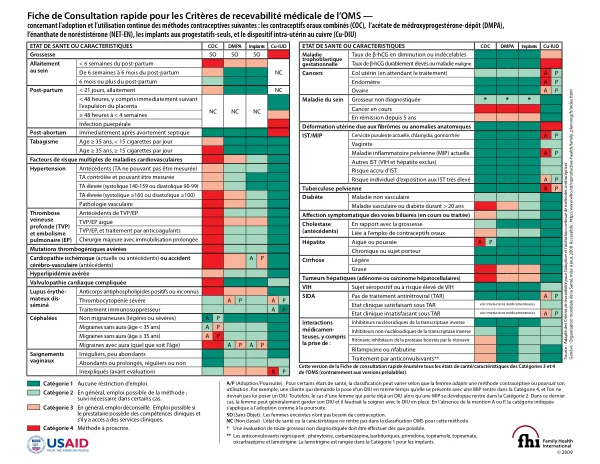
Fiche de consultation rapide pour les critères de recevabilité médicale de l'OMS
The World Health Organization's (WHO) criteria for medical eligibility of contraceptive methods categorize various health conditions and characteristics into four categories: Category 1, Category 2, Category 3, and Category 4.
2009 · 1 pages
Sign in to readA free account is required to download.
Abstract
Category 1 indicates no restriction on the use of a contraceptive method, Category 2 indicates that the method can be used in general but requires follow-up in certain cases, Category 3 indicates that the method is generally contraindicated but can be used if the healthcare provider has clinical skills and access to clinical services, and Category 4 indicates that the method is contraindicated. The criteria are applied to various health conditions and characteristics, including cardiovascular disease, hypertension, thrombosis, and cancer. For example, women with a history of deep vein thrombosis or pulmonary embolism are classified as Category 4 for the use of combined oral contraceptives (COC), DMPA, and Cu-IUD. However, women with a history of deep vein thrombosis or pulmonary embolism who are on anticoagulant treatment are classified as Category 2 for the use of COC and DMPA. Women with a history of cancer, including cervical, endometrial, and ovarian cancer, are classified as Category 4 for the use of COC, DMPA, and Cu-IUD. However, women with a history of cancer that is in remission for more than 5 years are classified as Category 1 for the use of COC and DMPA. The criteria also take into account the presence of other health conditions, such as diabetes, liver disease, and HIV. For example, women with HIV who are not on antiretroviral treatment are classified as Category 4 for the use of COC, DMPA, and Cu-IUD. However, women with HIV who are on antiretroviral treatment and have a good clinical status are classified as Category 1 for the use of COC and DMPA. The criteria also consider the presence of certain medications, such as anticonvulsants, which can interact with hormonal contraceptives. For example, women taking anticonvulsants such as phenytoin, carbamazepine, and barbiturates are classified as Category 4 for the use of COC and DMPA. The WHO criteria provide a framework for healthcare providers to assess the medical eligibility of women for various contraceptive methods. By considering the individual's health conditions and characteristics, healthcare providers can make informed decisions about the most appropriate contraceptive method for each woman. The criteria are based on the latest scientific evidence and are regularly updated to reflect new research and findings. The WHO criteria are widely used by healthcare providers around the world to ensure that women receive safe and effective contraceptive care. The criteria are organized into four categories, with Category 1 indicating no restriction on the use of a contraceptive method, Category 2 indicating that the method can be used in general but requires follow-up in certain cases, Category 3 indicating that the method is generally contraindicated but can be used if the healthcare provider has clinical skills and access to clinical services, and Category 4 indicating that the method is contraindicated. The criteria are applied to various health conditions and characteristics, including cardiovascular disease, hypertension, thrombosis, and cancer. The criteria also take into account the presence of other health conditions, such as diabetes, liver disease, and HIV. The criteria also consider the presence of certain medications, such as anticonvulsants, which can interact with hormonal contraceptives. The WHO criteria provide a framework for healthcare providers to assess the medical eligibility of women for various contraceptive methods. By considering the individual's health conditions and characteristics, healthcare providers can make informed decisions about the most appropriate contraceptive method for each woman. The criteria are based on the latest scientific evidence and are regularly updated to reflect new research and findings.