MERCY CORPS INTERNATIONAL
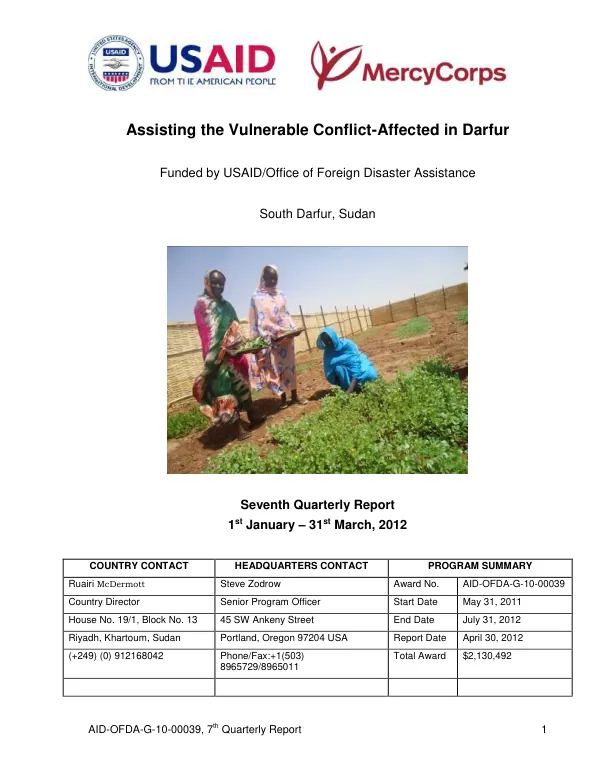
Fifth Quarter Report: Assisting the Vulnerable Conflict-Affected in Darfur – 2
The conflict-affected population in Darfur, Sudan, continues to face significant challenges.
2016 · 5 pages
Sign in to readA free account is required to download.
Abstract
Fighting between the Sudan Army Forces and rebels in the Jabal Marra area led to new displacement throughout the Darfur states, with an estimated 143,700 people displaced. The Sudan Government Humanitarian Aid Commission and the Office for the Coordination of Humanitarian Affairs reported that 129,200 people were displaced from their villages to North Darfur State, while 14,500 people reached Central Darfur State. In addition, 43,932 South Sudanese refugees from Northern Bahr El Ghazal and Warrap states arrived in Eastern Darfur and South Darfur States. The security situation in South Darfur State generally remained calm but unpredictable, with a night curfew and a ban on the use of motorbikes in place. The threat of kidnapping and carjacking around Nyala town, particularly targeting humanitarian agencies, decreased. Despite security incidents and restrictions, the implementing partner, MC, continued to access and implement program activities in the three IDP camps - Dereige, Sakaly, and El Serif - and rural areas, with due security precautions and vigilance. The MC WASH program continued to support the operation and maintenance of water supply systems, including diesel motorized systems and dual power solar motorized water supply systems. The program aimed to increase sustainable access to safe drinking water through the introduction of Water User Fees, improving safe access to sanitation facilities, promoting hygiene, and creating more participation of communities through capacity building trainings. The program also encouraged the use of environmentally friendly construction practices and the monitoring of water tables and water quality in IDP camps. During the reporting period, MC's WASH team conducted a KAP survey, sampling 1,103 households in the three IDP camps. The survey aimed to evaluate the progress and impact of the program. The current water coverage is estimated at 12.94 liters per person per day in Dereige, 9.2 liters per person per day in Sakaly, and 12.0 liters per person per day in El Serif camps. The decrease in current water coverage is temporary, due to the transition of diesel-powered water supply systems from diesel to solar power. In El Serif camp, the WASH committees screened marginalized households and disabled and excluded 474 families out of the total registered 2,725 families from the monthly contribution. The financial system in El Serif is established, and the WASH committees are continuing to collect the monthly household's contribution, which ranges from 6 Sudanese Pounds to 14 Sudanese Pounds per household per month. The majority of the targeted households are committed to pay the monthly contribution, and the amount collected is used to contribute for the cash incentives of operators and guards to run the dual power solar motorized water supply systems. The MC WASH team also conducted water quality testing for E.coli bacteria and water chlorination at all three IDP camps. Results of bacteriological tests of water samples collected from the water points indicated a 100% success rate with 0% faecal coliforms in the three IDP camps. The results of the Free Residual Chlorine (FRC) samples taken from 66 random water points indicated a 100% success rate in all three camps. However, the success rate was less at the household level, with 40% for FRC exceeding 0.2 mg/l from water collection and storage containers in all the three camps. Field observation for water quality showed lower levels of chlorine at households due to algae inside water containers. As a counter measure to algae growth, MC supported water users with cleaning materials and carried out campaigns to clean their water containers to remove these growths. In addition, MC continued supporting IDP beneficiaries with environmentally friendly materials for construction of new household latrines in the three IDP camps. A total of 163 new household latrines were constructed, including 130 in Dereige and 33 in El Serif, benefiting 815 people. MC also continued supporting solid waste management campaigns for IDP beneficiaries in all three camps, with efforts made by community volunteers, women groups, and community leaders to mobilize their respective communities to participate in regular waste management campaigns to clean up their camps.
Related documents