USAID DEC
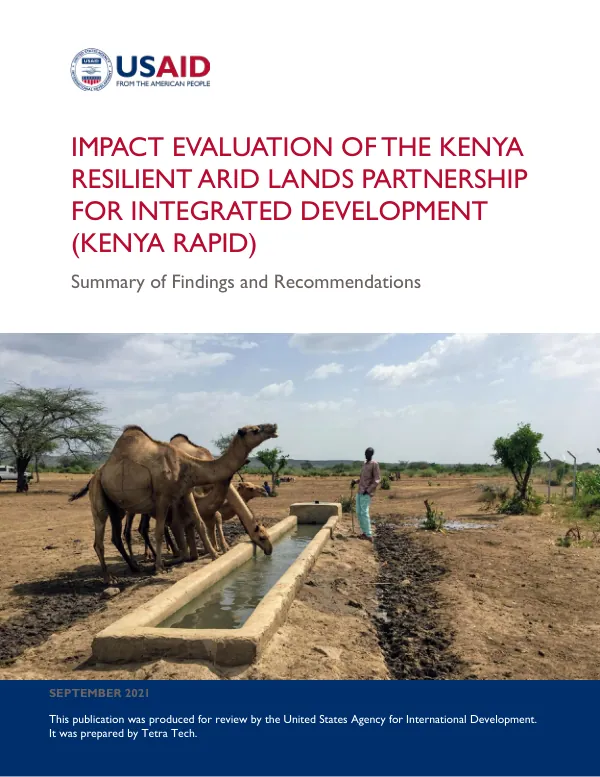
Impact Evaluation of the Kenya Resilient Arid Lands Partnership for Integrated Development (Kenya RAPID)
Sign inTETRA TECH
Impact Evaluation of the Kenya Resilient Arid Lands Partnership for Integrated Development (Kenya RAPID)
The Kenya Resilient Arid Lands Partnership for Integrated Development (RAPID) was a US$35.5 million public-private partnership implemented from 2015 to 2020 and funded jointly by USAID, Swiss Agency for Development and Cooperation (SDC), private sector partners, and Millennium Water Alliance members.
2021 · 18 pages
Sign in to readA free account is required to download.
Abstract
The partnership aimed to improve water management in arid lands through the installation of sensors on water borehole pumps to transmit information to data dashboards in real time. The evaluation team used a quasi-experimental impact evaluation design to understand the effect of RAPID's ICT intervention on strategic borehole pump use and functionality during drought periods. The evaluation team installed sensors on water borehole pumps in five implementation counties and compared them with a set of 132 strategic boreholes across eight comparison counties. The results suggest that strategic boreholes that received the RAPID ICT intervention performed similarly to strategic boreholes in comparison counties. Across multiple analyses, results indicate that the RAPID ICT intervention did not have a statistically significant or meaningful impact on borehole pump functionality during the drier months of the intervention, from 2018 to 2020, relative to comparison county strategic boreholes. However, water managers reported similar timelines for borehole repairs in RAPID and comparison counties, but officials in RAPID counties had a positive perception of the ICT intervention. County- and sub-county-level water managers in RAPID counties viewed the sensor-based system favorably and said it provided useful data to support water management activities. However, these officials also pointed out that lack of access to resources for repairs continues to limit borehole functionality in RAPID counties. Officials in Garissa, a RAPID county, reported that they did not yet have full access to the data dashboard, and others reported that a lack of office internet and issues with network connectivity for using mobile devices limited access to the data dashboard. The evaluation team offers the following recommendations to USAID: continue to focus on water system governance, clarifying roles and responsibilities for water management and establishing dedicated and sustainable funding sources for water system maintenance and repairs. Address community concerns carefully in planning for delivery of water services, as evaluation results identified a number of problems cited by users that were not directly addressed by the sensor-based intervention. Consider rural water ICT intervention costs and context, and use of ICT to collect and share information in some contexts may be worthwhile. However, USAID should consider implementation costs and systemic challenges in thinking about the theory of change for ICT interventions given large structural constraints, such as limited budgets and climate change. For future evaluation efforts, make sure that implementation monitoring is included as a key, funded component, as sparse implementation data on specific activities outside of the ICT intervention and detailed budget information limited the evaluation team's ability to track progress over time. The institutional framework for water management in Kenya consists of multiple stakeholders, with counties operating at the regional and local levels. The Common Programme includes the Ending Drought Emergencies Initiative to better align stakeholders involved in drought mitigation and water management across all levels of government.