USAID DEC
Responding with Emergency Assistance to Communities and Displaced Households in Eastern DRC III+ (REACH-III+)
Sign inMERCY CORPS INTERNATIONAL
Responding with Emergency Assistance to Communities and Displaced Households in Eastern DRC III+ (REACH-III+)
The REACH-III+ program, funded by USAID/OFDA, aims to reduce mortality and morbidity related to water-borne illnesses among displaced populations in Eastern provinces of the Democratic Republic of Congo, including North Kivu, South Kivu, Ituri, and Tanganyika.
2020 · 10 pages
Sign in to readA free account is required to download.
Abstract
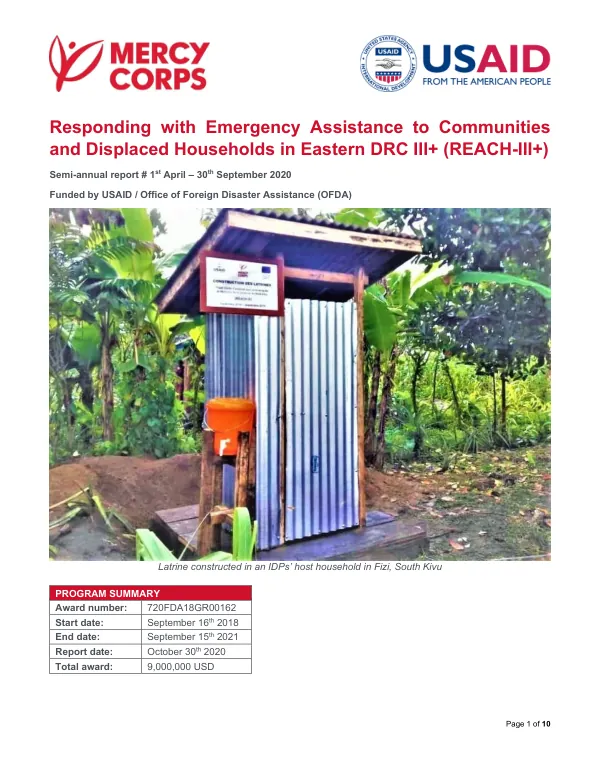
The program is implemented by Mercy Corps, a leading actor for rapid response mechanisms in eastern Congo. Initial WaSH assessments were conducted in three areas: Iga Barriere/Lopa in Ituri, Nyarambe in Mahagi, Ituri, and Fizi in South Kivu. The assessments identified significant WaSH needs among displaced populations, with an estimated 15,131 households in need of WaSH intervention in Nyarambe. The response to these needs began in September 2020, with the construction of latrines and other WaSH infrastructure. The security context in the DRC remains volatile, with ongoing conflicts and intercommunity violence in the eastern part of the country. The resumption of hostilities by armed groups on several fronts and intercommunity violence in the eastern part of the country indicate an uncertain future for those areas plagued by the continued displacement of populations. This military presence restricts people's access to water points, exposing them to protection risks, especially for populations that walk long distances to fetch water. The COVID-19 pandemic has further exacerbated the humanitarian situation, with restrictions on movement and gatherings imposed by the government. These restrictions have compromised the operational capacity of Mercy Corps teams to provide prompt response to displaced populations. Despite these challenges, Mercy Corps continues to monitor the ongoing WaSH intervention in Nyrambe and assess new alerts in North Kivu and South Kivu where potential responses might be confirmed. The Congo Humanitarian Analysis Team (CHAT) team has shared alerts with the humanitarian community, providing details of the context, physical and security access, demographic pressure, and causes of displacement. These alerts have been followed by multisector rapid assessments to meet the needs of vulnerable populations. Training has been provided to whistleblowers in the territories of Rutshuru, Masisi, and Walikale to strengthen their capacities in the transmission, monitoring, and feedback of information related to humanitarian watch. The REACH-III+ program has made progress in addressing the WaSH needs of displaced populations, despite the challenging security context and COVID-19 pandemic. The program continues to adapt to the evolving humanitarian situation, with a focus on providing life-saving WaSH assistance to those in need.