ABT. GLOBAL
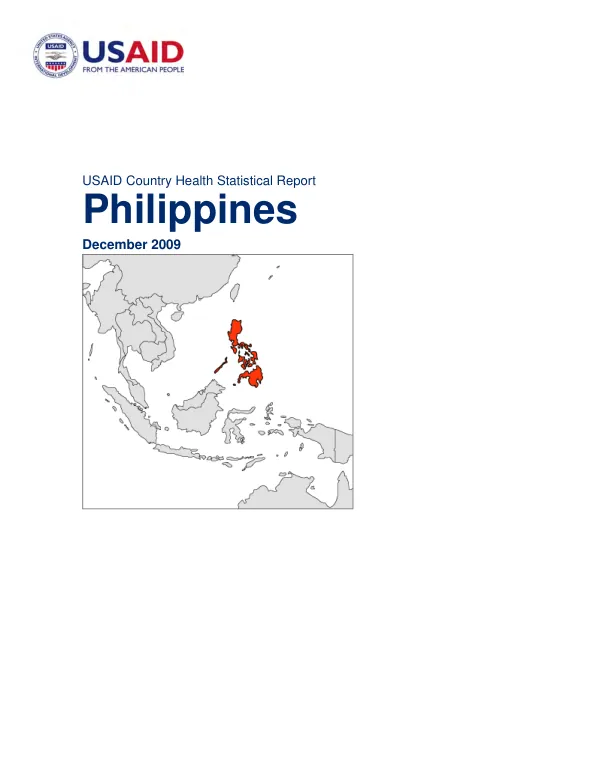
USAID Country Health Statistical Report Philippines
The Philippines has a total population of 97,976,603 as of 2009.
2009 · 21 pages
Sign in to readA free account is required to download.
Abstract
The population growth rate is 2% per year, and the urban population accounts for 62% of the total population. The country has a high total fertility rate, with a value of 3.4 children per woman in 2009. The crude birth rate is 26 per 1,000 people, and the crude death rate is 5.1 per 1,000 people. The country has a high infant mortality rate, with a value of 20.6 per 1,000 live births in 2009. The under-5 mortality rate is 32.9 per 1,000 live births, and the neonatal mortality rate is 17 per 1,000 live births. The country has a high prevalence of acute respiratory infection and diarrhea among children under 5, with 46.4% of children under 5 receiving care for acute respiratory infection and 58.9% receiving oral rehydration therapy. The country has a high prevalence of anemia among women of reproductive age, with 46.4% of women of reproductive age having anemia. The country has a high maternal mortality ratio, with a value of 210 per 100,000 live births in 2005. The country has a high prevalence of antenatal care, with 93.5% of women receiving at least one antenatal visit and 89.2% receiving four or more antenatal visits. The country has a high prevalence of assisted delivery, with 59.8% of women receiving assisted delivery by a health professional. The country has a high prevalence of skilled attendance at delivery, with 59.8% of women receiving skilled attendance at delivery. The country has a high prevalence of modern contraceptive use, with 21.6% of women using modern contraceptive methods. The country has a high prevalence of HIV/AIDS, with an estimated 8,300 people living with HIV/AIDS in 2007. The country has a high prevalence of tuberculosis, with 1,300 new cases per 100,000 people in 2007. The country has a high prevalence of malaria, with 1,300 cases per 100,000 people in 2007. The country has a high prevalence of diarrhea, with 1,300 cases per 100,000 people in 2007. The country has a high prevalence of acute respiratory infection, with 1,300 cases per 100,000 people in 2007. The country has a high prevalence of pneumonia, with 1,300 cases per 100,000 people in 2007. The country has a high prevalence of measles, with 1,300 cases per 100,000 people in 2007. The country has a high prevalence of polio, with 1,300 cases per 100,000 people in 2007. The country has a high prevalence of tetanus, with 1,300 cases per 100,000 people in 2007. The country has a high prevalence of vitamin A supplementation, with 1,300 cases per 100,000 people in 2007. The country has a high prevalence of DPT3 vaccination, with 78.9% of children receiving DPT3 vaccination in 2003. The country has a high prevalence of measles vaccination, with 79.7% of children receiving measles vaccination in 2003. The country has a high prevalence of polio vaccination, with 79.8% of children receiving polio vaccination in 2003. The country has a high prevalence of tetanus toxoid vaccination, with 37.4% of children receiving tetanus toxoid vaccination in 2003. The country has a high prevalence of vitamin A supplementation, with 1,300 cases per 100,000 people in 2007. The country has a high prevalence of improved sanitation/hygiene practices, with 1,300 cases per 100,000 people in 2007. The country has a high prevalence of vitamin A supplementation, with 1,300 cases per 100,000 people in 2007.