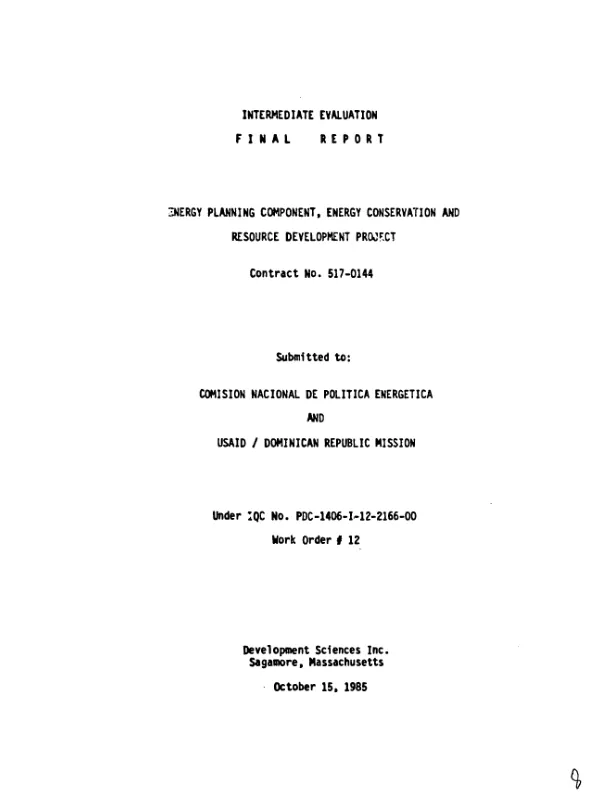
DEVELOPMENT SCIENCES, INC.
Final evaluation : energy policy development, contract no. 517-0143
Presents final external evaluation of a project to improve energy policymaking in the Dominican Republic.
1985
Sign in to readA free account is required to download.
Abstract
The evaluation is based on document review and interviews. Project purposes were only partially met. Public and private sector participants attended technical mini-courses; energy information was provided to Government of the Dominican Republic (GODR) agencies and in public information campaigns; there was a gradual growth in the number of people skilled in data collection and processing, as well as increasing evidence of awareness of the national importance of dealing constructively with the energy sector; and there is a good probability of achieving project goals in the the planning component of follow-on project 5170144. The key problem was the failure to anticipate how the energy planning information developed under the project would be used. Because the planning software (Al-Edis) and associated hardware (PRIME) did not relate well to the GODR decision structure, much of the information generated did not address issues of interest to the GODR; also, considerable computer maintenance problems were experienced. A second major problem was personnel turnover, resulting in large training efforts but few long-term benefits to the National Energy Policy Commission (COENER); this is especially true of training given in use of PRIME and Al-Edis. Toward of the end of the project extension in 1984, the diagnostic capability of COENER spokespersons and their framing of policy issues showed some improvement, but there is no evidence that this was translated into an active COENER role in policymaking at that time. In fine, the project did not meet the expectations expressed in the Project Paper, but it did lay the groundwork for subsequent efforts. Four lessons were learned. (1) Unless information systems aimed at helping with policymaking are designed not only to improve current policy, but also to work with the world as it is, they are not well supported by the host country and are not worth A.I.D. resources. (2) Policy TA requires mutual trust, sensitivity, and a great deal of time. This cannot be accomplished through training, but usually requires a resident - which was not provided in this project. (3) The project confirmed the rule that equipment without local maintenance support and adequate funds often become a white elephant. (4) Lack of a coherent training plan leads to a diffusion of effort and a loss of human resources. The cancellation of the project training plan and the impact of proceeding without it was an unfortunate loss.