DUAL & ASSOCIATES, INC.
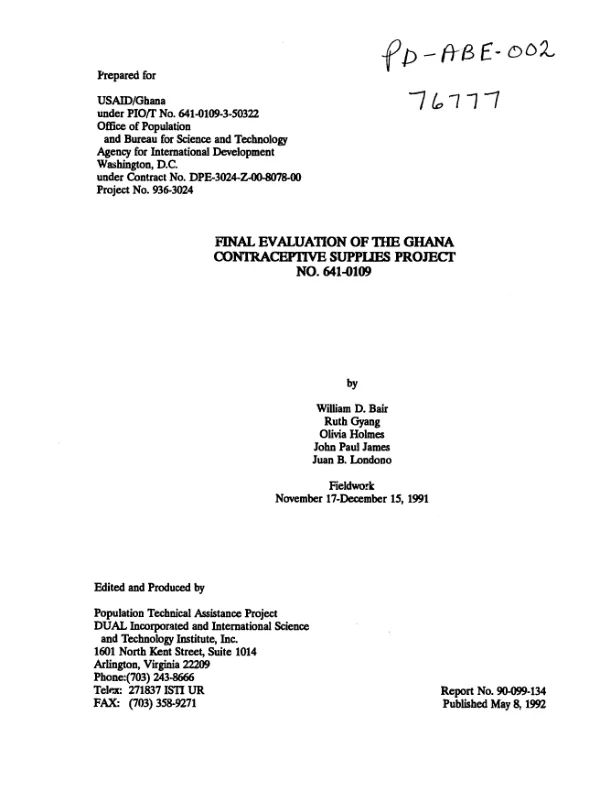
Final evaluation of the Ghana contraceptive supplies project, no. 641-0109
Evaluates project to ensure an adequate supply of contraceptives and family planning (FP) services through Ghana's Ministry of Health (MOH) and through development of the Ghana Contraceptive Social Marketing Program (GSMP) in the private sector.
Bair, William D.|Gyang, Ruth · 1992
Sign in to readA free account is required to download.
Abstract
Final evaluation covers the period 9/85-3/92. The project has faced difficult problems, yet its efforts in two areas -- training, and strengthening the GSMP -- have been outstanding. The breadth of training accomplishments, both in Ghana and abroad, have provided FP and communications skills to personnel numbering in the thousands: 170 persons were trained in short courses abroad, while in-country training has been provided to, among others, 2,949 traditional birth attendants, 238 private sector midwives and 435 public sector midwives, 20 physicians and 50 interns (in minilaparotomy), 50 private physicians (in IUD insertion), 689 personnel (in logistics and information management), and 5,154 Level B health service providers (in IEC and FP). Achievements related to the GSMP have included: 3,500 retail outlets for barrier methods and orals; sales increases of 29% between 1988 and 1990; and development of a market research program. Good progress was also made in expanding FP delivery through the public sector. Services are now available at 584 MOH clinics (up from 87 in 1987), and a public sector IEC campaign has provided excellent materials to health professionals and consumers alike. And yet the project is far from meeting its goals for increased contraceptive prevalence. A number of factors have contributed to this outcome, including the lack of strong budgetary or personnel support from the Government of Ghana (in fact, there are no full-time professionals assigned FP responsibilities at MOH central, regional, or district levels); conflict between GSMP's social objectives and its profitmaking nature; problems with product delivery in the private sector; limited USAID staffing; failure on the part of both U.S. and Ghanaian parties with respect to procurement and port clearance of contraceptives as well as MOH problems with inventory and supply; regulatory restrictions on oral contraceptives; and the need for systematic evaluation of the training received by Level B personnel. The project teaches several lessons. (1) Social marketing programs must realistically appraise the practical commercial objectives of the cooperating private sector enterprise. (2) An effective national FP program requires government commitment that goes beyond policy statements. (3) The need for local cost financing must be clearly recognized. (4) FP programs should intensify their efforts in the areas of greatest population density. (5) There can be no quality FP services without a full and constant supply of contraceptives.