USAID DEC
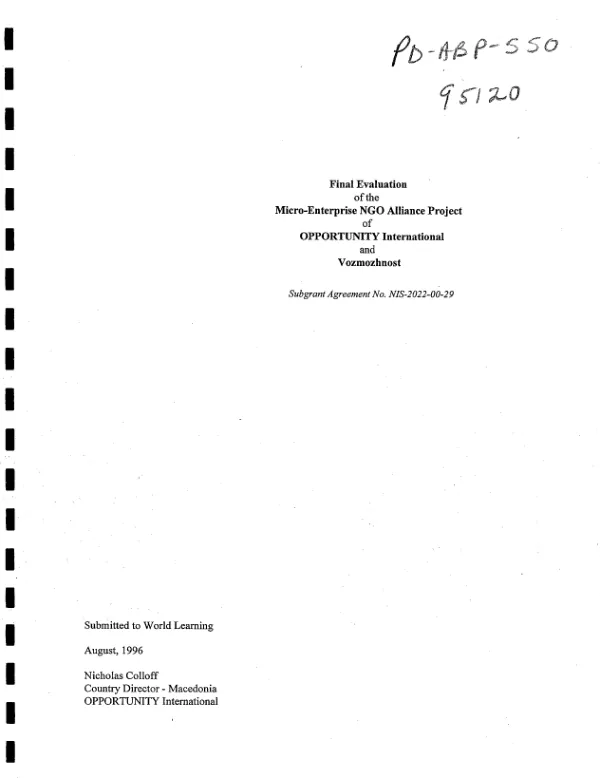
Final evaluation of the micro-enterprise NGO alliance project of Opportunity International and Vozmozhnost
Sign inOPPORTUNITY INTERNATIONAL
Final evaluation of the micro-enterprise NGO alliance project of Opportunity International and Vozmozhnost
Final evaluation of a project (5/94-6/96) to promote microenterprise development in Nizhny Novgorod Oblast, Russia, by creating an alliance of 10-15 NGOs serving microenterprises in the target area.
1996
Sign in to readA free account is required to download.
Abstract
The project was implemented by Opportunity International (OI), under a subgrant from World Learning, and Vozmozhnost, a local NGO. The project's principal accomplishment has been the establishment of a strong working partnership between OI, Vozmozhnost, and Slyzhenia, the NGO alliance created under this agreement, which now exists as a legally registered association. Both Slyzhenia's capacity and that of its members has been strengthened; each has set its own visions, objectives, and priorities in a participatory manner. Ownership of Slyzhenia has come to rest in its members, with its day-to-day tasks vested in a fully functioning and competent voluntary board and an effective executive director. Slyzhenia has established a regional training center, which has an extensive, ongoing program of seminars, networking opportunities, and information distribution. This is valued by Slyzhenia's members, as witnessed by high participation rates. In all, 23 of a targeted 25 training seminars have been conducted with 392 participants. However, effective measures of this development and training impact remain undeveloped. The Job Creation Programme initiated as a result of the 2/96 grant revision is at the forefront of Slyzhenia's service program. This program has enhanced participating NGOs' vision, capacities, employment, and incomes, making a major contribution (if initial results can be sustained) to members' long-term viability. Slyzhenia is meeting its job creation obligations under both the initial and revised proposal. The Programme has created 46 new jobs, vs. a target of 60, and improved the incomes of 17 NGOs, vs. a target of 10-15, by 15-100% in a 6-month period. This has had a significant impact on their long-term viability. However, progress towards sustainability (i.e., without reliance on external grants) has been limited. In this vein, only two-thirds of Slyzhenia's members pay regular (and only nominal) membership dues and Slyzhenia continues to provide services free. However, Slyzhenia has diversified funding and developed a coherent, if unproved, short- to medium- term funding strategy, comprised of external grants, social contracts, and slowly rising membership dues. Overall, it is the opinion of the evaluators that Slyzhenia will survive beyond the closure of the grant because of the commitment of its members and the quality of the services it aims to provide -- even if it must do so on a reduced budget. The implementation of the project was beset by a number of misunderstandings, which delayed a restructuring that was needed to more clearly focus the program. All involved failed to understand the difficulty in implementing the original micro-enterprise strategy. This misunderstanding was persistent, as the mid-term evaluation sought to reinforce rather than re-think the strategy. Even after the original strategy was rethought, it took 3 months for OI and World Learning to agree on a revision, possibly because of their differing organizational structures. In 2/96, the grant was revised and extended for 3 months, with the possibility of a further 3-month extension based on measurable progress. World Learning decided not to approve the second extension, although even 2 additional months might have given Slyzhenia enough time to show the effective results of the Job Creation Programme. World Learning has still not given Slyzhenia a coherent account of this decision, and this has generated an atmosphere of mistrust. A lesson learned is that great care must be taken to establish trust with one's partners, as the experience sets a precedent for the tone of future development partnerships.