USAID DEC
Fostering craft enterprise and the voluntary business assistance sector in Russia : final report
Sign inAID TO ARTISANS, INC.
Fostering craft enterprise and the voluntary business assistance sector in Russia : final report
Final report of the contractor, Aid to Artisans, Inc.
1970
Sign in to readA free account is required to download.
Abstract
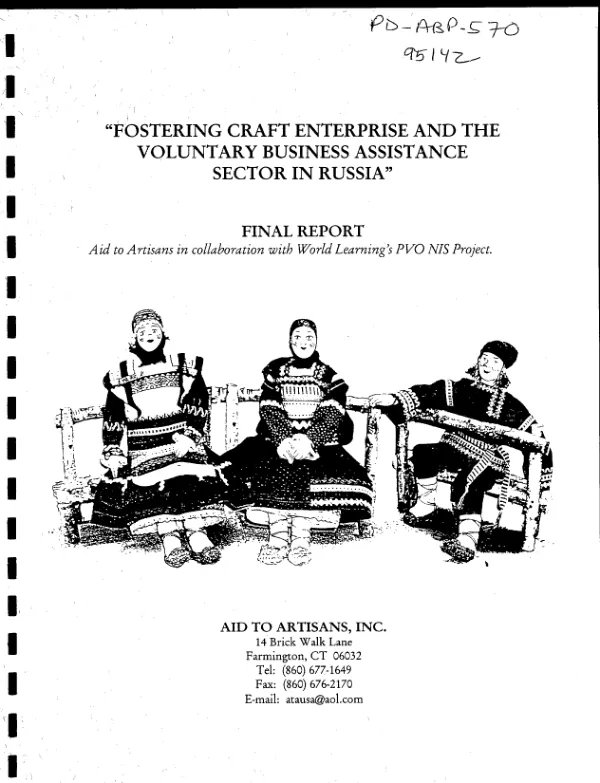
(ATA), on a project (10/93-2/96) to increase employment opportunities and incomes in Russia"s handcraft export sector and strengthen local craft-based NGOs. ATA coordinated all activities with 6 NGO partners in the Moscow and St. Petersburg areas. The project met or exceeded all of its targets, identifying over 400 (vs. a target of 375) artisans, mostly women; completing approximately 43 (vs. 30) design and business training workshops for over 375 artisans and NGO members (over 150 of whom are return attendants); and exhibiting over 600 (vs. 150) products for export at five New York International Gift Fairs. In terms of market receptiveness to products developed, business relationships were established with 6 U.S. importers. Twenty-five businesses increased their wholesale revenues by $169,000 through project-related sales. ATA"s work with partner NGOs strengthened their assistance to artisan entrepreneurs and greatly leveraged the number of artisans reached by project activities. For example, five NGOs have initiated regular and independent business assistance, marketing, and product development programs; Irida is now servicing as the handicraft sector"s craft export agent; partner NGOs have co-sponsored 40+ events and seminars; and 100 NGO members have been trained in marketing, product, business, and organizational development. It is estimated that approximately 2,370 individuals have been reached by the ATA project. Unfortunately, the project"s efforts were and will continue to be thwarted by economic conditions in the former Soviet State. Inflation, poor banking systems, unstable raw materials supply, lack of international market awareness, inconsistent communications, and lack of packing materials and of trained export agents will continue to cause Russian craft-based NGOs and artisan entrepreneurs difficulties in competing successfully in the international market. The ATA project taught a valuable lesson. Managing growth and opportunities that a project such as this can generate is difficult. Early successes can be misleading and breed unrealistic expectations, which very quickly are dispelled by slow market response. The best antidote to this problem was the open communication established between project participants and ATA staff. Additionally, much of the former Soviet Union is still unclear as to what constitutes good business practices. More time will be needed for the lessons of this project to be absorbed by members of a country living with the legacy of 40 years of communism.
Related documents
Documents in this collection
USAID DEC
Counterpart Foundation, Inc. : final report -- partnership project with Rossiskaya Zabota (Russian Care)
Open record 1997
1997USAID DEC