USAID DEC
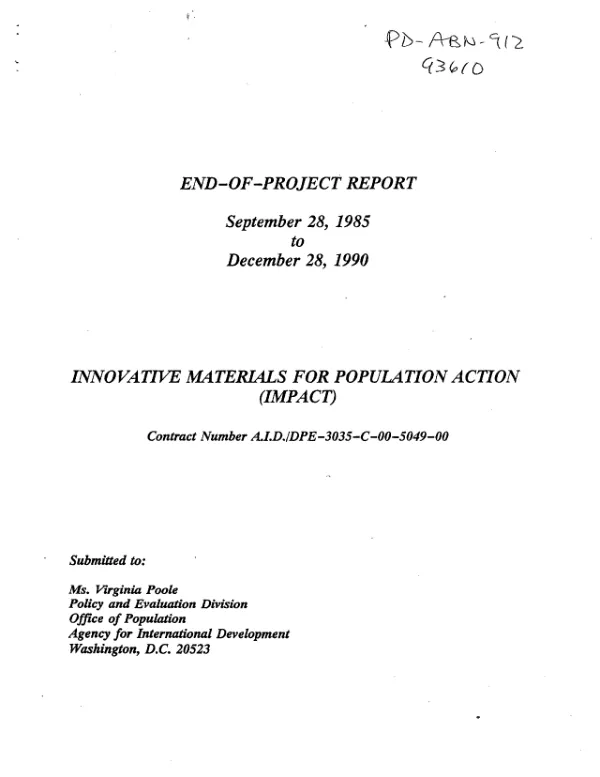
End-of-project report, September 28, 1985 to December 28, 1990 : innovative materials for population action (IMPACT) -- contract number AID/DPE-3035-C-00-5049-00
Sign inUSAID. BUR. FOR SCIENCE AND TECHNOLOGY. OFC. OF POPULATION
End-of-project report, September 28, 1985 to December 28, 1990 : innovative materials for population action (IMPACT) -- contract number AID/DPE-3035-C-00-5049-00
Final evaluation of a project (9/85-12/90) to facilitate the communication of population and family planning (FP) research findings to policymakers in developing countries (IMPACT project).
1990
Sign in to readA free account is required to download.
Abstract
The project was a success. Through research, evaluation, and trial-and-error, IMPACT has developed an approach to developing, "packaging", and distributing materials to targeted audiences that can be used by other future projects and other donors. Major outputs include 97 separate booklets on 40 topics, including region- or country-specific versions in English, French, Spanish, Portuguese, Arabic, Turkish and, Somali, as well as 37 separate posters, 6 population data sheets, an international satellite teleconference, 3 videos, and a variety of audiocassettes, slide sets, fact sheets, press releases, and conference folders and agendas. In all, some 200,000 booklets and 50,000 other educational materials have been distributed to targeted lists of leaders in 26 countries and to USAIDs and requesters in 50 additional developing countries. In addition, IMPACT has developed and supported population-policy communications programs through major subprojects in 6 countries (Ghana, Madagascar, Somalia, Zimbabwe, Nepal, and Turkey) and for a nine-country Sahel consortium. Through these programs, IMPACT has brought the attention of thousands of developing country policymakers to a number of key messages: FP saves lives; modern contraceptives are in general safe and effective; rapid population growth imperils the quality of the environment in development countries; and case histories show that FP programs do work in developing countries. IMPACT activities contributed to certain advances in the complex process of building support for population and FP among developing country leaders. (1) IMPACT brought population and FP issues to the attention of far more developing country leaders than originally expected. IMPACT expected to send about 15,000 booklets to 5,000 leaders in all 69 A.I.D.-supported countries. But by narrowing its focus to 25 countries and working through in-country representatives, it developed a list of 13,200 leaders, who received about 40,000 booklets. About 30,000 more booklets were distributed through secondary requests from developing and developed-country organizations that collaborate with or train FP personnel. (2) IMPACT materials probably stimulated some policy-relevant activities among at least several thousand developing country leaders. Over half the recipients surveyed had read the IMPACT materials and over 40% had discussed them with colleagues, used them for articles, presentations, or for training, or in some other capacity; another 40% had said they planned to do so. The external evaluation found that one-third of the developing country audiences surveyed felt that IMPACT materials had contributed noticeably to their country's population policy or FP policy. (3) In Jordan, IMPACT's FP Saves Lives (FPSL) had a catalytic effect among the large numbers of leaders to whom it was distributed. The politically volatile health rationale for FP -- based on demographics -- presented in the booklet was embraced enthusiastically, and formed the basis for a new kind of information campaign. (4) IMPACT's subprojects contributed to incremental policy change. For example, the Government of Ghana's endorsement of a population authority to implement Ghana's 20-year-old population policy has been attributed to an IMPACT subproject. In Madagascar, a joint IMPACT/OPTIONS I subproject has contributed to the adoption of a population policy. IMPACT's assistance (often in collaboration with OPTIONS I) to the Center for Applied Research on Population and Development (CERPOD) has inspired more interest in population policies and CERPOD assistance among the Sahelian member states. In Turkey, the country-specific version of "Contraceptive Safety: Rumors and Realities", was so popular that an extra print run permitted distribution to every obstetrician and gynecologist and every medical school in the country. (5) Global Edition, a subproject to improve the quality and quantity of press coverage of issues related to population and the environment, has taken on a life of its own. A collaborative effort with editors of newspapers and magazines throughout the developing world, it is now supported by the MacArthur Foundation. Global Edition has retained its original participants and has added editors in Egypt, India, Nigeria, and Indonesia. It is now developing plans to expand into radio networks. This former IMPACT activity now reaches an estimated 12 million readers. (6) IMPACT materials are useful for policy dialogue between donors and top country leaders. On a recent trip to Africa, the A.I.D. Administrator brought special presentation copies of IMPACT's African Population Images to present to national leaders. In addition, the State Department Coordinator for Population Affairs uses IMPACT materials for briefings with U.S. ambassadors and ambassador-nominees to provide them with the information they will need to discuss population assistance with their national counterparts. Project experience indicates that brief, attractive materials written for non-specialists are effective, especially if they focus on country-specific topics and are written by and distributed under the aegis of highly regarded country nationals, and targeted to balanced categories of leaders. (Author abstract, modified)