USAID DEC
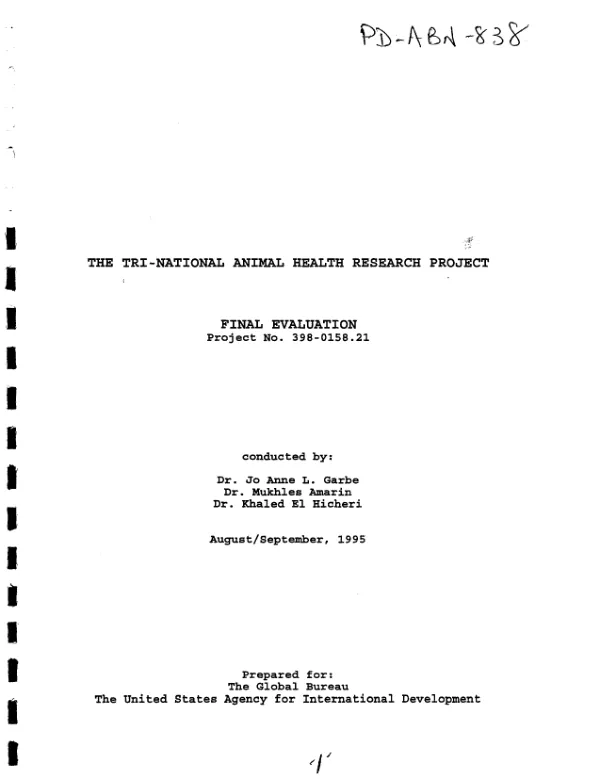
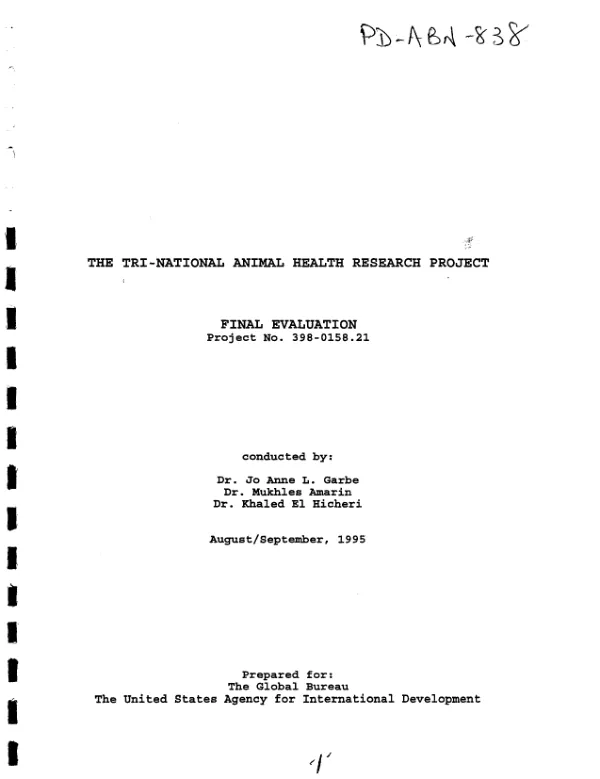
Tri-national animal health research project : final evaluation -- project no. 398-0158.21, USAID-USDA PASA no. ANE-0158-P-AG-0030-00
Sign inUSAID. BUR. FOR ASIA AND NEAR EAST. OFC. OF DEVELOPMENT RESOURCES
Tri-national animal health research project : final evaluation -- project no. 398-0158.21, USAID-USDA PASA no. ANE-0158-P-AG-0030-00
Final evaluation of a project (1990-9/95) to support collaborative animal health research by Egyptian, Israeli, and U.S.
Garbe, Jo Anne L.|Amarin, Mukhles|El Hicheri, Khaled · 1995
Sign in to readA free account is required to download.
Abstract
scientists (TAHRP project). Each of the project's three subprojects (SPs) has reached its ambitious goals and leant medical attention to previously ignored species: the neonatal SP decreased morbidity and mortality of neonatal calves in Egypt and Israel; the brucellosis SP facilitated the initiation of country-wide control programs; and the foot and mouth disease SP produced rapid identification and surveillance techniques which can be incorporated into regional control programs. This research has contributed significantly to the economic well-being of Israelis and Egyptians. The project not only helped to elevate the level of in-country scientific expertise -- and consequently of service capacity -- for animal research, but has paved the way for collaborative animal health research and disease control between Egypt and Israel, including that between veterinary services and public health officials. The project was designed solely by the two Country Coordinators and representatives from the United States, but by the project's end laboratory scientists were collaborating on the drafting of final technical reports and planning future joint activities. Critical to the evolution of these relationships were the U.S. scientific collaborators. Finally, the project created a nucleus of scientists within the region that now attracts others to join in and participate. Four international workshops were well attended and received, and the researchers have a clear desire to continue fostering relationships developed through this project, particularly in including other regional parties. In sum, thanks to the project, real opportunities now exist to promote regional cooperation in animal health and related activities and to coordinate regional strategies for the control of animal diseases. Overall, the project was adequately managed, although under some constraints. These include insufficient transparency in many areas of project administration leading to a lack of information sharing and decision-making at all levels; failure to articulate the priorities of each sub-project in order to avoid overlap and increase efficient decision-making; difficulty of the researchers in contacting one another; and chronic difficulties in the preparation and presentation of quarterly, semiannual, and annual reporting documents. The following lessons were learned. (1) Equality between country scientists is critical. Future projects should promote exchanges between scientists and field implementors from all countries involved. (2) The sustainability of project activities would be ensured and enhanced by increased movement toward privatization of veterinary services and livestock production activities in Egypt. (3) Sustainability depends upon the commitment of each country to providing in-kind contributions either through an institution, the state, or the private sector. (4) Country Coordinators, administrators, or contractors should provide detailed schedules to the Team Leader well in advance of in-country activity. Modifications could then be made without jeopardizing onsite evaluation time. (5) On-site monitoring would help ensure that projects meet goals and objectives.
Related documents