USAID DEC
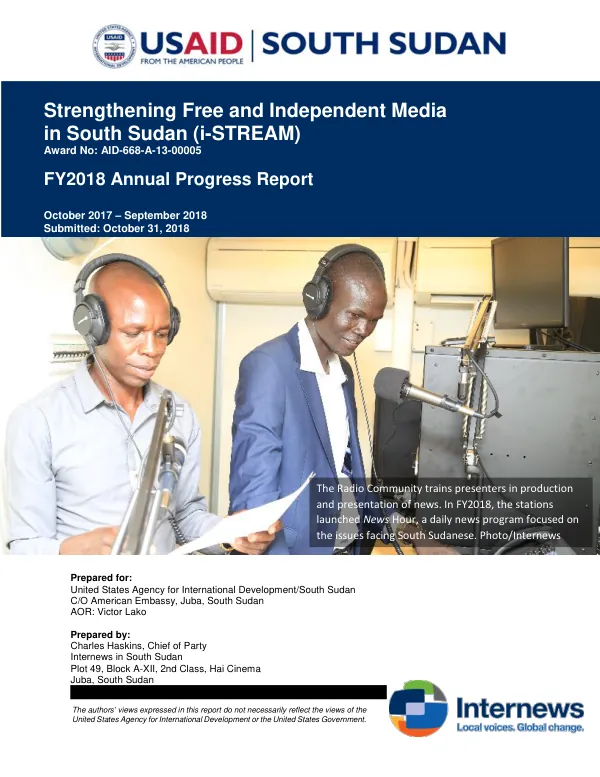
Final Performance Evaluation of i-STREAM South Sudan: Strengthening Free and Independent Media in South Sudan
Sign inME&A, INC.
Final Performance Evaluation of i-STREAM South Sudan: Strengthening Free and Independent Media in South Sudan
The i-STREAM program in South Sudan was designed to strengthen autonomous, journalistic professionalism and facilitate the development of an institutionally well-managed, financially self-sustained, independent media in the country.
2021 · 120 pages
Sign in to readA free account is required to download.
Abstract
The program was implemented from 2013 to 2021 and was supported by the United States Agency for International Development (USAID). The evaluation of the program was conducted using a mixed-methods approach, which included document reviews, key informant interviews, focus group discussions, and site visits. The evaluation found that the program was widely considered to have been overly ambitious in its design, scope, and timeframe given South Sudan's context. However, it had a strong performance and was able to be flexible and adaptive. Eye Radio has become the most trusted and respected radio station in the country, and the supported community radio stations provided a lifeline to communities in the most traumatic of times. The evaluation team identified several key findings, including the changing media paradigm in South Sudan, the design and implementation of the i-STREAM program, and progress toward the development of an institutionally well-managed and financially self-sustained independent media. The evaluation also highlighted the importance of media education and journalism training, and the need for capacity building and advocacy for capacity building. Based on the findings, the evaluation team made several recommendations for the future of the i-STREAM program. These recommendations included moving the program from the start-up phase into a new phase (Phase 2 - Consolidation) with a focus on improving the cost-effectiveness and income-generating capabilities of the supported radio networks. The evaluation team also recommended expanding the sharing of central resources and developing single centers of excellence, such as digital content development, staff training, administration functions, engineering and maintenance, news gathering and content development, and sales and marketing. The evaluation team also identified several key stakeholders who were interviewed as part of the evaluation, including representatives from Eye Radio, the Radio Community, and the Community Engagement Network. The evaluation team also conducted focus group discussions and site visits to gather data and information about the program. The i-STREAM program has made significant progress in strengthening autonomous, journalistic professionalism and facilitating the development of an institutionally well-managed, financially self-sustained, independent media in South Sudan. However, there are still challenges to be addressed, including improving the cost-effectiveness and income-generating capabilities of the supported radio networks. The evaluation team's recommendations provide a roadmap for the future of the program and highlight the importance of continued support for the sector. The evaluation team's findings and recommendations are based on a thorough analysis of the program's progress and challenges. The evaluation team used a mixed-methods approach to gather data and information, including document reviews, key informant interviews, focus group discussions, and site visits. The evaluation team's recommendations are designed to inform the future and shape of the USAID/South Sudan Mission's continuing support for the sector. The i-STREAM program has made significant contributions to the development of an independent media in South Sudan. The program has provided training and support to journalists and media professionals, and has helped to establish a network of community radio stations that provide a lifeline to communities in the most traumatic of times. The program has also helped to promote media education and journalism training, and has supported the development of a financially self-sustained independent media. The evaluation team's recommendations provide a roadmap for the future of the program and highlight the importance of continued support for the sector. The recommendations are designed to improve the cost-effectiveness and income-generating capabilities of the supported radio networks, and to promote the development of a financially self-sustained independent media. The recommendations also highlight the importance of capacity building and advocacy for capacity building, and provide a framework for the future of the program.