CHECCHI AND COMPANY, CONSULTING, INC.
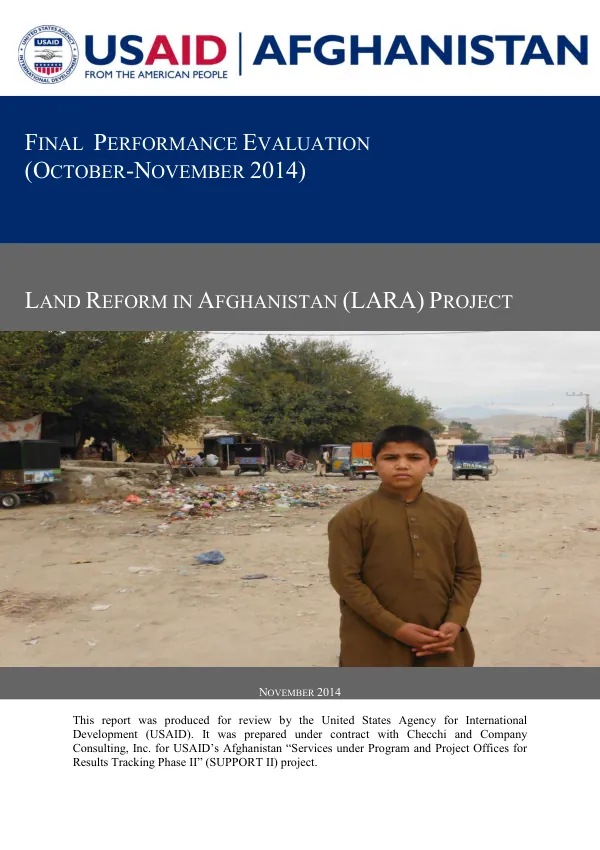
Final Performance Evaluation of the USAID/Land Reform in Afghanistan Project (LARA)
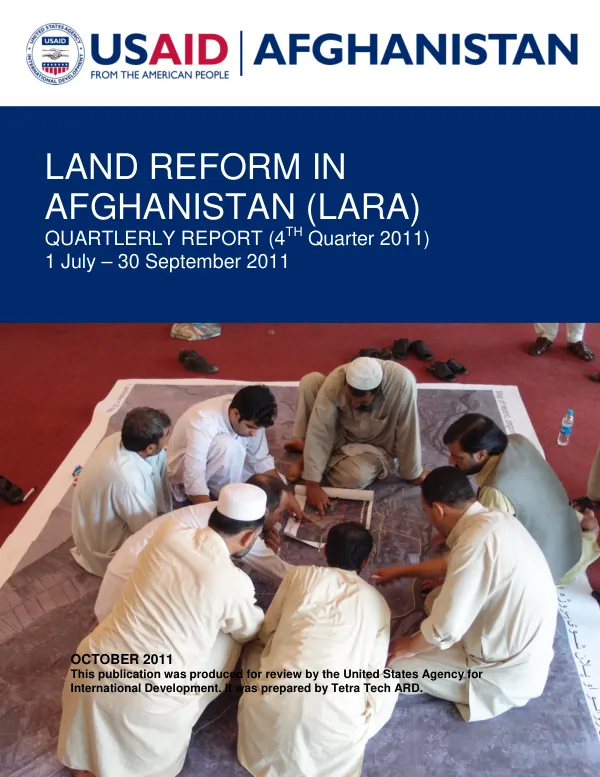
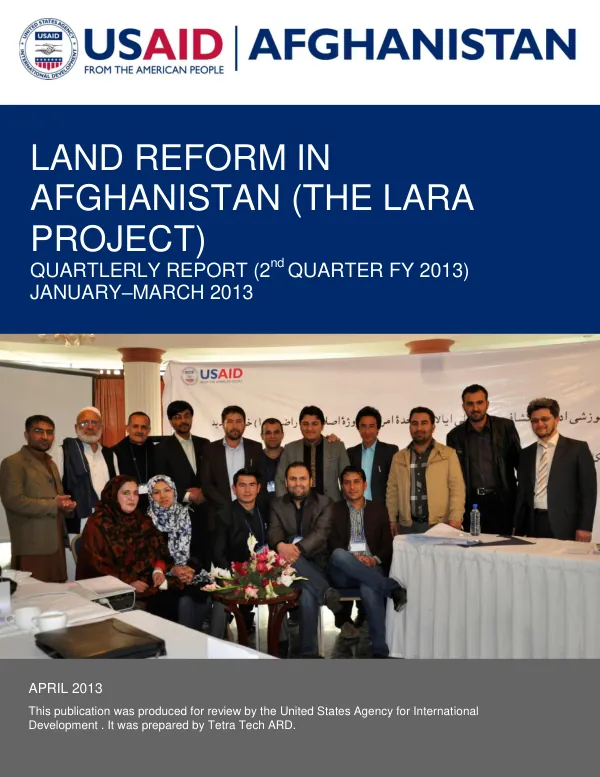
The Land Reform in Afghanistan Project (LARA) was a USAID-funded initiative aimed at supporting the Government of the Islamic Republic of Afghanistan (GIRoA) in implementing the National Land Policy.
2014 · 101 pages
Sign in to readA free account is required to download.
Abstract
The project was implemented in two phases from January 2011 to November 2014 by Tetra Tech ARD. The primary objective of LARA was to develop a robust, Afghan-owned and -managed land market framework that encourages investment and growth, mitigates land-based conflict, and builds confidence in the government's legitimacy. The project had five key objectives: to improve property rights delivery, enable citizens to exercise their rights through public information awareness, strengthen land dispute resolution processes, strengthen institutional, policy, and legal reform, and provide assistance in cross-cutting areas such as gender, training, and private sector development. The evaluation of LARA focused on eight questions, with a priority on systems and sustainability. The evaluation found that the system upgrades improved the functionality of Arazi, the major land agency of Afghanistan, in several ways. The upgrades strengthened Arazi's leadership and integrated the cadastral unit formerly located in the Afghan Geodesy and Cartography Head Office (AGCHO) into the agency. The plan is to make Arazi responsible for formalization and other land titling, based on the integrated cadastral database, Arazi Land Records Management Information System (ALRMIS). However, obstacles to Arazi's functioning include the incomplete training of its staff and the incomplete extension of its central office systems to its divisional offices. Additionally, the evaluation noted that the project faced challenges in implementing its objectives, particularly in the areas of land dispute resolution and institutional reform. The evaluation team also assessed the project's progress in achieving its objectives. The team found that the project made significant progress in improving property rights delivery, particularly in the areas of land formalization and public information awareness. However, the project faced challenges in strengthening land dispute resolution processes and institutional reform. The evaluation team made several recommendations to inform USAID on the feasibility of supporting land reform initiatives across its Afghanistan programs. The recommendations included continuing to support the development of a robust, Afghan-owned and -managed land market framework, strengthening institutional and policy reform, and providing assistance in cross-cutting areas such as gender and private sector development. The evaluation also highlighted the importance of addressing the challenges faced by the project, particularly in the areas of land dispute resolution and institutional reform. The evaluation team recommended that USAID provide additional support to the Government of Afghanistan to address these challenges and ensure the long-term sustainability of the project's achievements. In terms of geographic focus, the project was implemented in Afghanistan, with a focus on supporting the Government of the Islamic Republic of Afghanistan in implementing the National Land Policy. The project had a national scope, with activities implemented in various provinces across the country. The evaluation was conducted in October-November 2014, with the final report submitted to USAID in November 2014. The evaluation team consisted of experts from Tetra Tech ARD, who worked closely with the Government of Afghanistan and other stakeholders to assess the project's progress and achievements.