USAID DEC
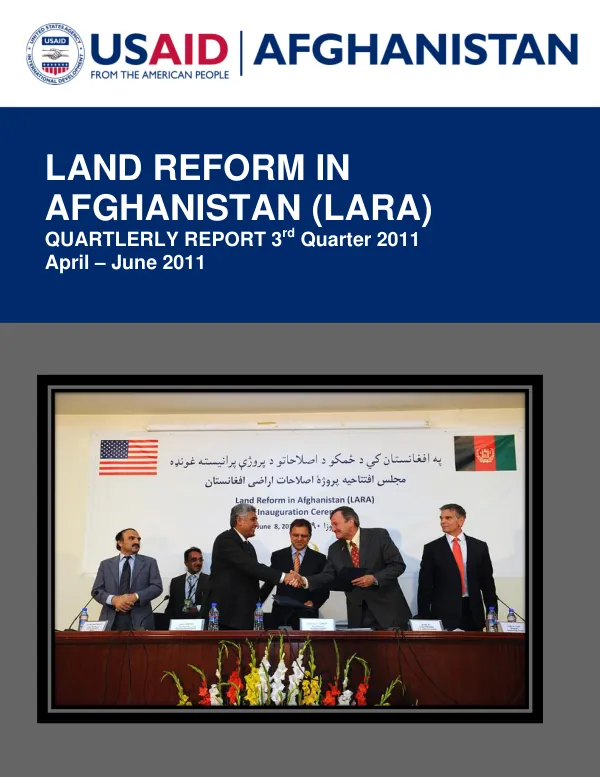
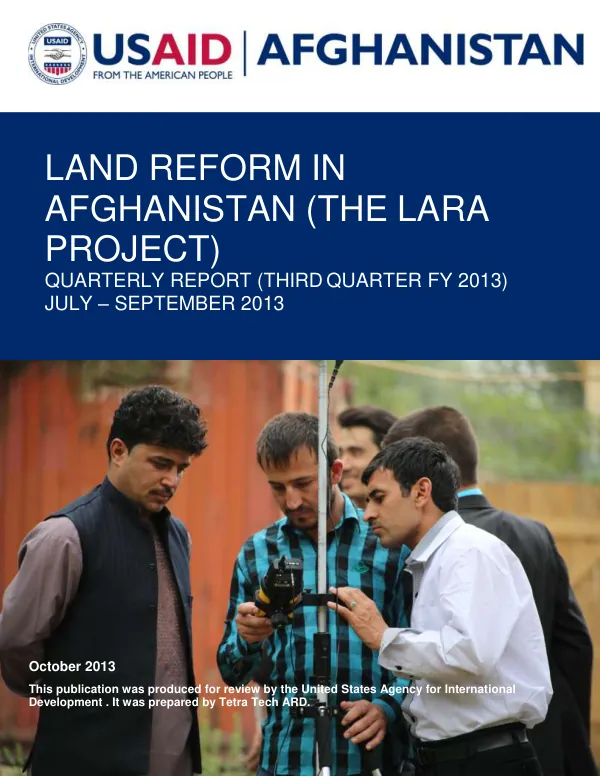
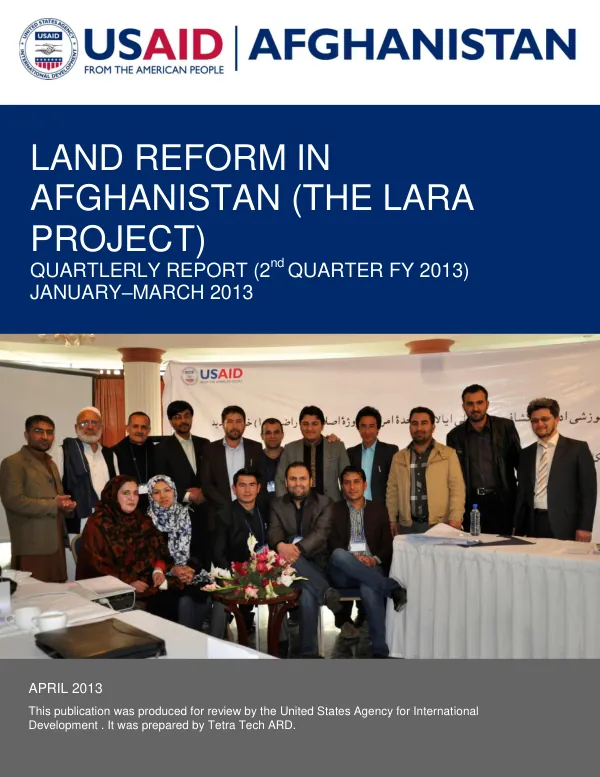
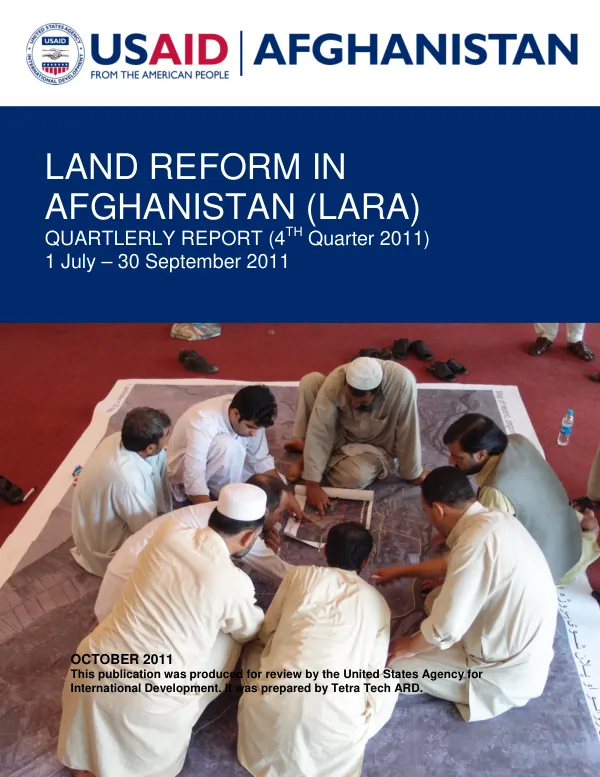
Land Reform in Afghanistan (LARA) Quarterly Report (4th Quarter) July–September 2011
Sign inDEVELOPMENT AND TRAINING SERVICES, INC.
Land Reform in Afghanistan (LARA) Quarterly Report (4th Quarter) July–September 2011
The LARA project, managed by Tetra Tech ARD under USAID Contract No.
2011 · 51 pages
Sign in to readA free account is required to download.
Abstract
306-C-00-11-00514-00, aims to develop a robust, enduring, and Afghan-owned and-managed land market framework. The project's primary government partners are ARAZI, the Ministry of Urban Development Affairs (MUDA), the Independent Directorate of Local Governance (IDLG), the Supreme Court, and selected local municipalities. The LARA project is designed to contribute to USAID's Afghanistan Objective and the Afghanistan National Development Strategy. The project's objectives include improving property rights delivery, enabling all citizens to exercise their rights through public information awareness, strengthening land dispute resolution processes, promoting economic development, and strengthening institutional, policy, and legal reform. These objectives are supported by four components: Informal Settlements & Formalization, Strengthen Land Tenure Security, Legal Framework, and Capacity Building. The Informal Settlements & Formalization component supports MUDA, AGCHO, IDLG, and the Municipality of Jalalabad with informal settlements upgrading, formalization, cadastral mapping, laws for urban planning and land use regulation, and training in planning and enforcement. The Strengthen Land Tenure Security component strengthens tenure security by supporting the Supreme Court and communities with rights formalization and informal dispute resolution. The Legal Framework component provides limited assistance to ARAZI to identify, manage, lease, and obtain revenue from Afghan government lands and provides targeted technical assistance. The Capacity Building component builds capacity of public and private sector service providers to improve and streamline land tenure processes. During the 4th quarter of 2011, the project implemented various activities across its components. In the Informal Settlements & Formalization component, the project expanded institutional support for the coordination and management of land services, provided urban planning technical assistance, and conducted upgrading and formalization activities in informal settlements. In the Strengthen Land Tenure Security component, the project evaluated and reformed inheritance laws to support women's access to land and provided support for land dispute resolution focusing on community and customary dispute resolution processes and institutions. The project also conducted diagnostics to evaluate existing and proposed legal frameworks for real estate and drafted changes to real estate legislation as needed. In the Capacity Building component, the project provided institutional support and strengthened capacity of land service providers in areas of organization, financial management, procurement, contracting, and reporting. The project also provided technical support and capacity building in technical services and capacity building and training in urban planning, plan implementation, development control, and monitoring. The project's financial report for the 4th quarter of 2011 indicates that the project has made significant progress in achieving its objectives. The project has implemented various activities across its components, including informal settlements upgrading, formalization, cadastral mapping, laws for urban planning and land use regulation, and training in planning and enforcement. The project has also strengthened tenure security, provided limited assistance to ARAZI, and built capacity of public and private sector service providers. The project's performance monitoring and evaluation table indicates that the project has achieved significant progress in its objectives, including improving property rights delivery, enabling all citizens to exercise their rights through public information awareness, strengthening land dispute resolution processes, promoting economic development, and strengthening institutional, policy, and legal reform. The project's activities have been implemented across its four components, and the project has made significant progress in achieving its objectives. The project's events calendar indicates that the project has planned various activities for the next quarter, including informal settlements upgrading, formalization, cadastral mapping, laws for urban planning and land use regulation, and training in planning and enforcement. The project has also planned to evaluate and reform inheritance laws to support women's access to land and provide support for land dispute resolution focusing on community and customary dispute resolution processes and institutions. Overall, the LARA project has made significant progress in achieving its objectives, and the project's activities have been implemented across its four components. The project's financial report, performance monitoring and evaluation table, and events calendar indicate that the project has achieved significant progress in its objectives and has planned various activities for the next quarter.