USAID DEC
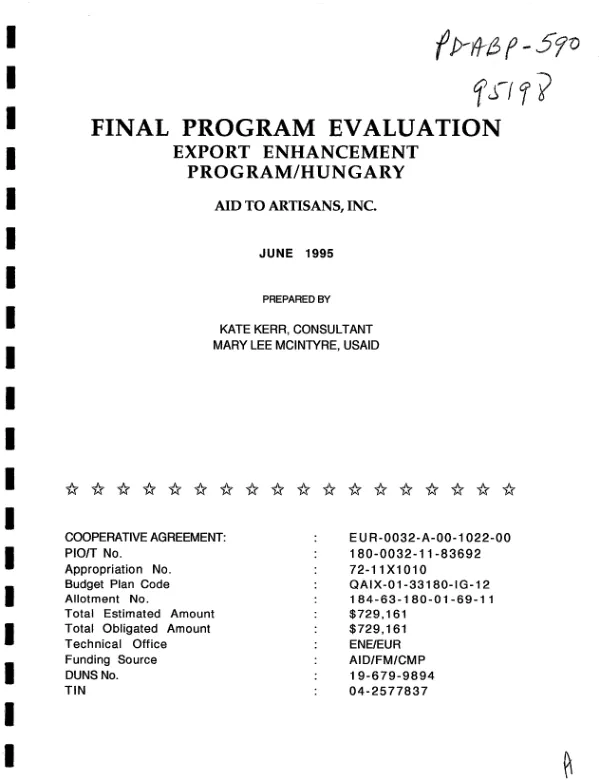
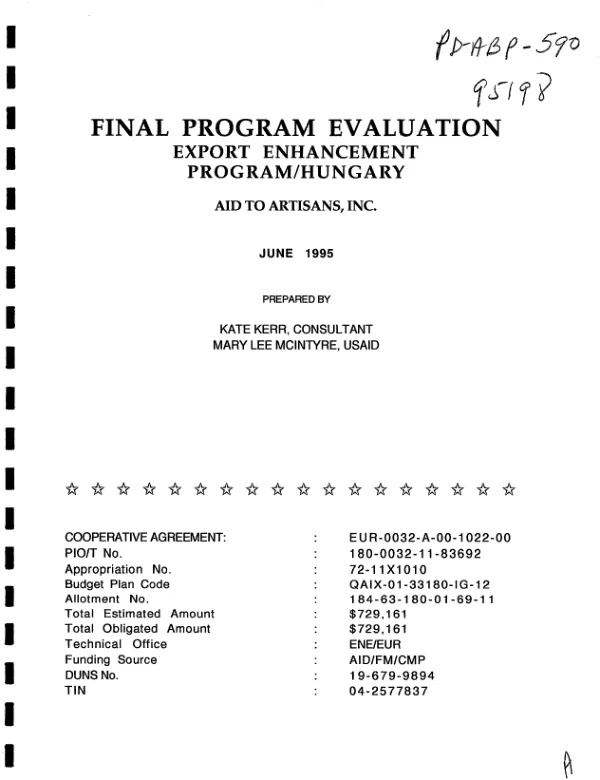
Final program evaluation : export enhancement program/Hungary -- Aid to Artisans, Inc.
Sign inUSAID. BUR. FOR EUROPE AND THE NEW INDEPENDENT STATES. OFC. OF DEVELOPMENT RESOURCES
Final program evaluation : export enhancement program/Hungary -- Aid to Artisans, Inc.
Final evaluation of a project (4/91-4/95) to help disadvantaged artisans in Hungary to increase their incomes through the development of sustainable craft businesses.
Kerr, Kate|McIntyre, Mary Lee · 1995
Sign in to readA free account is required to download.
Abstract
The project was implemented by Aid to Artisans, Inc. The project was remarkably successful in generating new business opportunities for a broad cross-section of artisan enterprises, most of which employed women in rural regions. Specifically, the project generated over $1 million in direct revenues to small enterprises and microenterprises; provided business training programs for 30 small businesses, 28 microenterprises, and 5 foreign trade companies and independent export agents; and helped participating enterprises to stay in business and stabilize their employment levels. The project also strengthened a local NGO, the Hungarian Folkart Association, and fostered long-term, committed business relationships between U.S. and Hungarian companies. Several factors impeded implementation. These included: (1) a highly changeable legal and regulatory environment, which created general confusion among project participants whose businesses were under constant stress and financial uncertainty; (2) language constraints, which reduced program participants' ability to take maximum advantage of opportunities to interact directly with representatives from U.S. business; and (3) differences in cultural attitudes and values, which created misunderstandings and a general lack of experience with market concepts, American business styles, and gender roles. Additionally, macro-economic conditions had a massive impact on the program: inflation, lack of credit, a legacy of top-heavy management, and low productivity all contributed to painful down-sizing methods throughout businesses in Hungary. The evaluation noted that successful, break-even, and unsuccessful businesses could each be characterized by a different set of traits. Successful businesses were driven by managements which were willing to take great risks, possessed a positive, pro-active approach, and seized every possible opportunity to implement program recommendations related to product design, marketing, and customer relations. While break-even enterprises should be recognized for their achievements in staying afloat despite overwhelming debt burdens, they were also reluctant to trim costs and reduce their workforce and only partially able to avail themselves of program resources, sometimes stubbornly refusing to make price concessions to would-be buyers. Failed enterprises took a passive attitude towards marketing, tended to be highly negative in their outlook, and did not take steps to participate in the mainstream workplace. The project demonstrated an important lesson: managing growth and opportunities that a project such as this can generate is difficult. Early successes can breed unrealistic expectations, which very quickly are dispelled by slow market response. The best antidote to this problem is a feedback loop that fosters open communication between all participants and program management. Fostering new business opportunities and working with the private sector raises sensitive issues related to fairness, access, and conflict of interest, and much of this formerly communist society is still not clear on what constitutes good business practices. More time will be needed for the lessons of this project to be absorbed by members of a country living with the legacy of 40 years of communism. (Author abstract, modified)