USAID DEC
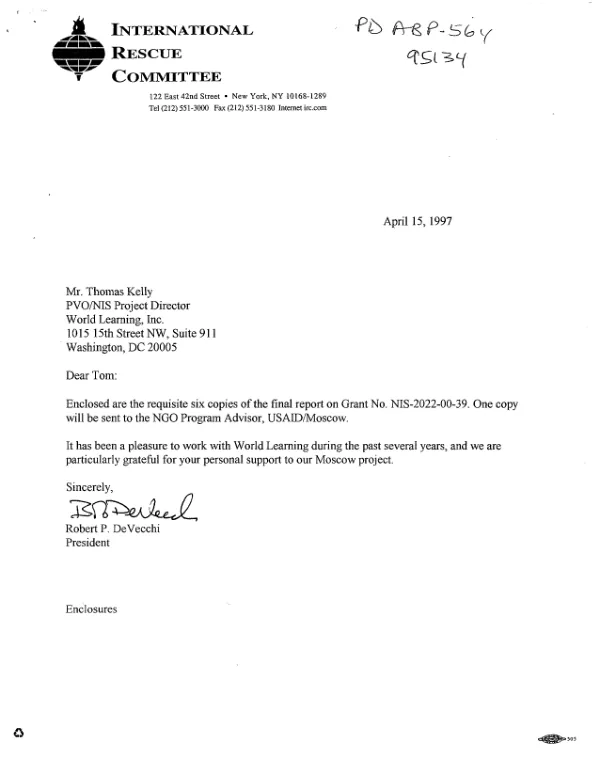
Final project status report : Oct. 1, 1994-Dec. 31, 1996 -- International Rescue committee, Inc. : grant no. NIS-2022-00-39 -- compassion project
Sign inINTERNATIONAL RESCUE COMMITTEE (IRC)
Final project status report : Oct. 1, 1994-Dec. 31, 1996 -- International Rescue committee, Inc. : grant no. NIS-2022-00-39 -- compassion project
Final report of the International Rescue Committee (IRC), on a subgrant from World Learning, Inc., for a program (10/94-12/96) to expand efforts of IRC"s partner institution, the Compassion Center, a Russian NGO, to provide supplementary medical and social support to former political prisoners and other needy residents of the Moscow Region.
1997
Sign in to readA free account is required to download.
Abstract
Goals were met or exceeded in almost all respects. By the end of 1996, the Compassion Center had assisted close to 2,500 clients. Highlights include the following. (1) A total of 1,582 new clients were added to the roles, vs. a target of 1,500. (2) In most quarters, the target of 300 clients served by doctors and home attendants was met. (3) The number of doctors in the program more than doubled. (4) The number of home care attendants was doubled, to 96. (5) While the number of volunteer home care attendants did not reach the target, 12-14 young volunteers from Germany were on the roster at any one time during the period. Efforts to recruit Russian volunteers have been unsuccessful, but continue. Decades of communism have made "volunteer" a bad word. (6) An outpatient unit was opened in a space that also serves as a more efficient base for home care operations. (7) Five of a projected six volunteer American medical specialists visited Moscow, in specialties including orthopedic rehabilitation, clinical psychology, occupational therapy, family practice, and geriatrics. (8) Three of a projected five Russian physicians received training in the United States. (9) A number of items of medical equipment unavailable on the Russian market, such as a portable x-ray machine, were purchased and brought to Moscow. As the country converted to a more or less free market, required drugs could be purchased locally. (10) The Medical Director and the Volunteer Coordinator received training in non-profit management in the United States. More important than the bare numbers was the improvement in patient care, thanks to the increase in the number of specialists and home care attendants. The Compassion Center has become a model for an approach to health care delivery previously unknown in Russia: the team approach, which combines aspects of Western-style home hospice care and visiting nurse agencies. The team, which includes a physician, nurse, or home care attendant, and a social worker and a volunteer, has been developed much like an American hospice team, although the patients, while elderly, are not necessarily terminal. To strengthen this concept, the Home Health Director and the Volunteer Coordinator received 2 weeks of hands-on training at Hospice Care of Rhode Island. IRC has raised about $50,000 from private sources to continue funding the Center until 7/1/97, by which time support from European Union charitable institutions is anticipated. The project"s success in establishing grassroots, non-profit institutions in the country"s emerging private sector has not come easily. Compassion"s board of directors is not as engaged as it should be, local financial backing is hard to find in a society with no tradition of philanthropy outside of the Church, and reliance on volunteers solely from Germany and a few other Western countries is disappointing. In retrospect, some of World Learning"s grant should have been made dependent upon matching funds raised in Moscow in order to spur a greater fund-raising effort by Compassion"s staff. With diminished resources and a leaner operation, Compassion intends to cut back on the number of specialist physicians in the program and concentrate on geriatrics, seeking the cooperation of Moscow hospitals in this growing field. (Author abstract, modified)