USAID DEC
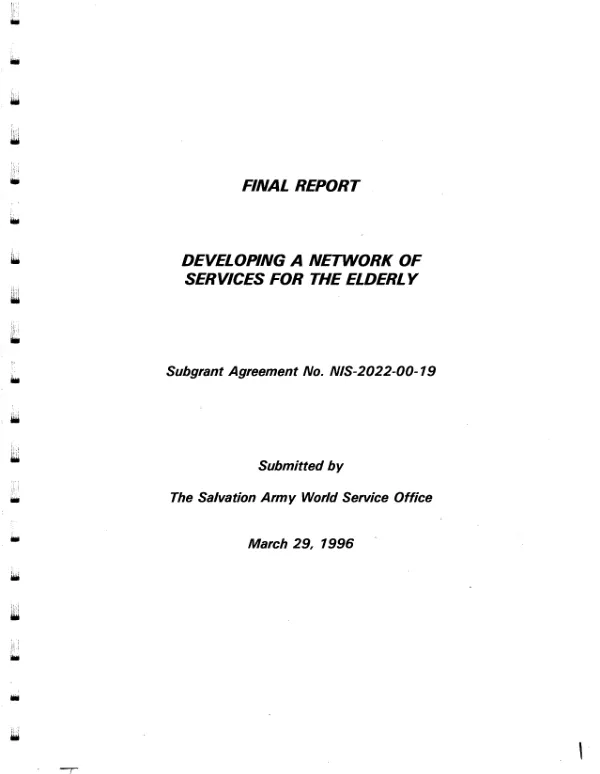
Final report : developing a network of services for the elderly -- subgrant agreement no. NIS-2022-99-19
Sign inSALVATION ARMY WORLD SERVICE OFC.
Final report : developing a network of services for the elderly -- subgrant agreement no. NIS-2022-99-19
Final report of the contractor, Salvation Army World Service Office (SAWSO), on a project (9/93-1/96) to improve the quality and coordination of services provided to the elderly in Russia.
1996
Sign in to readA free account is required to download.
Abstract
The project has made remarkable progress in establishing a service system for the aged and in facilitating the development of NGOs working in the sector. The outcomes of the demonstration effort far exceeded the most optimistic expectations, especially in view of the economic and social transition underway in Russia. Project funds were often used to leverage the initial cooperation of other NGOs. Providing seed money for a collaborative activity often sets the stage for an ongoing partnership. The Training Institute conducted in 1994 in the United States was crucial to the success of the project. Countries unfamiliar with a client-centered service approach have tremendous difficulty in conceptualizing a service systems approach, understanding the interrelationship of service components and the array of services, and visualizing how they are delivered. In addition, collaboration among organizations both hierarchically and horizontally across services is difficult in a society organized and directed by a centralized government. The exposure at the Training Institute to a wide variety of settings and approaches to service delivery helped the participants to see possibilities, and also to apply their own creativity to adapting the concepts to their own environments. A direct result of the Training Institute is the development of the Moscow Council on Aging, which is in the process of becoming an NGO in its own right and which has been instrumental in policy development and service delivery coordination for the aging population. With support from Salvation Army staff, an elected official of the Dhuma will take over chairmanship of the Council. This will improve the success of policy development and advocacy efforts. The Seniors Center and Home Care Programs are serving as models for other NGOs as well as state-run operations. An exchange program has been developed with state centers, and training seminars are offered to both governmental and non-governmental organizations. Additional Home Care Programs will be developed through the Russian Salvation Army. Finally, significant organizational and financial commitments towards institutionalizing the program have been made by The Salvation Army/Russia to ensure the continued availability of services for the poor and frail elderly of Moscow. (Author abstract)
Related documents
Documents in this collection
USAID DEC
Counterpart Foundation, Inc. : final report -- partnership project with Rossiskaya Zabota (Russian Care)
Open record 1997
1997USAID DEC