USAID DEC
Final project report : Novosibirsk Disabled Community Health Clinic -- cooperative program by medical professionals and disabled consumers : grant no. NIS-2022-00-46
Sign inSAN FRANCISCO STATE UNIVERSITY. WHEELED MOBILITY CENTER
Final project report : Novosibirsk Disabled Community Health Clinic -- cooperative program by medical professionals and disabled consumers : grant no. NIS-2022-00-46
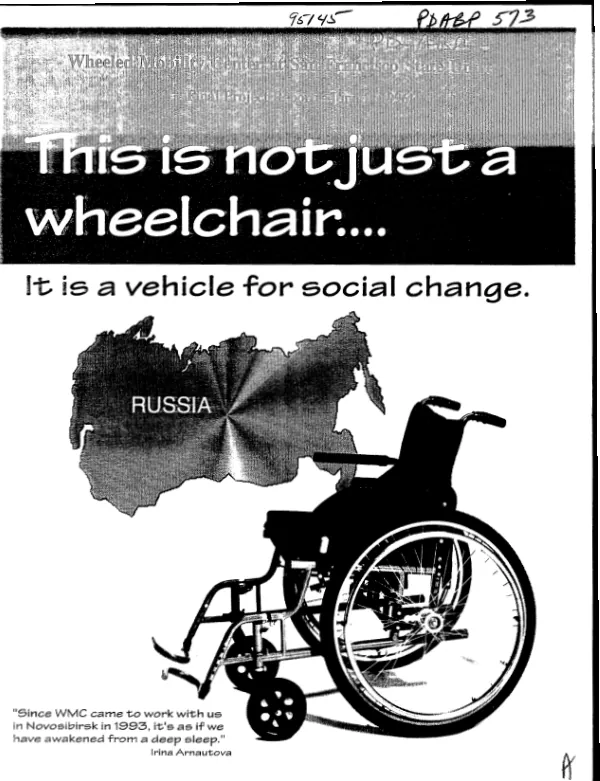
Final report of the contractor, Wheeled Mobility Center of San Francisco State University, on a project (11/94-12/96) to integrate people with disabilities in Novosibirsk, Russia into all aspects of social life.
Krizack, Marc; Bosker, Irena · 1997
Sign in to readA free account is required to download.
Abstract
The project was implemented in collaboration with the Center"s partner, the Novosibirsk Regional Center for Independent Living (FINIST). The project established a wheelchair-accessible Disabled Community Health Clinic (DCHC) in Polyclinic #6 located on the left bank of the Ob River. The clinic, which began operating in 11/95, is open 3 days a week; to date, 197 disabled people have received complete physical examinations and, when necessary, medical treatment. A second DCHC clinic was opened in 5/97 in Polyclinic #27, a more modern and centrally located facility. The project also established a Disability Resource Center at Library for the Blind as the main repository for all disability-related materials, health and otherwise, along with a satellite resource center at Polyclinic #6. In addition, the project translated into Russian or provided existing Russian language practical materials on a wide variety of subjects in such areas as multiple sclerosis, paralysis, reproductive and sexual health, women"s health issues, bowel and bladder control, skin care, aging and disability, and ulcers. Medical training included the training of 3 employees from NIITO (the Trauma Institute), 3 doctors from Polyclinic #6, 4 doctors from the Children"s Rehabilitation Center, 2 doctors from the regional hospital, 2 ambulance doctors, and 2 doctors from the Russian Family Planning Association. The project trained 26 disabled persons (23 of them women) in peer education training techniques. The peer educators, in turn, conducted at least four small-scale seminars for other disability groups and provided individual counseling to peers in the DCHC and NIITO, as well as in people"s homes. In the area of organizational and leadership development, the project held a formal leadership training seminar for members of ARIADNA, FINIST"s women"s sector, with emphasis on team leadership, strategic planning, and public education through the media; supported FINIST sponsorship of a citywide Disabilities Festival; and helped increase ARIADNA"s membership from three active and five occasional members to 12 active members and 40+ members overall. The project provides a model for establishing client-centered health care in the former Soviet Union and in developing countries. Funds for equipment, medical supplies, even doctors" and nurses" salaries were paid directly by FINIST. By funding its partner, which then funded clinic operations, the contractor was able to place its partner in a position of active influence within the clinic. A collateral benefit of the project was the inclusion of disabled women"s sexuality issues in Planned Parenthood of Northern New England"s international program (PPNNE) for the first time. PPNNE"s intention to have a disabled women"s component in all its international work is an immensely positive development for disabled women and should lead to similar projects in developing countries. FINIST appears to be a stable, functioning NGO. ARIADNA has a core leadership group with experience, skills, and self-confidence. The clinic has been functioning for more than a year with significant input from its disabled clientele. Rehabilitation medicine is gaining in prestige, at least among the practitioners who work with the program. The linkup with Hospital #27, with its director"s better political connections, is a hopeful sign for the future.
Related documents
Documents in this collection
 1996
1996USAID DEC
Final project report : wheelchair building in Novosibirsk, Russia -- a comprehensive program of economic and social development : grant no. NIS-2022-00-13
Open record 1996
1996USAID DEC