USAID DEC
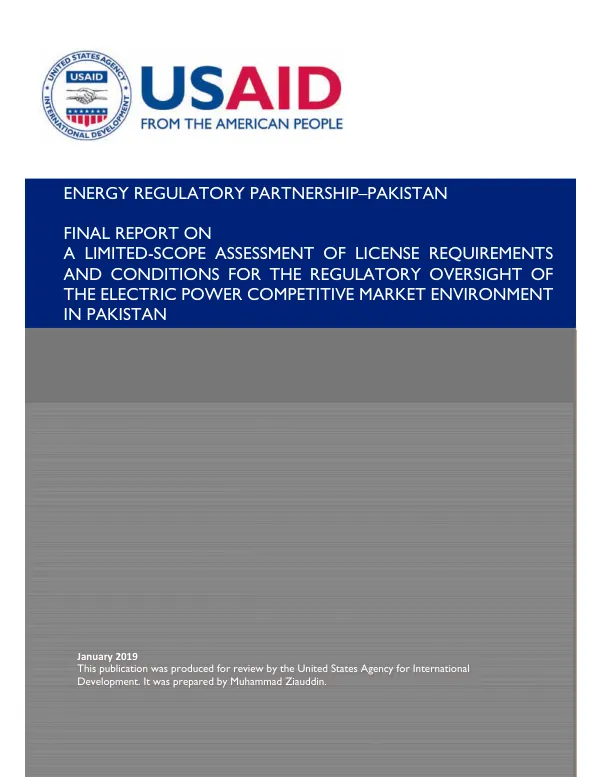
Final Report: A Limited-Scope Assessment of License Requirements and Conditions for the Regulatory Oversight of the Electric Power Competitive Market Environment in Pakistan
Sign inU.S. NATIONAL ASSOCIATION OF REGULATORY UTILITY COMMISSIONERS
Final Report: A Limited-Scope Assessment of License Requirements and Conditions for the Regulatory Oversight of the Electric Power Competitive Market Environment in Pakistan
The Energy Regulatory Partnership–Pakistan conducted a limited-scope assessment of license requirements and conditions for the regulatory oversight of the electric power competitive market environment in Pakistan.
2019 · 85 pages
Sign in to readA free account is required to download.
Abstract
The assessment aimed to explore and provide data on various choices for the development of a competitive market. The study was commissioned by the National Association of Regulatory Utilities Commissioners (NARUC) under USAID funding. The National Electric Power Regulating Authority (NEPRA) was established in 1997 with the mandate to regulate the entire power sector. However, the existing regulatory framework needs to be evolved towards a Market-Based or Divisional structure, where departments/divisions oversee specific segments of the market and cater for the entire lifecycle of a project. The NEPRA Act has already been amended in 2018 to provide legal cover to the Competitive Power Market (CPM). The study reviewed power sector reforms in other countries, including Brazil, Turkey, and the United States. Brazil's electric power market reform and restructuring due to its innovations in developing a competitive market based on the predominance of hydro-electricity is a good example. The reform changed the structure of the Brazilian power sector from being vertically integrated into a significantly unbundled form both vertically and horizontally. As a result, the quality of electricity service in Brazil has generally improved, and post-market restructuring has led to growth in generation capacity, diversification of energy sources, a more robust energy mix, efficiency gains, and labor productivity. Turkey's state-owned monopolized power sector was converted to a competitive market environment in 2013 as the Electricity Market Law (EML) overhauled the electricity legislation in Turkey and provided a basis for a transformed framework for the design and regulation of the market. The law paved the way towards unbundling of state-owned electricity assets, opening of the market for competition above a threshold level of electricity consumption, and also allowed third-party access to the grid. The United States initially had an electricity industry dominated by state-based integrated systems. Congress enacted Public Utilities Regulatory Policies Act (PURPA) in 1978, requiring utilities to purchase electricity from small-scale power producers, including renewable energy and cogeneration projects. This Act opened the monopolistic power market to independent power producers (IPPs). Thereafter, in 1992, the Energy Policy Act was passed, which provided the Federal Energy Regulatory Commission (FERC) the authority to grant transmission licenses on request. A comparison of licensing requirements in competitive power markets was made for Turkey, Brazil, and the United States of America (USA). It reflects that all three countries have a well-established licensing mechanism. In Turkey and Brazil, a national-level regulatory body exists, which practices the licensing system, while in the USA, a mixed system of regulatory authorities exists, i.e., central and state-level regulators. Consultations with CPM's stakeholders, including IPPs, GENCO, System Operator (NPCC), Market Operator (CPPAG), DISCO, and Regulator (NEPRA), were held to seek their opinion and to assess their knowledge, expertise, and environment to work in a CPM model. It was observed that majority of these players have little idea about the government's inclination towards developing a Competitive Power Market (CPM) in Pakistan. However, CPPA-G has started efforts for the formation/development of Comprehensive Competitive Trading Bilateral Contract Market (CTBCM) Plan and had commissioned a study to develop a Market Model Conceptual Design – Road Map for implementation under ADB funding. The assessment is divided into three parts: (A) General Assessment, (B) Assessment of Regulatory Framework, and (C) Assessment of Stakeholders' Knowledge and Expertise. The assessment highlights the need for a thorough study and understanding of the dynamics of the models with special focus on license mechanism, rules, procedures, and issues handling.