USAID DEC
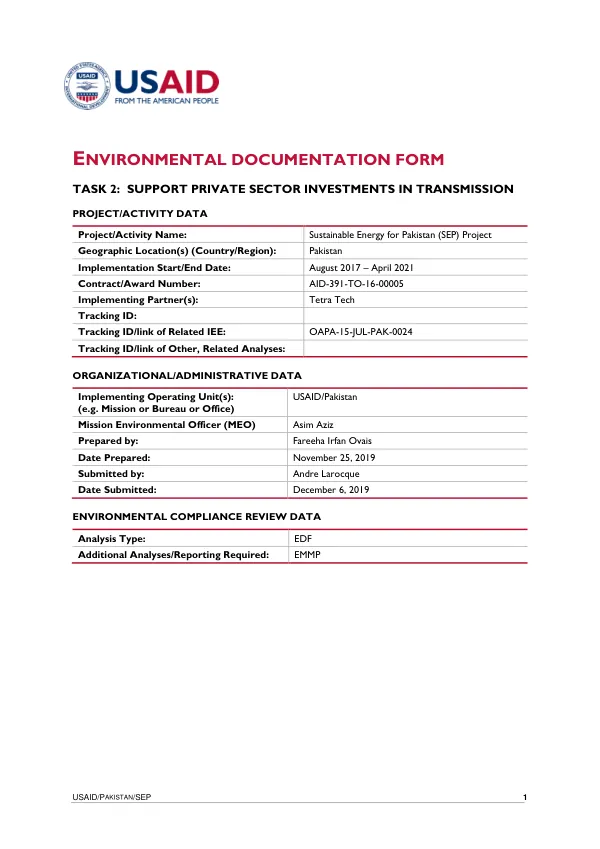
Environmental Documentation Form: Task 2 - Support Private Sector Investments in Transmission
Sign inTETRA TECH
Environmental Documentation Form: Task 2 - Support Private Sector Investments in Transmission
The Sustainable Energy for Pakistan (SEP) Project, implemented by Tetra Tech, aimed to increase private investment in developing transmission facilities in Pakistan.
2019 · 6 pages
Sign in to readA free account is required to download.
Abstract
The project's goal was to mobilize capital for the critically important transmission sector, which would face serious issues related to financing infrastructure development due to the projected increase in customer load and additional generation needed over the next decade. The project's objective was to increase private investment in transmission, with activities including developing documentation and security packages for private participation in transmission facilities and providing assistance on planning private transmission projects. The expected results included leveraging USD 100 million from the private sector, leading to a potential 750 MVA throughput capacity added to the NTDC network, and developing project documents and security packages. The project's primary stakeholders included the Planning Commission, PPIB, and NTDC. The completion date for Task 2 was set for Q2 FY 21. The project's deliverables included preparing project documents and security packages for the issue of an RFP for private transmission facilities by the Government of Pakistan. The project's timeline consisted of several milestones, including the approval of a consulting firm's TOR through the Steering Committee, the approval of a transmission facility as a candidate for private investment, the engagement of a consulting firm for the development of project agreements, and the review and approval of an RFP by the Working Group and Steering Committee. The project's key deliverables were expected to be completed by Q3 FY 20, with the issuance of an RFP by PPIB scheduled for June 2020 and the notification/award to a selected bidder scheduled for December 2020. The project's environmental impact assessment determined that the activities proposed for Task 2 were categorized as very low risk, with no significant adverse impacts expected. The activities included developing a Task Sustainability Plan, finalizing TOR for a consulting firm, and developing project documents and security packages. The project's implementing partner, Tetra Tech, was responsible for ensuring that the activities were carried out in accordance with national and provincial regulations.