PANAGORA GROUP, INC.
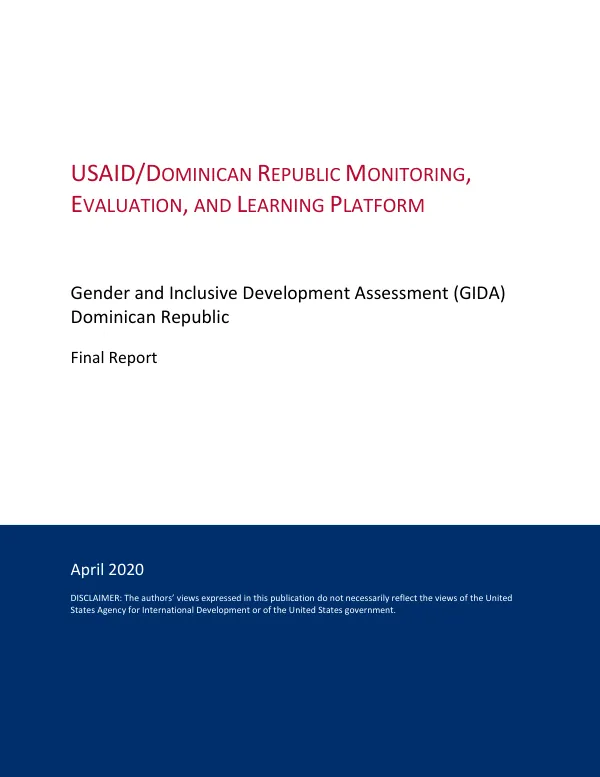
Gender and Inclusive Development Assessment (GIDA) Dominican Republic Final Report
The Gender and Inclusive Development Assessment (GIDA) for the Dominican Republic was conducted in April 2020 by Panagora Group under the USAID Monitoring, Evaluation, and Learning Platform.
2020 · 119 pages
Sign in to readA free account is required to download.
Abstract
The assessment aimed to identify key findings and analysis on gender and inclusive development in the Dominican Republic. The assessment focused on several key areas, including laws, policies, regulations, and institutional practices related to gender and inclusive development. The assessment found that the Dominican Republic has made progress in promoting gender equality, particularly in the areas of education and health. However, significant challenges remain, including high rates of gender-based violence, limited access to economic opportunities for women, and discrimination against lesbian, gay, bisexual, transgender, and intersex (LGBTI) persons. The assessment also examined the experiences of various marginalized groups, including persons of Haitian descent, Venezuelan migrants, persons with disabilities, and those living with HIV/AIDS. The assessment found that these groups face significant challenges, including limited access to education, healthcare, and economic opportunities. The assessment identified several key laws and policies related to gender and inclusive development in the Dominican Republic. These include the Convention on the Elimination of all Forms of Discrimination Against Women (CEDAW), the Convention on the Rights of Persons with Disabilities (CRPD), and the National Plan for the Prevention and Eradication of Human Trafficking and Smuggling. The assessment made several recommendations to bolster gender and inclusive development in the Dominican Republic. These include strengthening laws and policies related to gender and inclusive development, increasing access to education and economic opportunities for marginalized groups, and promoting cultural norms and beliefs that support gender equality. The assessment also highlighted the importance of intersectionality in addressing the needs of marginalized groups. The assessment found that intersectionality is critical in understanding the experiences of persons with disabilities, LGBTI persons, and other marginalized groups. The assessment used a range of data collection methods, including key informant interviews, focus group discussions, and literature reviews. The assessment also used an intersectional approach to analyze the experiences of marginalized groups. Overall, the GIDA assessment provides a comprehensive analysis of gender and inclusive development in the Dominican Republic. The assessment highlights the progress made in promoting gender equality, but also identifies significant challenges that remain. The assessment provides recommendations for strengthening laws and policies related to gender and inclusive development, increasing access to education and economic opportunities for marginalized groups, and promoting cultural norms and beliefs that support gender equality.