USAID DEC
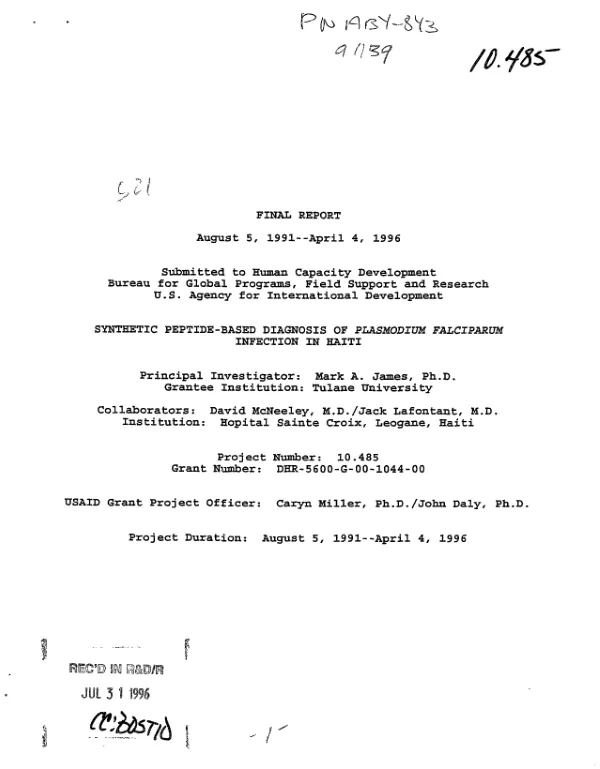
Final report : August 5, 1991-April 4, 1996 -- synthetic peptide-based diagnosis of Plasmodium falciparum infection in Haiti
Sign inHOSPITAL SAINTE CROIX
Final report : August 5, 1991-April 4, 1996 -- synthetic peptide-based diagnosis of Plasmodium falciparum infection in Haiti
The purpose of this project was to develop practical, field-applicable diagnostic tools to aid in the monitoring of malaria endemicity in Haiti.
James, Mark A.; McNeeley, David +1 more · 1996
Sign in to readA free account is required to download.
Abstract
Synthetic peptide-based immunoassays were developed from peptide sequences derived from a 70 kDa Plasomodium falciparum exoantigen; peptides were synthesized and then constructed as a copolymer (Spf70) for diagnostic purposes. Studies on the characterization of Spf70 resulted in a publication (Parasitol. Res., 79: 501-507, 1993) and a US Patent (No. 5,456,911 issued October 10, 1995) which covered the development of this technology. An advantage for international development is that this reagent can also be used to detect P. Vivax malaria. Peptide ELISAs for antibody and antigen detection were standardized in a microplate format, and a rapid latex agglutination test was optimized with SP70 peptides for the detection of anti-P. Falciparum antibodies. Antibody detection assays could serve as useful tools in the epidemiologic surveillance of malaria transmission in Haiti, facilitating and streamlining resources allocated for the malaria control program. Internal political strife in Haiti impeded the progress of the project at several points in its duration; longitudinal field studies could not be carried out as a result. Nonetheless, the project was successful in achieving its scientific goals, and technology was appropriately transferred as the Haitian counterparts and laboratory personnel at the Hospital Sainte Croix, Leogane, Haiti, were trained in methods and procedures developed herein. (Author abstract)
Related documents
Documents in this collection
 1997
1997USAID DEC
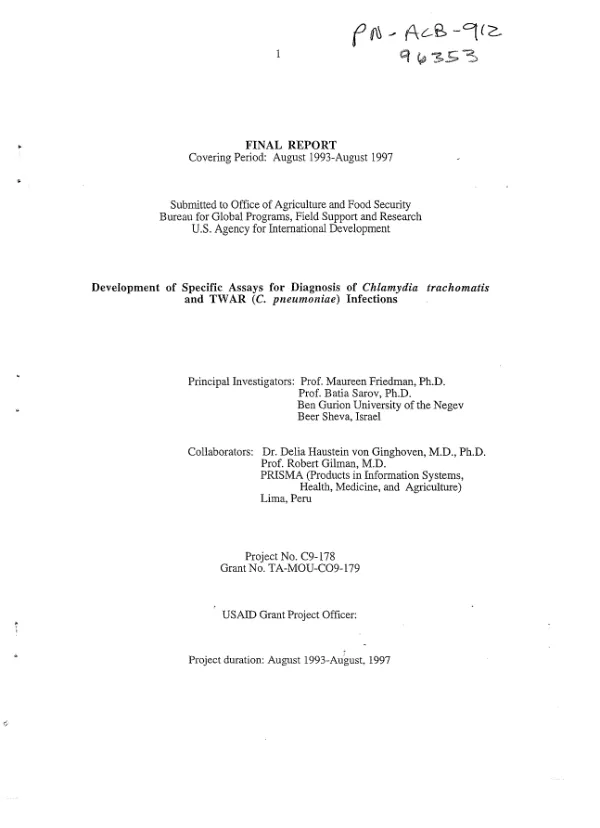
Final report covering period August 1993-August 1997 : development of specific assays for diagnosis of Chlamydia trachomatis and TWAR (C. pneumoniae) infections
Open record 1995
1995USAID DEC