USAID DEC
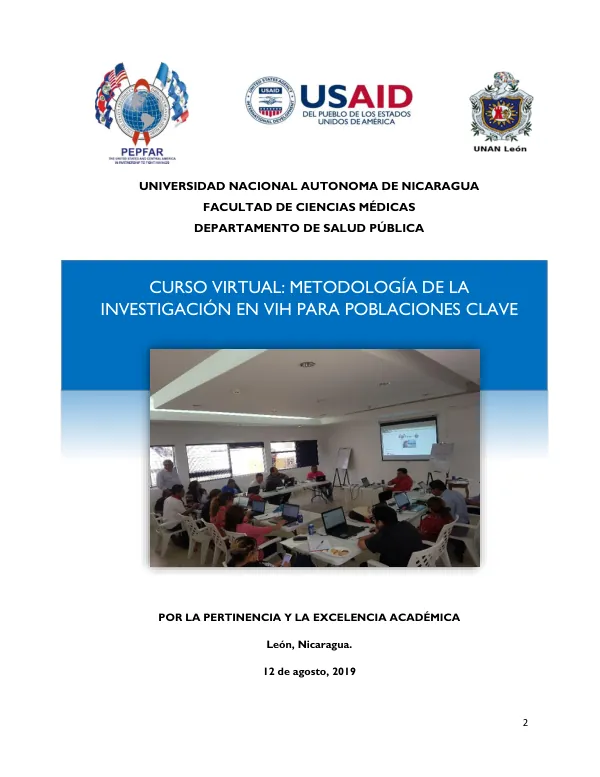
Final Report: Curso Virtual de Metodología de la Investigación en VIH para Poblaciones Clave
Sign inUNIVERSITY RESEARCH CORPORATION CO., LLC
Final Report: Curso Virtual de Metodología de la Investigación en VIH para Poblaciones Clave
The course virtual on methodology of research in HIV for key populations was conducted by the Universidad Nacional Autónoma de Nicaragua, León (UNAN) in collaboration with the Proyecto para la Prevención de la Transmisión del VIH en población clave (PrevenSida) of Nicaragua, and the Agencia de los Estados Unidos para el Desarrollo Internacional (USAID).
2019 · 20 pages
Sign in to readA free account is required to download.
Abstract
The course aimed to improve the capacities of local non-governmental organizations (ONGs) and academic institutions to manage knowledge related to the HIV epidemic in key populations. The course was implemented through a virtual platform, and the general contents of the methodology of research were provided. The academic team worked to organize a course that was friendly to the competencies of the groups and the technical and scientific requirements presented in the terms of reference. The course began in October 2018 and ended in March 2019, with an additional extension period in June and July 2019. During the course, the themes around research focused on the concerns of key populations, such as stigma, discrimination, difficulties of access/coverage, concern for knowledge on prevention, rights to promotion and attention services, non-adherence to treatment, causes of abandonment of the program, among others. Each institution with its members developed a research where they found results or necessary inputs to carry out strategies and organize plans to improve the situation. The participants learned to propose projects that led to the creation of a research protocol, which ultimately became investigations that generated results that will conform strategies for improvement. In this way, the ONGs of key populations appropriated the methodology based on the scientific method, transforming and providing new knowledge. Despite the effort to transmit knowledge for its application, not all participants were able to graduate, which is why a complementary module was created to the course that integrated the knowledge in methodology of research in HIV with the aim of helping those participants who were closer to graduating, having said period complementary a duration of two months (June and July). The present report contains information about the behavior and work carried out by the participants during the course, including the number of students and research projects submitted by country, the number of participants and research projects submitted by round of graduation, and the behavior of the participants in the extension period. The course had a total of 5 tables, which are: Table 1: Cumplimiento de actividades del curso virtual octubre 2018-marzo 2019 (Completion of virtual course activities from October 2018 to March 2019) Table 2: Número de estudiantes e Investigaciones entregados por país octubre 2018-marzo 2019 (Number of students and research projects submitted by country from October 2018 to March 2019) Table 3: Participantes según la ronda de graduación del curso octubre 2018-marzo 2019 (Participants by round of graduation of the course from October 2018 to March 2019) Table 4: Comportamiento de los participantes de extensión del curso junio-julio 2019 (Behavior of the participants in the extension period of the course from June to July 2019) Table 5: Cantidad de estudiantes e Investigaciones entregados por país (Number of students and research projects submitted by country) Table 6: Participantes según la ronda de graduación del curso (Participants by round of graduation of the course) Table 7: Participantes y temas de investigación realizados (Participants and research topics carried out) Table 8: Participantes y temas de investigación realizados en período de extension junio-julio 2019 (Participants and research topics carried out in the extension period from June to July 2019) The course was coordinated by Dr. Gregorio Matus Lacayo, Dr. Javier Zamora Carrión, Dra. Liseth Romero, Dra. Aura Paredes, Dr. Donoso Peñalba, and Dr. Juan Almendárez, among others. The course was supported by the USAID through the PrevenSida project, and the University Research Co. (URC) implemented the project under the cooperative agreement No. AID-524-A-10-00003.
Related documents
Documents in this collection
 2019
2019USAID DEC
Evaluación de las capacidades institucionales en gestión del conocimiento sobre VIH en organizaciones no gubernamentales de poblaciones clave en Centroamérica. Línea de base.
Open record 2019
2019USAID DEC