USAID DEC
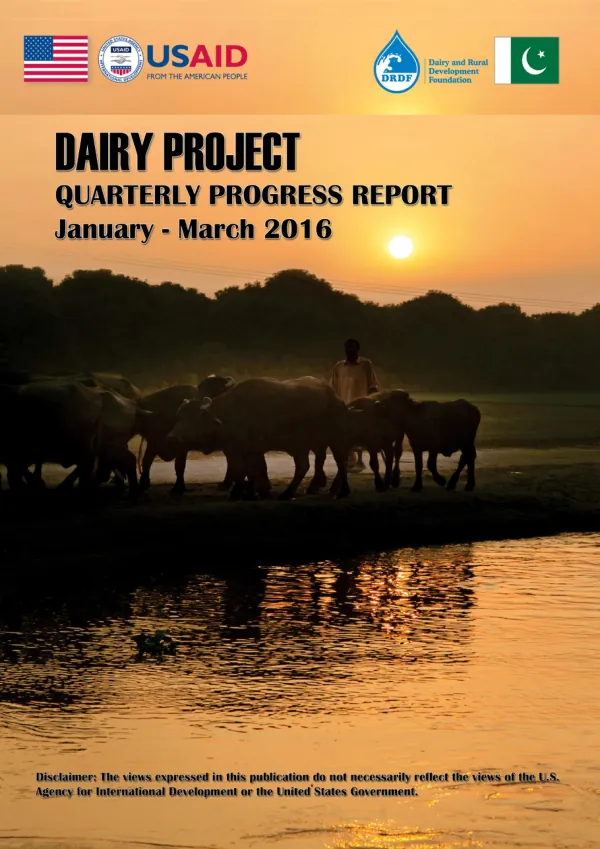
Final Report: Dairy Project, a joint collaboration of the United States Agency for International Development (USAID) and Dairy and Rural Development Foundation (DRDF)
Sign inDAIRY AND RURAL DEVELOPMENT FOUNDATION
Final Report: Dairy Project, a joint collaboration of the United States Agency for International Development (USAID) and Dairy and Rural Development Foundation (DRDF)
The Dairy Project, a joint collaboration of the United States Agency for International Development (USAID) and Dairy and Rural Development Foundation (DRDF), aims to enhance rural incomes by increasing livestock productivity.
2016 · 38 pages
Sign in to readA free account is required to download.
Abstract
In the first three years, the project focused on farmer trainings and adoption of best dairy farming practices. Simultaneously, the project also trained young rural men and women from these farming communities and established them as extension service providers for dairy farmers. The project has trained and established Artificial Insemination Technicians (AITs) and Women Livestock Extension Workers (WLEWs) as key services providers to small farmers at their doorstep. The project also initiated a farm upgradation component in the extension phase to support small/medium level farmers in upgrading their farms. The upgradations involve building easily replicable farm models which can also be used as training and learning centers for surrounding farmers. The project's farm upgradation team works closely with these farms to overcome farm level inefficiencies and improve farm economics. As of 30 March, 2016, the project has provided training to 41,899 dairy farmers, including 518 farm managers and commercial dairy farmers, in best dairy farm practices to help them increase milk productivity and consequently increase their income. In the reporting quarter, the project trained 4,129 farmers. Recent survey data reveals an increase in milk yield per animal of the project trained beneficiaries by 17%. A total of 84 farms have been upgraded till 30 March, 2016 which serve as training and learning centers. A total of 3,856 farmers received one-day training on these upgraded farms in the quarter. The project has also made significant progress in breeding, a crucial pillar in best dairy farming practices. As of March, 2016, the project has trained 2,304 AITs. In this quarter, 110 AITs were enrolled into the six-month training program after a methodical selection process duly monitored by the Monitoring and Evaluation Department. 70 AITs completed the six-month training during this quarter. The AITs were examined by the University of Veterinary and Animal Sciences (UVAS) with successful candidates awarded start-up kits and motorbikes. So far, 1,841 AITs have received motorbikes based on their performance evaluation. Women play a vital role in the informal dairy sector, and the project has made an effort to recognize their role by formally training and establishing them as independent extension service providers. As of March 2016, the project has trained 5,783 WLEWs which are providing services to more than 4,000 nearby villages. These women livestock extension workers (WLEWs) are not only providing much-needed extension services but are also breaking the social barriers in rural societies which discourage women from working in the field. From the trained WLEWs, some outperforming WLEWs are also given refresher courses and the project has provided 839 such WLEWs with refresher training.
Related documents