CHEMONICS
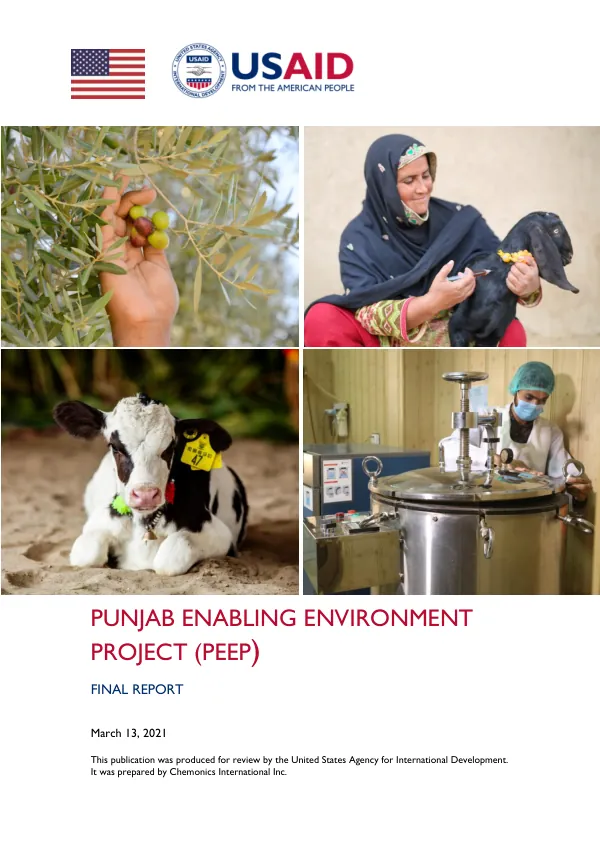
Punjab Enabling Environment Project (PEEP) Final Report
The Punjab Enabling Environment Project (PEEP) was a USAID-funded initiative aimed at improving the business environment in the agriculture sector in Punjab, Pakistan.
2021 · 209 pages
Sign in to readA free account is required to download.
Abstract
The project began in 2014 and concluded in 2018. PEEP's primary objective was to enhance the competitiveness of the agriculture sector by promoting private sector-led growth, improving institutional capacity, and mobilizing major private sector investment. Component I of the project focused on private sector-led advocacy for policy reforms. Core Advocacy Groups (CAGs) were established in the horticulture, livestock, and dairy sectors to promote policy reforms and advocate for the interests of farmers and private sector stakeholders. Roundtable meetings were held to facilitate dialogue between government officials, private sector representatives, and civil society organizations. The project also supported the establishment of a Collateral Management Company to facilitate the Warehouse Receipt System, which aimed to improve access to credit for farmers. Component 2 of the project focused on institutional capacity building. The project supported the development of the Punjab Halal Development Agency (PHDA) and the Center for Applied Policy Research in Livestock (CAPRIL). The project also implemented grants to nine livestock associations and supported the establishment of the Horticulture Business and Policy Research Center at Bahauddin Zakariya University, Multan. Additionally, the project supported the development of the Women Investment in Networks of Dairy Sector (WINDS) program, which aimed to empower women in the dairy sector. Component 3 of the project focused on mobilizing major private sector investment. The project organized investment promotion seminars and provided transaction advisory services to facilitate private sector investment in the agriculture sector. The project also implemented a matching grants program for olive sector development and supported the development of the milk pasteurization sector. Furthermore, the project established the South Punjab Private Sector Engagement Forum to promote private sector engagement in the agriculture sector. The project achieved several key outcomes, including the development of a comprehensive agriculture policy for Punjab, the establishment of a Collateral Management Company, and the implementation of grants to nine livestock associations. The project also supported the development of several research centers and institutions, including the Punjab Halal Development Agency and the Center for Applied Policy Research in Livestock. Additionally, the project promoted private sector investment in the agriculture sector, including the olive sector and the milk pasteurization sector. The project faced several challenges, including resistance from government officials and private sector stakeholders to policy reforms. The project also faced challenges in implementing grants to livestock associations and in promoting private sector investment in the agriculture sector. Despite these challenges, the project made significant progress in improving the business environment in the agriculture sector in Punjab, Pakistan. The project's impact was evaluated through several impact studies, which showed significant improvements in the business environment in the agriculture sector. The project also contributed to the development of several research centers and institutions, which will continue to promote private sector-led growth in the agriculture sector. The project's legacy will be felt for many years to come, as it has laid the foundation for future initiatives to promote private sector-led growth in the agriculture sector in Punjab, Pakistan.
Related documents