DAIRY AND RURAL DEVELOPMENT FOUNDATION
USAID-DRDF Dairy Project Trains Dairy Farmer to Adopt Best Farm Practices
The Dairy Project, a collaborative effort between the United States Agency for International Development (USAID) and Dairy and Rural Development Foundation (DRDF), aims to improve the lives of rural dairy farmers in Punjab, Pakistan.
2012 · 8 pages
Sign in to readA free account is required to download.
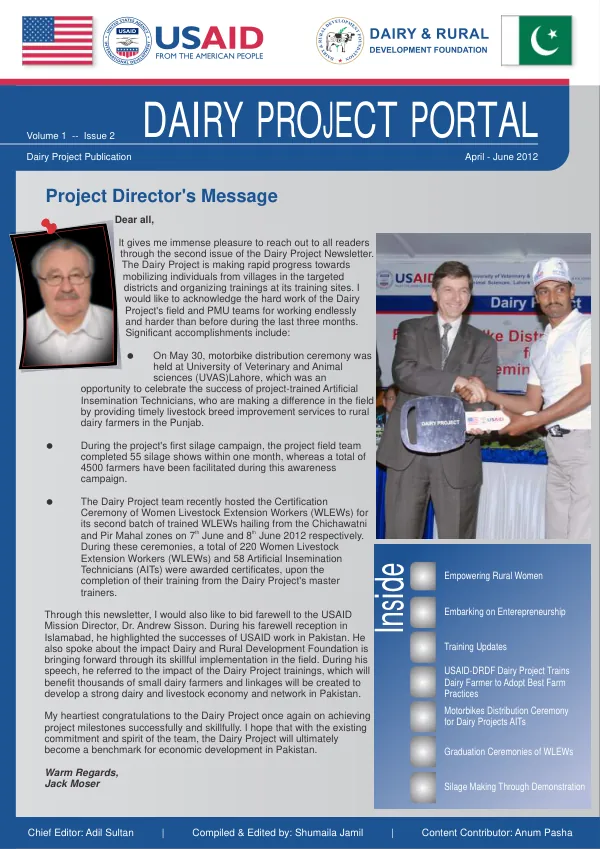
Abstract
The project focuses on providing training and support to individuals from villages in the districts of Punjab, enabling them to become Artificial Insemination Technicians (AITs) and establish their own businesses. One of the key interventions of the Dairy Project is the training of Women Livestock Extension Workers (WLEWs). These women are trained to provide animal health care and disease prevention services to dairy farmers in their villages. Bushra Yasmeen, a WLEW, shares her experience of participating in the USAID-DRDF Dairy Project's training course. She explains that prior to the training, she was unemployed and struggled to earn a living. However, after completing the course, she was able to set up a clinic and provide animal health care services to dairy farmers in her village. The Dairy Project also provides training in Artificial Insemination (AI) techniques to individuals from villages in Punjab. Ali Muhammad, a beneficiary of the project, shares his experience of participating in the AI training course. He explains that he was initially apprehensive but decided to pursue the training after meeting the Dairy Project team. Muhammad was able to pass the exam and was provided with a kit, including nitrogen gas for safe storage of semen. He began working as an AIT and has attended over 100 artificial insemination cases, earning an average income of 12,000 rupees per month. The Dairy Project's efforts have led to significant improvements in the lives of rural dairy farmers. The project's performance evaluation revealed that Muhammad has impregnated cows at a 100 percent success rate through artificial insemination. Due to his high performance, he was awarded a motorbike, which has enabled him to expand his AI services and attend more artificial insemination cases. The Dairy Project's goal is to improve the lives of many other young individuals with the target of training and supporting 2000 individuals to become AITs and entrepreneurs working towards breed improvement in Pakistan. With better milk yield and better incomes, Pakistan's dairy sector is expected to see a significant improvement. The project's impact extends beyond the individuals who have benefited from the training and support. The Dairy Project has also created a network of AITs and WLEWs who are working together to improve the lives of rural dairy farmers. This network has the potential to create a ripple effect, leading to a more sustainable and prosperous dairy sector in Pakistan. The Dairy Project's success is a testament to the power of collaboration and innovation. By providing training and support to individuals from villages in Punjab, the project has empowered them to take control of their lives and improve their lives and incomes. The project's focus on animal health care and disease prevention has also led to significant improvements in the lives of rural dairy farmers. The Dairy Project's achievements are a result of the hard work and dedication of the project team, including the field and management teams. The project's progress has been significant, with over 55 silage shows conducted in one month, and 4500 farmers facilitated during the awareness campaign. The project's impact is not limited to the individuals who have benefited from the training and support. The Dairy Project's efforts have also led to the creation of a network of AITs and WLEWs who are working together to improve the lives of rural dairy farmers. This network has the potential to create a ripple effect, leading to a more sustainable and prosperous dairy sector in Pakistan. The project's achievements are a result of the hard work and dedication of the project team, including the field and management teams
Related documents
Documents in this collection
 2016
2016USAID DEC
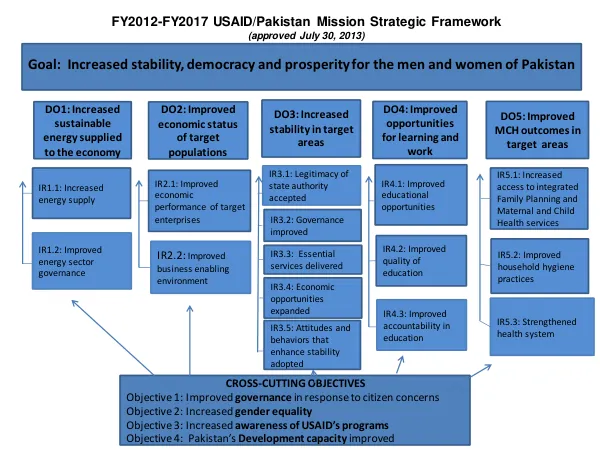
CROSS-CUTTING OBJECTIVES for Pakistan
Open record 2019
2019USAID DEC