USAID DEC
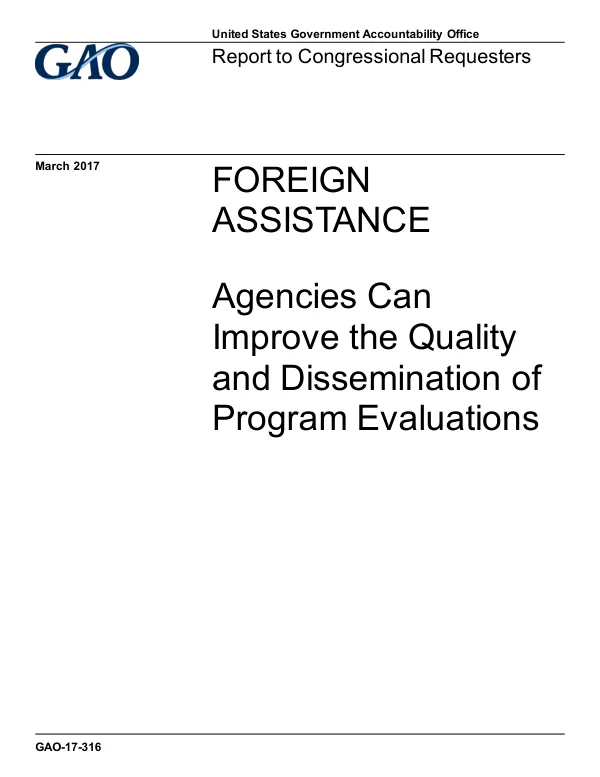
Final Report: FOREIGN ASSISTANCE Agencies Can Improve the Quality and Dissemination of Program Evaluations
Sign inU.S. GOVERNMENT ACCOUNTABILITY OFFICE
Final Report: FOREIGN ASSISTANCE Agencies Can Improve the Quality and Dissemination of Program Evaluations
The U.S.
2017 · 88 pages
Sign in to readA free account is required to download.
Abstract
government plans to spend approximately $35 billion on foreign assistance in 2017. Evaluation is an essential tool for U.S. agencies to assess and improve the results of their programs. Government-wide guidance emphasizes the importance of evaluation, and the Foreign Aid Transparency and Accountability Act of 2016 requires the President to establish guidelines for conducting evaluations. However, evaluations can be challenging to conduct, and GAO has previously reported on challenges in the design, implementation, and dissemination of the evaluations of individual foreign assistance programs. An estimated 73 percent of evaluations completed in fiscal year 2015 by the six U.S. agencies GAO reviewed generally or partially addressed all of the quality criteria GAO identified for evaluation design, implementation, and conclusions. Agencies met some elements of the criteria more often than others. For example, approximately 90 percent of all evaluations addressed questions that are generally aligned with program goals and were thus able to provide useful information about program results. About 40 percent of evaluations did not use generally appropriate sampling, data collection, or analysis methods. Evaluation costs ranged widely and were sometimes difficult to determine, but the majority of evaluations GAO examined cost less than $200,000. Millennium Challenge Corporation (MCC) evaluations had a median cost of about $269,000, while median costs for the U.S. Agency for International Development (USAID), the U.S. Department of Agriculture (USDA), and the Department of State (State) ranged from about $88,000 to about $178,000. High-quality evaluations tend to be more costly, but some well-designed lower-cost evaluations also met all quality criteria. Agencies generally posted and distributed evaluations for the use of internal and external stakeholders. However, shortfalls in some agency efforts may limit the evaluations' usefulness. Public posting was a challenge, with USDA not developing procedures for reviewing and preparing its evaluations for public posting. Timeliness was also an issue, with some HHS reports and more than half of MCC reports posted a year or more after completion. Dissemination planning was also a concern, with State not currently having a policy requiring a plan that identifies potential users and the means of dissemination. GAO recommends that each of the six agencies develop a plan to improve the quality of its evaluations and that HHS, MCC, State, and USDA improve their procedures and planning for disseminating evaluation reports. The agencies concurred with our recommendations.