USAID
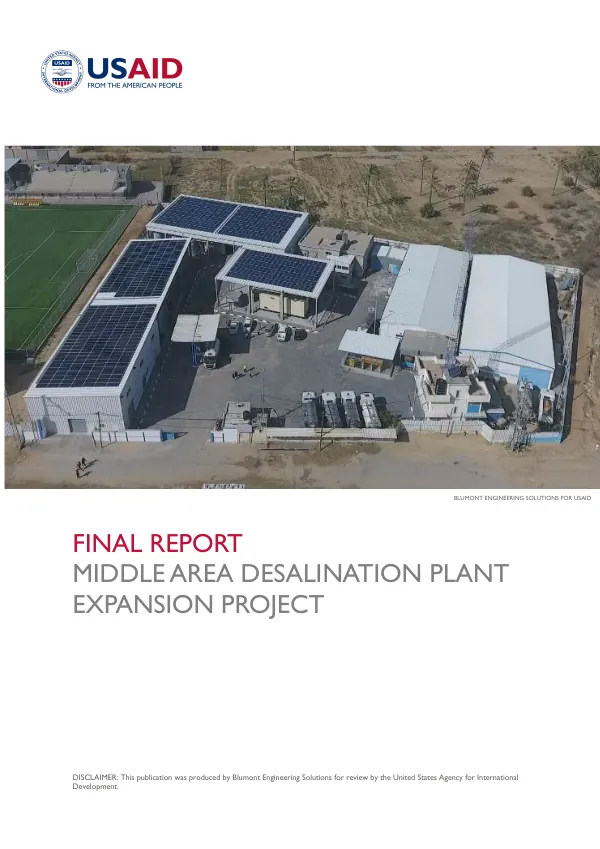
Final Report: Middle Area Desalination Plant Expansion Project
The Middle Area Desalination Plant Expansion Project is a large-scale infrastructural project located in the Middle Area Governorate of the Gaza Strip.
2019 · 550 pages
Sign in to readA free account is required to download.
Abstract
The project aimed to expand the existing 2,600 cubic meters per day Middle Area Desalination Plant by 3,400 cubic meters per day of treated potable water. The new desalination plant has a capacity of 3,400 cubic meters per day and is located within the boundaries of the existing operating desalination plant. The project scope included the construction of new seawater intake beach well, intake pipeline, brine discharge pipeline, outfall and diffuser system, workshop area, pretreatment building system, RO building systems, chemical system, treated water system, electromechanical equipment, and desalinated drinking water conveyance to an existing blending and storage reservoir for further distribution to the middle area. The project also included commissioning and ongoing training for 180 days following successful completion of the Performance Acceptance Testing. The project was awarded to Blumont Engineering Solutions (BES) on September 27, 2016, with a Notice to Proceed (NTP) received on November 16, 2016. The original completion date was January 04, 2019, with an original duration of 780 calendar days. However, due to USAID's cessation notification, the project completion date was revised to January 31, 2019. The Final Acceptance Certificate and Construction Site Handover were signed and issued on January 30, 2019. The project site is bordered by a small stadium and mosque to the west, agricultural land and palm orchard to the south, existing desalinated water tank to the east-north, and palm trees to the north-east. The nearest house is located 100m to the south of the proposed site. The project was constructed in accordance with the USAID Mission Infrastructure Needs Program II (INP II) guidelines, which focuses on large-scale infrastructural projects in the West Bank and Gaza. The project's construction activities started on January 19, 2017, with the start of demolition works. The project's original duration was 780 calendar days, but due to excusable delays and approved extensions, the final modified project duration was 807 calendar days. The total excusable delays and approved extensions were 177 days, with an accumulated working day of 651 calendar days and an accumulated non-working day of 121 calendar days. The project's construction involved various activities, including site preparation, civil works, electromechanical works, and commissioning. The project's construction was carried out in accordance with the USAID guidelines and regulations, with regular site visits and inspections conducted by the USAID representatives. The project's construction was also subject to various quality control and quality assurance measures to ensure that the project was constructed to the required standards. The project's commissioning and ongoing training were carried out in accordance with the USAID guidelines and regulations. The project's commissioning was completed on January 30, 2019, with the Final Acceptance Certificate and Construction Site Handover signed and issued on the same day. The project's ongoing training was carried out for 180 days following the successful completion of the Performance Acceptance Testing. The project's construction was carried out by BES, with various subcontractors and suppliers involved in the project. The project's construction was subject to various risks and challenges, including delays, cost overruns, and quality control issues. However, the project's construction was ultimately completed to the required standards, with the project's commissioning and ongoing training carried out successfully. The project's impact on the local community was significant, with the project providing a reliable source of potable water to the residents of the Middle Area Governorate. The project's construction also created employment opportunities for the local residents, with various construction workers and laborers involved in the project. The project's construction also contributed to the local economy, with various materials and equipment sourced from local suppliers. In conclusion, the Middle Area Desalination Plant Expansion Project was a significant infrastructural project that aimed to expand the existing 2,600 cubic meters per day Middle Area Desalination Plant by 3,400 cubic meters per day of treated potable water. The project was constructed in accordance with the USAID guidelines and regulations, with various quality control and quality assurance measures in place to ensure that the project was constructed to the required standards. The project's commissioning and ongoing training were carried out successfully, with the project's impact on the local community significant.
![A guide to preparing planning budgets and operating and maintenance budgets for drinking water and sanitation companies [Arabic]](https://covers.devme.ai/gen/138315.webp)