USAID DEC
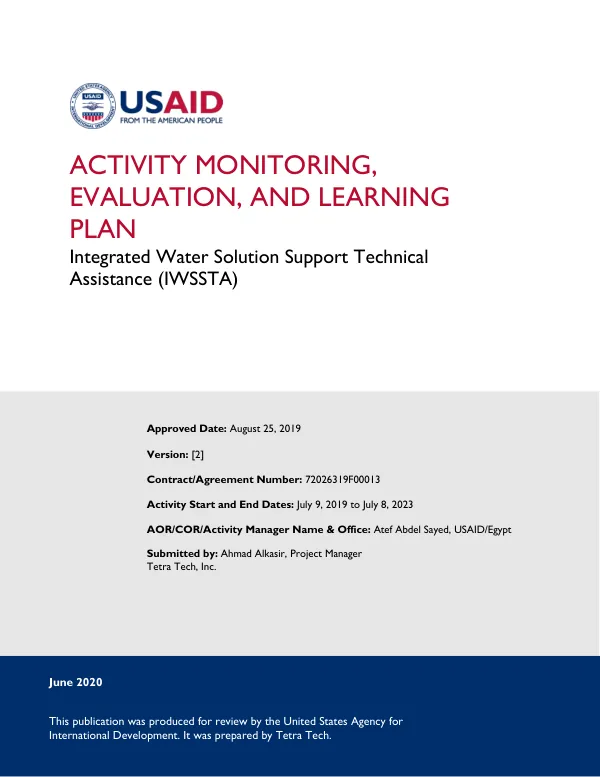
Activity Monitoring, Evaluation, and Learning Plan - Integrated Water Solution Support Technical Assistance
Sign inTETRA TECH
Activity Monitoring, Evaluation, and Learning Plan - Integrated Water Solution Support Technical Assistance
The Integrated Water Solution Support Technical Assistance (IWSSTA) Activity is a four-year project funded by the United States Agency for International Development (USAID) under the Making Cities Work Indefinite Delivery/Indefinite Quantity (MCW IDIQ) contract.
2020 · 66 pages
Sign in to readA free account is required to download.
Abstract
The project began on July 9, 2019, and aims to increase access to clean water and sanitation for Upper Egypt's rural population. IWSSTA is designed to strengthen the capabilities of Egypt's Holding Company for Water and Wastewater (HCWW) and its subsidiaries to implement recent Government of Egypt (GOE) initiatives aimed at improving the operational performance and financial sustainability of the water and wastewater sector (WWS). The project focuses on five Water and Sanitation Companies (WSC) in Minia, Assiut, Sohag, Qena, and Luxor, and targets four pillars within each WSC: operational efficiency, asset management, quality of service, and cost recovery. The contract provides eight expected results (ERs), which include full coverage of operation and maintenance costs, increased coverage of repair and replacement costs, improved operational efficiency, full automation of asset management systems, increased revenue from water and wastewater tariffs, improved collection of water and wastewater fares, reduced unaccounted water from leakage and illegal connections, and development of a sustainability and replicability plan. IWSSTA will use a variety of quarterly and annual indicators to track progress of the eight expected results and the overall progress. The Monitoring, Evaluation, and Learning (MEL) Plan outlines the overall approach to monitoring and evaluation, including the phases of monitoring, performance monitoring, context monitoring, internal evaluations, plans for collaborating with external evaluators, and learning activities. The MEL Plan identifies the roles and responsibilities of key stakeholders, including the Activity Manager, Deputy Chief of Party, and Contract Officer Representative. The plan also outlines the resources required to implement the MEL Plan, including personnel, equipment, and budget. The project will use a range of tools and techniques to collect and analyze data, including data quality assessments, focus group discussions, and performance indicator reference sheets. The MEL Plan outlines the procedures for reviewing and managing data, including data validation, data cleaning, and data analysis. The project will also conduct internal evaluations to assess progress towards the expected results and to identify areas for improvement. The MEL Plan outlines the procedures for conducting internal evaluations, including the development of evaluation questions, data collection, and data analysis. The project will also collaborate with external evaluators to conduct independent evaluations of the project's progress and impact. The MEL Plan outlines the procedures for collaborating with external evaluators, including the development of evaluation questions, data collection, and data analysis. The project will also conduct learning activities to identify lessons learned and to share best practices with stakeholders. The MEL Plan outlines the procedures for conducting learning activities, including the development of learning questions, data collection, and data analysis. Overall, the MEL Plan provides a comprehensive framework for monitoring and evaluating the IWSSTA Activity, and for learning from the project's experiences and successes.
Related documents
![A guide to preparing planning budgets and operating and maintenance budgets for drinking water and sanitation companies [Arabic]](https://covers.devme.ai/gen/138315.webp)