MID-AMERICA INTERNATIONAL AGRICULTURAL CONSORTIUM
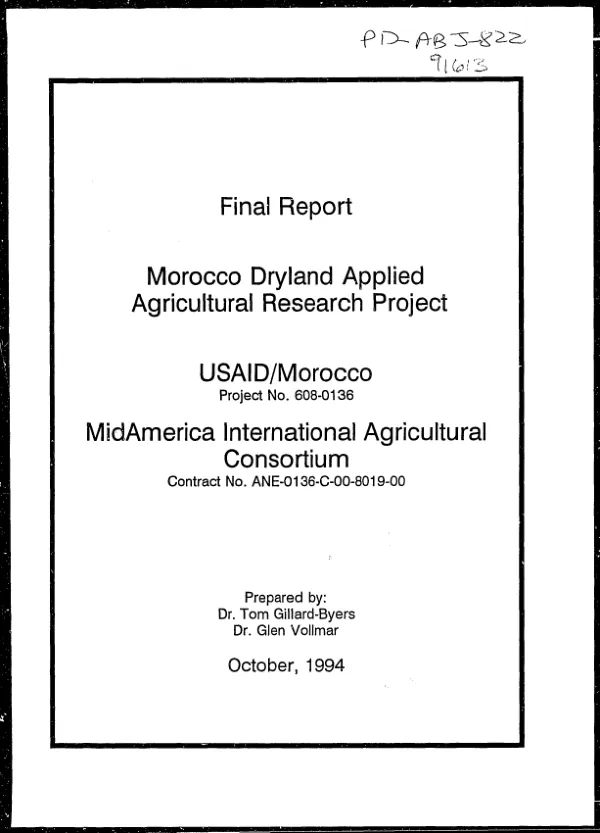
Final report : Morocco dryland applied agricultural research project
Final contractor report on a project to develop Morocco"s dryland agricultural research capability.
Gillard-Byers, Tom; Vollmar, Glen · 1994
Sign in to readA free account is required to download.
Abstract
The project has been implemented by the Mid-America International Agricultural Consortium (University of Nebraska-Lincoln, with the assistance of Iowa State University, Kansas State University, the University of Missouri, and Oklahoma State University). The evaluation covers the period 1980-10/94. The project"s goal, to develop a dryland research center with Moroccan leadership and management, culminated in a highly successful Dryland Agriculture Research Workshop held in Rabat, May 24-27, 1994. The workshop was planned and implemented by Moroccan administrators, scientists, and technicians. The objective of the project was the establishment of a dryland research center in the semiarid area of Morocco at Settat. The environment poses a challenge for crop production in this area because the rainfall is relatively low and extremely variable from year to year. Soils vary greatly in productivity. The center provides a research base that contributes to Morocco"s food grain supply and enhances an economy made up of mostly small farmers, who are located in an approximate 23,000 square mile area. It was also anticipated that there would be impacts in U.S. agricultural areas where water and soil management are similar and where there are similar constraints to food grain and forage production, such as insects and plant diseases. The project involved planning, construction, and program implementation for 14 laboratories, a greenhouse complex, 4 research substations, a technology transfer center, and service facilities. Some irrigation equipment was installed in order to insure against the loss of germplasm and to evaluate irrigation strategies which could make the best use of limited supplies of water. Human resource input was vital to the project"s success. Seventy Moroccan participants were trained at the graduate degree level to fill scientist and research management roles. In addition, 171 Moroccans participated in short-term non-degree programs for technical support roles. TA to the project was provided by 87 short- and long-term consultants from U.S. research institutions and international research centers. The end result is a dryland research center that is Moroccan managed and staffed and has the capacity for quality research programs that are applicable to the dryland farming areas of Morocco. In addition, the research center has the potential to form linkages with research institutions around the world. Its operations also benefit areas with similar climatic and soil characteristics, especially in other North African nations. The center has the leadership, scientific staff, support staff, and infrastructure to design and follow through with a research agenda capable of making a difference in the dryland farming economy and the Moroccan food supply. The framework to conduct on-station and on-farm research has been established. Technology transfer of research-based information to farmers in the dryland area is an important aspect of the overall program effort. The project has the socioeconomic capability to guide the development of research agendas and to monitor and evaluate the impacts of new technologies developed at the center. One study reported that the economic return to the research investment in the development of new wheat varieties resistant to Hessian fly damage was 39%. The project has had an impact on wheat production in the United States. The research on Hessian fly resistant wheat varieties, Russian wheat aphid, and the introduction of new wheat germplasm are of interest to the U.S. wheat industry. There has also been an indication that cooperation with Morocco has contributed to Morocco"s importation of U.S.-produced wheat to meet its bread wheat deficit. (Author abstract)
Related documents
![Final report : EPIQ [environmental policy and institutional strengthening indefinite quantity contract] Slovakia -- environmental policy component](https://covers.devme.ai/gen/32363.webp)