USAID DEC
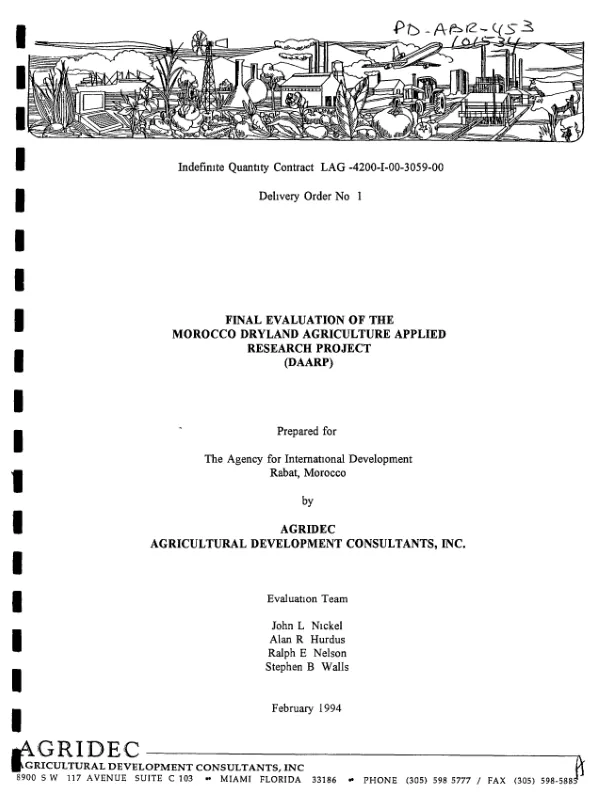
Final evaluation of the Morocco dryland agriculture applied research project (DAARP)
Sign inAGRICULTURAL DEVELOPMENT CONSULTANTS, INC.
Final evaluation of the Morocco dryland agriculture applied research project (DAARP)
Final evaluation of a project to develop a center for applied research on rainfed agriculture production in the dryland areas of Morocco (DAARP project).
Nickel, John L.; Hurdus, Alan R. · 1994
Sign in to readA free account is required to download.
Abstract
The major implementing agency was the MidAmerica International Consortium (MIAC). The evaluation covers the period 1977-2/94 against a PACD of 8/94. Major project achievements are as follows: (1) A functioning and sustainable research center (Aridoculture Center), along with four satellite research stations, capable of generating technology for dryland agriculture has been developed. This center will serve as a model for other National Agricultural Research Institute (INRA) centers as INRA pursues its goal of decentralization. (2) A critical mass of highly-skilled and motivated scientific staff has been trained. By the end of the project, 61 INRA staff will have received higher degree training in the United States, 45 at the Ph.D. level. In addition, non- degree training, both in the United States and at the Center, has upgraded skills in areas such as research station management, research planning and budgeting, rapid rural appraisal, technology transfer, human resources management, financial management, and equipment maintenance. (3) Substantial progress has been made in the planning, prioritization, and evaluation of research activities, based on an assessment of production constraints faced by farmers. This process is still incomplete, however, especially regarding the prioritization of research projects and their linkage to resource allocation. (4) Effective linkages have been forged between technology generation and technology transfer. (5) A useful body of knowledge, indicated in part by an impressive list of publications, has been generated on dryland agriculture, including socioeconomic data on low- resource farmers in the region and the production constraints they face. (6) An impressive volume of technology in terms of improved varieties and agronomic practices has been generated. Farming equipment suitable for small and medium-scale farmers in dryland areas has been developed and to some extent adopted, though it is too early to expect a change in national production figures. Two sets of actions that need to be taken after the PACD are described: (1) General areas that need attention, irrespective of the funding source, to ensure institutional sustainability include: equipment maintenance; linkages with the international scientific community; in-service training; and improved access to scientific information. (2) Specific actions that should be supported by USAID after the PACD are, in order of declining priority: completion of course work by Ph.D. students still in the United States; facilitation of continued linkages between Regional Research Center (CRRA) Settat staff and MIAC universities; a study on the development of a national agricultural science documentation service; additional work to identify problems and prioritize research; collaborative research on sustainability and natural resources management issues; an assessment of the impact of Center-developed technologies; collaborative research on integrated pest management; policy analyses; provision of stand-by electric power facilities; continued assistance in development of a research planning and monitoring system; and procurement of publications and compact disks for the Center"s Technical Reference Center and the national documentation service. Lessons learned are divided into three parts: (1) Positive elements of project design and execution include: a long-term commitment for agricultural research and institution- building; involvement of U.S. universities in agricultural institution-building projects; thesis research conducted in the host country; and management training. (2) Components that should have been done earlier in the project include: baseline studies on farming systems and socioeconomic indicators in the target region; program planning by objectives; human resources needs assessment based on program planning; and attention to post-PACD needs. (3) Actions that might have been done better include: phasing of project to provide for an orderly end-of project transition, with less or no TA in the latter years; more on-farm research, with farmer feedback loops; integration of project activities with those of other donors; site selection of the Center; integration of project activities with those of the host center; and timing of equipment purchases. (Author abstract, modified)