TEXAS A&M INTERNATIONAL UNIVERSITY
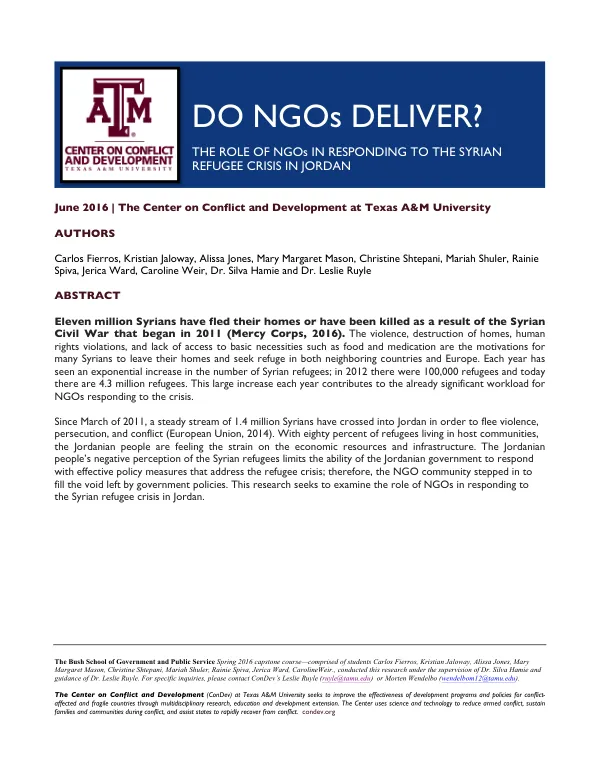
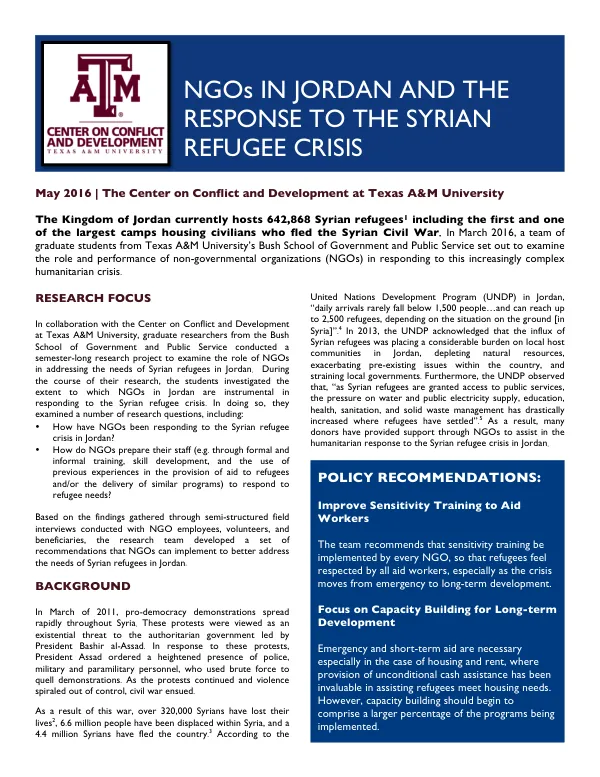
Final Report: NGOs in Jordan and the Response to the Syrian Refugee Crisis
The Kingdom of Jordan hosts 642,868 Syrian refugees, including those in the first and one of the largest camps housing civilians who fled the Syrian Civil War.
2016 · 3 pages
Sign in to readA free account is required to download.
Abstract
In March 2016, a team of graduate students from Texas A&M University's Bush School of Government and Public Service conducted a research project to examine the role and performance of non-governmental organizations (NGOs) in responding to the Syrian refugee crisis in Jordan. The research team investigated the extent to which NGOs in Jordan are instrumental in addressing the needs of Syrian refugees. They examined a number of research questions, including how NGOs have been responding to the Syrian refugee crisis in Jordan and how they prepare their staff to respond to refugee needs. The team conducted semi-structured field interviews with NGO employees, volunteers, and beneficiaries, and developed a set of recommendations for NGOs to better address the needs of Syrian refugees in Jordan. The Syrian Civil War began in March 2011, with pro-democracy demonstrations spreading rapidly throughout the country. The war has resulted in over 320,000 deaths, 6.6 million people displaced within Syria, and 4.4 million Syrians fleeing the country. The influx of Syrian refugees has placed a considerable burden on local host communities in Jordan, depleting natural resources, exacerbating pre-existing issues, and straining local governments. NGOs in Jordan have been instrumental in responding to the Syrian refugee crisis, with many establishing program quality control systems, individual and targeted needs assessments, and internal reporting mechanisms. However, the team's findings indicate that NGOs also face three major challenges: coordination, psychological preparation and training, and transitioning to long-term development programs. Coordination between NGOs and with the Jordanian government was frequently cited as a challenge during interviews. Many NGOs have difficulty gaining access to information from the government, and some have reported duplication of efforts. Psychological preparation and training are also a concern, with burnout and sensitivity while interacting with refugees being major issues. The team recommends that sensitivity training be implemented by every NGO to ensure that refugees feel respected by all aid workers. Transitioning to long-term development programs is also a challenge for NGOs. Many have had difficulty deciding on whether to treat the crisis as an emergency response or as a long-term development program. The Jordanian government has made progress in this direction by offering a three-month grace period for Jordanian employers to obtain work permits for Syrian refugee employees in specific sectors. However, NGOs will have to play a major role in developing programs and projects that can assist in building refugees' capacity to live independently in Jordan. The team's recommendations for NGOs include improving sensitivity training to aid workers, focusing on capacity building for long-term development, and transitioning to more sustainable mid- and long-term development programs. The research team's findings highlight the need for NGOs to address the challenges of coordination, psychological preparation and training, and transitioning to long-term development programs in order to effectively manage the protracted humanitarian crisis in Jordan.