TEXAS A&M INTERNATIONAL UNIVERSITY
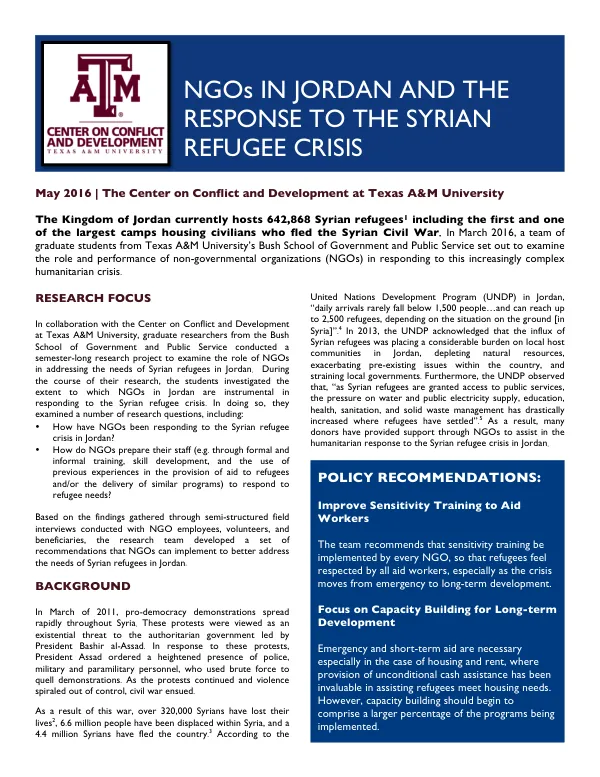
The Role of NGOs in Responding to the Syrian Refugee Crisis in Jordan
The Syrian Civil War, which began in 2011, has resulted in the displacement of 11 million Syrians, with 4.3 million refugees currently residing in neighboring countries and Europe.
2016 · 41 pages
Sign in to readA free account is required to download.
Abstract
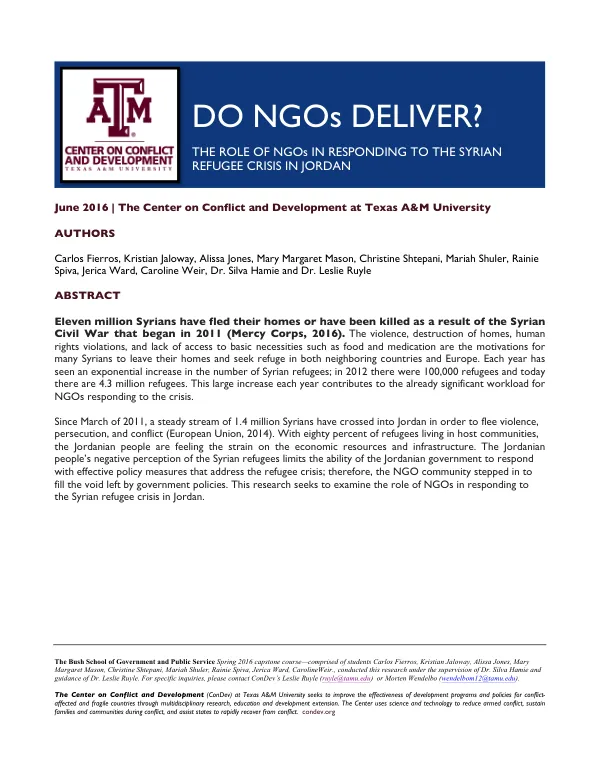
The violence, destruction of homes, human rights violations, and lack of access to basic necessities such as food and medication have driven many Syrians to flee their homes in search of refuge. The number of Syrian refugees has increased exponentially each year, with 100,000 refugees in 2012 and 4.3 million refugees today, placing a significant burden on NGOs responding to the crisis. NGOs play a crucial role in meeting the basic needs of refugees, including providing food, clothing, and shelter, as well as medical care and access to clean water. Funding is required to support these efforts, and NGOs have stepped in to fill the void left by government policies in responding to the refugee crisis. In Jordan, where 1.4 million Syrians have crossed into the country since March 2011, the NGO community has taken on a significant role in addressing the needs of refugees. The research conducted by students from the Bush School of Government and Public Service at Texas A&M University, under the supervision of Dr. Silva Hamie and guidance of Dr. Leslie Ruyle, aimed to examine the role of NGOs in responding to the Syrian refugee crisis in Jordan. The study sought to answer key questions, including how NGOs have been responding to the crisis, whether an NGO's area of operations and activities affect their performance, and how NGOs prepare their staff to respond to refugee needs. The research methodology involved a qualitative approach, including interviews with program managers, country directors, project managers, field officers, and refugees. The study also examined the operations of NGOs, including their emergency and development responses, referral processes, needs assessments, training, burnout and psychological support, funding, coordination, and refugee perceptions. The findings highlighted the successes and challenges faced by NGOs in responding to the crisis, including the provision of food, shelter, and medical care, as well as the need for psychological support and training for staff. The study's analysis revealed that NGOs have been responding to the crisis in various ways, including providing emergency aid and development programs. However, the quality of programs offered by NGOs varied, and some faced challenges in terms of funding, coordination, and staff burnout. The research also highlighted the importance of leveraging existing technology to increase coordination and providing psychological support and training for staff. The study's recommendations included moving from emergency aid to development, providing psychological support and training, and leveraging existing technology to increase coordination. The study's findings and recommendations aim to inform policymakers and practitioners working to address the Syrian refugee crisis in Jordan and beyond.
Related documents