MINISTRY OF HEALTH
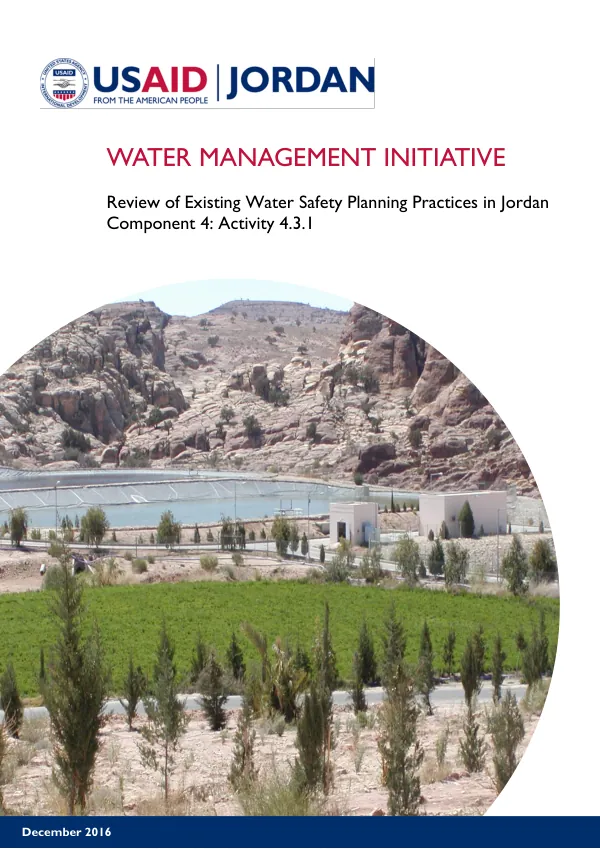
Review of Existing Water Safety Planning Practices in Jordan
The Water Management Initiative (WMI) is a 5-year project to support the Government of Jordan (GOJ) in achieving measurable improvement and greater sustainability of the water sector.
2016 · 30 pages
Sign in to readA free account is required to download.
Abstract
The project is part of the WMI's protection of water supply component. The WMI aims to support the GOJ in implementing the concept of water safety planning (WSP) to conserve and monitor water resources used for drinking purposes. The WSP approach was introduced by the World Health Organization (WHO) in 2004 as a preventive management framework for safe drinking water. The approach comprises system assessment and design, operational monitoring and management plans, and documentation and communication. The WSP is implemented through 9 steps, which include identifying potential hazards, assessing the risk of contamination, and developing a plan to prevent or mitigate the risk. In 2006, the WHO introduced the WSP concept in Jordan through direct implementation in cooperation with the Ministry of Water and Irrigation (MWI), the Water Authority of Jordan (WAJ), the Ministry of Health (MOH), and water utility companies in Jordan. The first demonstration site for implementing the WSP methodology was the Wadi Esir Spring Water Supply System, located in Amman Governorate and operated by Miyahuna company. The Wadi Esir spring is a major water source that supplies the Wadis Esir residential area with its water demands. In 2009, a Joint Program (JP) named "Adaptation to Climate Change to Sustain Jordan's MDG Achievements" was launched by four UN agencies working in Jordan and the Jordanian Government. The "WHO-JP" aims to protect human health against water scarcity induced by climate change through sustain access to improved water supply sources despite increased water scarcity. The main program output was to strengthen the national Drinking Water Quality Management System (DWQMS) at central and periphery levels. Achieving this output required a series of activities that were implemented in full synchronization to each other, including the three main pillars of system management: processes, personnel, and tools. Two committees were formulated to support the implementation of the WSP concept: the National Guiding Committee for "Water Safety Planning" Implementation and the Technical Committee (Task force teams & WSP teams). The WSP approach was tested in five demonstration areas selected by the steering committee with the support of the project's technical committee. The selected sites cover supply systems in urban and rural areas and were chosen to compare the performance of water companies versus traditional government water directorates. The five demonstration sites were used to test the WSP approach and to identify best practices for implementing the concept in Jordan. The results of the WSP implementation in the five demonstration sites showed that the approach can be effective in improving the safety of drinking water supplies. The sites demonstrated a significant reduction in the risk of contamination and improved the overall quality of the drinking water. The WSP approach also helped to identify areas for improvement in the water supply management practices and provided recommendations for strengthening the DWQMS. The WMI project has provided technical assistance and capacity building to the GOJ to support the implementation of the WSP concept. The project has also provided training and capacity building to water utility companies and government agencies to support the implementation of the WSP approach. The project has also provided technical assistance to the GOJ to support the development of policies and regulations to support the implementation of the WSP concept. The WMI project has also supported the development of a national WSP framework for Jordan, which provides a comprehensive approach to water safety planning. The framework provides a set of guidelines and tools for implementing the WSP concept in Jordan and provides a framework for monitoring and evaluating the effectiveness of the WSP approach. Overall, the WMI project has made significant progress in supporting the GOJ in implementing the WSP concept in Jordan. The project has provided technical assistance and capacity building to support the implementation of the WSP approach and has helped to improve the safety of drinking water supplies in Jordan.
Related documents