USAID DEC
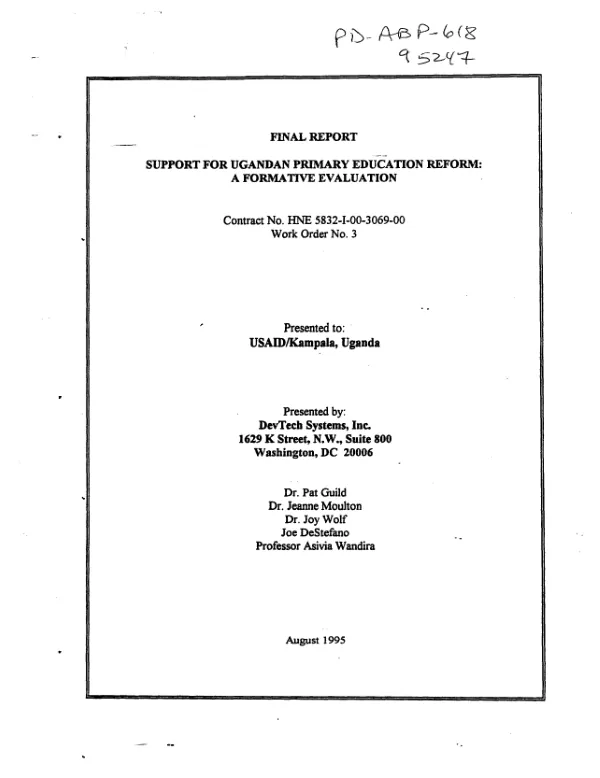
Final report -- support for Ugandan primary education reform : a formative evaluation
Sign inDEVTECH SYSTEMS INC.
Final report -- support for Ugandan primary education reform : a formative evaluation
Interim evaluation of a program/project to improve the quality of and reduce inequities in Uganda's primary education system (SUPER).
Guild, Pat|Moulton, Jeanne · 1995
Sign in to readA free account is required to download.
Abstract
Evaluation covers the period 8/92-Spring 1995, and concentrates on SUPER's potential problems rather than its general success, which has already been well-documented. Achievement towards the project's three purposes, each of which is matched by a program-level policy objective, are as follows. (1) Efforts have focused on improving students' mastery of literacy, numeracy, and other basic skills, mostly by trying to improve the quality of teaching and instructional materials. Progress in improving teachers' terms, conditions, and training was remarkable; however, training modules and sessions may be more effective if used as part of in-service training. (2) As regards school administration, the initial work done under the Management Training component is excellent and the materials and training will be effective. With no history of school management training in Uganda, the Teacher Development and Management System (TDMS) staff are not hampered by traditional practices. The head count and development of establishment ceilings have also improved school management, as has the Ugandan government's efforts to decentralize school administration to the district level. SUPER has used the project as an opportunity to train district level education officers and inspectors. (3) Unfortunately, little progress has been made in reducing inequities in the persistence in school of different groups of children. The corresponding policy objective needs to be revised, including a better definition of what "disadvantaged groups" of children are being targeted, clarification of the strategy for achieving the PAAD objective, and the provision of TA by USAID and SUPER to implement the strategy. Also, to ensure that it does not create inequities in the quality of schools, SUPER should share its products with non-core Parent Teachers' Colleges (PTCs) and with PTCs in districts not served by the project. This could probably be done at little cost. Overall, the SUPER design is a good blueprint for support for educational reform in Uganda. However, three aspects of the plan should be reconsidered. (1) Since SUPER is focused more on improving the quality of teaching than on improving students' mastery of skills, the project should revise its purpose to "to improve the quality of instruction." This revision would also remove SUPER from the debate about whether primary schools should give priority to literacy, math, science, and social studies, or to vocational skills. (2) Policy objective Two should be revised to focus on improving girls' persistence rather than, more broadly, on eliminating inequities. Strategies for achieving this new aim should be clarified, including the use of community mobilization and incentive grants. (3) The fourth EOPS could be split into two separate items, giving more weight to increasing parental and community participation in schooling. The corresponding EOPS should be rephrased in terms of policies, structures, and procedures to ensure that improvements are sustained. Currently, the EOPS describes conditions that could disappear when program inputs end. Four problems were found with implementation. (1) SUPER modules and training programs may not improve teacher training as much as they might because they are not based on a curriculum with clear priorities, have a weak instructional framework, and are too voluminous. The materials should make it clear what is most important for teachers to learn and how they are expected to achieve and demonstrate success. They should also be pilot tested. (2) To promote sustainability, the TDMS should be moved from the Project Implementation Unit to the Ugandan education ministry. Institutions hitherto ignored by the reform process, such as the Institute for Teacher Education and Makerere University, should be drawn into the process. The Educational Planning Unit within the Ministry needs to hone its capacity to estimate the costs of universal free primary education and reform, and to devise a strategy for using information to engender dialogue about cost-effective ways of achieving government objectives. (3) The strategy for improving equity is disjointed, with community mobilization activities off to a slow start, the Incentive Grants program in need of an overhaul, and with both of these components, which were designed to work in concert with one another, now separated. The focus on girls' persistence has eroded as a wider range of disadvantaged groups have became eligible for program benefits. (4) As regards the TDMS, there are concerns about drastically shortening the pilot phase to 3 months and enlarging the areas served from single districts to catchment areas that serve several districts. If major flaws appear in the system, adjustments will be more difficult in the shortened time frame and the expanded geographical scope.
Related documents