TETRA TECH
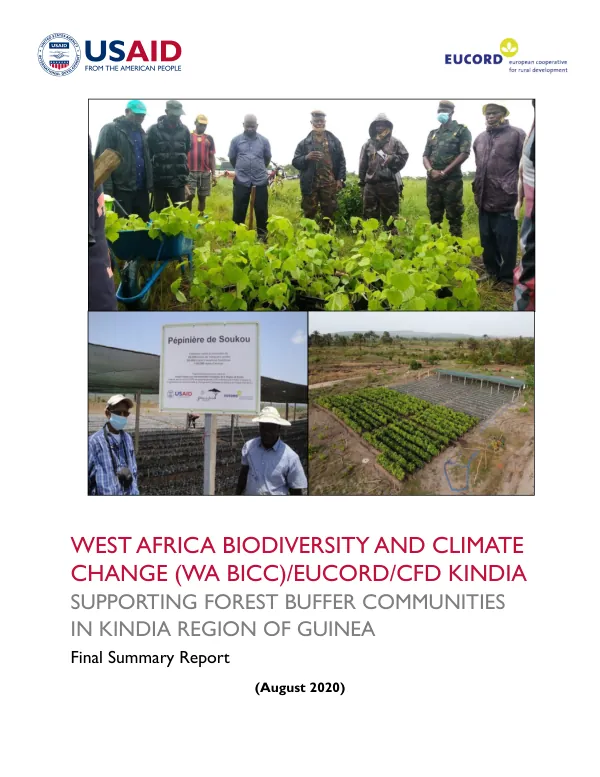
Final Report: Supporting Forest Buffer Communities in Kindia Region of Guinea
The agricultural development initiative in Kindia Region of Guinea began in 2019 with funding from the USAID-funded West Africa Biodiversity and Climate Change (WA BiCC) Program.
2021 · 11 pages
Sign in to readA free account is required to download.
Abstract
The project aimed to involve the private sector in creating sustainable and environmentally friendly livelihoods in forest buffer communities. The four specific objectives of the project were to set up and manage a fruit and forest plant nursery, promote sustainable plantation management practices, contribute to sustainable management of the Kindia landscape, and raise local people's awareness of the need to plant and maintain diverse tree species. The project intervention zone included forest buffer zones around community plantations and several classified forests that supply the private company La Fruitière de Daboya (CFD). CFD manages mango and pineapple plantations and a packing plant in Kindia, and purchases, packages, and exports 1,000 metric tons of fresh mangoes to the European Union market each year. The company has also been involved in reforestation activities, planting 8,000 forest trees, and plans to support the introduction of contract farming to improve producers' livelihoods, promote good agricultural practices, and secure a reliable supply of quality products for its customers. The project was initially supposed to last for 8 months but was extended to 13 months to take advantage of the 2020 rainy season and mitigate the constraints created by the COVID-19 pandemic. Despite these constraints, the EUCORD team was able to achieve the project objectives, working in conjunction with the team from CFD, the network of 12 trainers, technical agents from the Water and Forestry services, producers affiliated to CFD, and members of the NRM committees supported by the project. The team exceeded the objective of reforesting 50 hectares of land, having replanted 10 hectares in 2019 and 41.63 hectares in 2020. The capacity building and sensitization targets were also exceeded, with a total of 841 people sensitized in small groups, 30 members of NRM Committees trained, and 12 trainers trained. The 12 rural trainers trained 122 people, 88 of whom were subsequently selected to participate in planting/outreach activities. The project also established and managed a fruit and forest plant nursery to supply seedlings for target groups, with a total of 51,604 forest species distributed, 10,000 mango trees distributed, and 110,000 pineapple seedlings distributed. The project's outcomes included the inception phase, where the project unit was set up and the team had a clear understanding of beneficiary needs. The recruitment package and report on CDA were approved, with 3 staff recruited and the CDA report approved. The project also achieved the deliverables, including establishing the work plan, monitoring and evaluation learning plan, and branding plan, procuring the equipment needed to set up a plant nursery, conducting a participatory assessment of natural resource management, replanting over 50 hectares of forest, training 12 rural trainers, and disseminating the training among 88 other economically active adults in villages targeted by the project.
Related documents